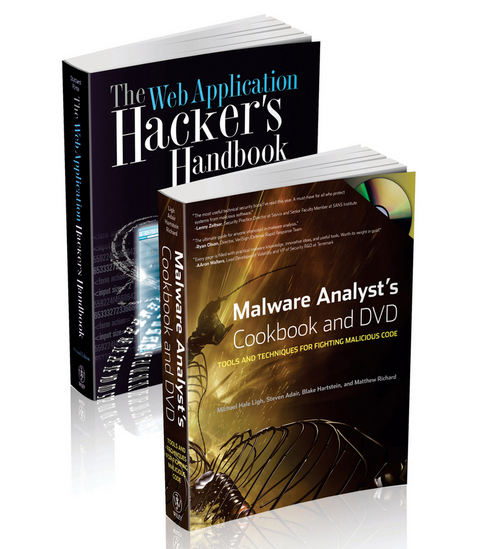
Dafydd Stuttard has more than 10 years' experience in the area of web application security. He is the lead author of Web Application Hacker's Handbook 1e and 2e, has performed penetration testing training around the world. Marcus Pinto is co-author of Web Application Hacker's Handbook 1e and 2e and has over 10 years' experience within web application security. He has delivered a variety of training courses to technical audiences and speaks at security events around and outside of the UK. Michael Hale Ligh is the lead author of The Malware Analyst's Cookbook and Director of Malware Research of the The Volatility Project. Michael is a regular presenter at DefCon conferences. Matt Richard is and is the Malicious Code Operations Lead at Raytheon Corporation and has written a number of testing tools. Steven Adair is a security researcher with The Shadowserver Foundation and co-author of The Malware Analyst's Cookbook and deals with cyber attacks of all kinds esp. those linked to cyber espionage. Blake Hartstein conducts incident response and intrusion detection for Bloomberg and previously for VeriSign. The biggest and best companies worldwide depend on him for intelligence about attacks affecting their organization.
WEB APPLICATION HACKER'S HANDBOOK 2E
Chapter 1: Web Application (In)security 1
Chapter 2: Core Defense Mechanisms 17
Chapter 3: Web Application Technologies 39
Chapter 4: Mapping the Application 73
Chapter 5: Bypassing Client-Side Controls 117
Chapter 6: Attacking Authentication 159
Chapter 7: Attacking Session Management 205
Chapter 8: Attacking Access Controls 257
Chapter 9: Attacking Data Stores 287
Chapter 10: Attacking Back-End Components 357
Chapter 11: Attacking Application Logic 405
Chapter 12: Attacking Users: Cross-Site Scripting 431
Chapter 13: Attacking Users: Other Techniques 501
Chapter 14: Automating Customized Attacks 571
Chapter 15: Exploiting Information Disclosure 615
Chapter 16: Attacking Native Compiled Applications 633
Chapter 17: Attacking Application Architecture 647
Chapter 18: Attacking the Application Server 669
Chapter 19: Finding Vulnerabilities in Source Code 701
Chapter 20: A Web Application Hacker's Toolkit 747
Chapter 21: A Web Application Hacker's Methodology 791
MALWARE ANALYST'S COOKBOOK AND DVD
Chapter 1: Anonymizing Your Activities 1
Chapter 2: Honeypots 27
Chapter 3: Malware Classifi cation 51
Chapter 4: Sandboxes and Multi-AV Scanners 89
Chapter 5: Researching Domains and IP Addresses 119
Chapter 6: Documents, Shellcode, and URLs 155
Chapter 7: Malware Labs 211
Chapter 8: Automation 239
Chapter 9: Dynamic Analysis 283
Chapter 10: Malware Forensics 337
Chapter 11: Debugging Malware 395
Chapter 12: De-Obfuscation 441
Chapter 13: Working with DLLs 487
Chapter 14: Kernel Debugging 511
Chapter 15: Memory Forensics with Volatility 571
Chapter 16: Memory Forensics: Code Injection and Extraction 601
Chapter 17: Memory Forensics: Rootkits 637
Chapter 18: Memory Forensics: Network and Registry 673
| Erscheint lt. Verlag | 17.3.2014 |
|---|---|
| Sprache | englisch |
| Themenwelt | Informatik ► Netzwerke ► Sicherheit / Firewall |
| Schlagworte | Computer Science • Informatik • Networking / Security • Netzwerke / Sicherheit • web application security, web application security flaws, web application security hacks, web application security prevention, how to prevent web application security hacks, how to discover web application security flaws, solutions for web application hacks, web application security defense, web application security solutions, security, malware, malicious attacks, hacking, hackers, malware analysis, eliminating malware, identifying malware, removing malware, sandboxing malware, IT security books, computer f |
| ISBN-13 | 9781118919873 / 9781118919873 |
| Informationen gemäß Produktsicherheitsverordnung (GPSR) | |
| Haben Sie eine Frage zum Produkt? |
 EPUB (Ohne DRM)
Digital Rights Management: ohne DRM
Dieses eBook enthält kein DRM oder Kopierschutz. Eine Weitergabe an Dritte ist jedoch rechtlich nicht zulässig, weil Sie beim Kauf nur die Rechte an der persönlichen Nutzung erwerben.
Dateiformat: EPUB (Electronic Publication)
EPUB ist ein offener Standard für eBooks und eignet sich besonders zur Darstellung von Belletristik und Sachbüchern. Der Fließtext wird dynamisch an die Display- und Schriftgröße angepasst. Auch für mobile Lesegeräte ist EPUB daher gut geeignet.
Systemvoraussetzungen:
PC/Mac: Mit einem PC oder Mac können Sie dieses eBook lesen. Sie benötigen dafür die kostenlose Software Adobe Digital Editions.
eReader: Dieses eBook kann mit (fast) allen eBook-Readern gelesen werden. Mit dem amazon-Kindle ist es aber nicht kompatibel.
Smartphone/Tablet: Egal ob Apple oder Android, dieses eBook können Sie lesen. Sie benötigen dafür eine kostenlose App.
Geräteliste und zusätzliche Hinweise
Buying eBooks from abroad
For tax law reasons we can sell eBooks just within Germany and Switzerland. Regrettably we cannot fulfill eBook-orders from other countries.
aus dem Bereich