


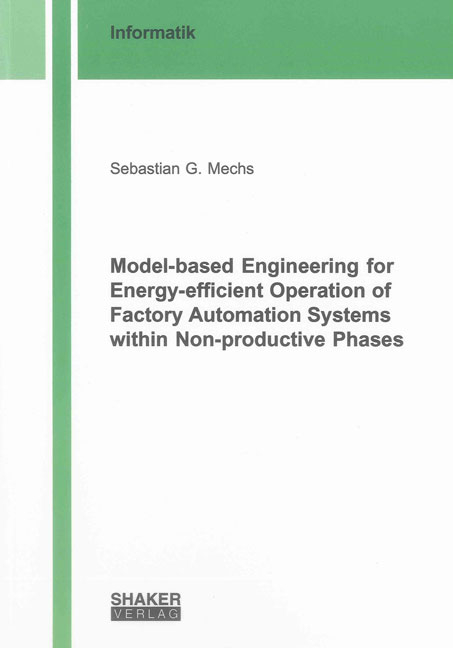
Model-based Engineering for Energy-efficient Operation of Factory Automation Systems within Non-productive Phases
Seiten
- Keine Verlagsinformationen verfügbar
- Artikel merken
In the face of a future rise in energy prices, energy-efficient operation of industrial automation systems has strategic impact for manufacturing companies. The reduction of energy demand during non-productive phases helps to contribute to the overall energy efficiency of automated production systems.
The approach of this thesis enables the analytical description of structural and behavioral aspects of industrial automation systems. This kind of mathematical modeling serves as basis for identifying optimal strategies analytically relying on a structure-exploiting procedure which enables efficient strategy computation. Those strategies quantify the energy savings potentials and give support for technical realization.
In the face of a future rise in energy prices, energy-efficient operation of industrial automation systems has strategic impact for manufacturing companies. The reduction of energy demand during non-productive phases helps to contribute to the overall energy efficiency of automated production systems.
Up to now, there is no general scientific concept which addresses energy-efficient operation of factory automation systems within non-productive phases technically and economically on a multi-subsystem level. However, proposing detailed instructions and strategies for multiple interacting subsystems is crucial in order to realize energy savings technically.
On this account, the proposed automaton-based system model enables the analytical description of structural and behavioral aspects of industrial automation systems. This kind of mathematical modeling serves as basis for identifying optimal strategies analytically relying on a structure-exploiting procedure which enables efficient strategy computation. Those strategies quantify the energy savings potentials and give support for technical realization.
Since the computation of optimal strategies for industrial automation systems is complex, a novel approach is developed to calculate those strategies efficiently incorporating the problem structure provided by the model. Using models of real-world automation systems, the approach of this thesis is evaluated regarding further objectives. First, the feasibility of strategy execution is ensured which enables the evaluation of design decisions. Computed strategies are verified in the target system regarding correct execution. The prediction of energy demands by strategies is sensitive to model-to-system deviations, so that tests are applied to check the system model for accuracy of predictions. Economic considerations complete the assessment of the approach.
Using the general concepts and methods of this thesis, the energy demand for industrial automation systems can be substantially reduced within non-productive phases. The chosen approach supports the model generation, the computation and evaluation of strategies, and the technical realization for industrial automation systems.
The approach of this thesis enables the analytical description of structural and behavioral aspects of industrial automation systems. This kind of mathematical modeling serves as basis for identifying optimal strategies analytically relying on a structure-exploiting procedure which enables efficient strategy computation. Those strategies quantify the energy savings potentials and give support for technical realization.
In the face of a future rise in energy prices, energy-efficient operation of industrial automation systems has strategic impact for manufacturing companies. The reduction of energy demand during non-productive phases helps to contribute to the overall energy efficiency of automated production systems.
Up to now, there is no general scientific concept which addresses energy-efficient operation of factory automation systems within non-productive phases technically and economically on a multi-subsystem level. However, proposing detailed instructions and strategies for multiple interacting subsystems is crucial in order to realize energy savings technically.
On this account, the proposed automaton-based system model enables the analytical description of structural and behavioral aspects of industrial automation systems. This kind of mathematical modeling serves as basis for identifying optimal strategies analytically relying on a structure-exploiting procedure which enables efficient strategy computation. Those strategies quantify the energy savings potentials and give support for technical realization.
Since the computation of optimal strategies for industrial automation systems is complex, a novel approach is developed to calculate those strategies efficiently incorporating the problem structure provided by the model. Using models of real-world automation systems, the approach of this thesis is evaluated regarding further objectives. First, the feasibility of strategy execution is ensured which enables the evaluation of design decisions. Computed strategies are verified in the target system regarding correct execution. The prediction of energy demands by strategies is sensitive to model-to-system deviations, so that tests are applied to check the system model for accuracy of predictions. Economic considerations complete the assessment of the approach.
Using the general concepts and methods of this thesis, the energy demand for industrial automation systems can be substantially reduced within non-productive phases. The chosen approach supports the model generation, the computation and evaluation of strategies, and the technical realization for industrial automation systems.
| Erscheint lt. Verlag | 2.4.2014 |
|---|---|
| Reihe/Serie | Berichte aus der Informatik |
| Sprache | englisch |
| Maße | 148 x 210 mm |
| Gewicht | 345 g |
| Einbandart | Paperback |
| Themenwelt | Mathematik / Informatik ► Informatik ► Software Entwicklung |
| Schlagworte | energy efficiency • Factory automation • Model-based engineering |
| ISBN-10 | 3-8440-2721-1 / 3844027211 |
| ISBN-13 | 978-3-8440-2721-1 / 9783844027211 |
| Zustand | Neuware |
| Informationen gemäß Produktsicherheitsverordnung (GPSR) | |
| Haben Sie eine Frage zum Produkt? |
Mehr entdecken
aus dem Bereich


aus dem Bereich
Grundlagen, Prozesse, Methoden und Werkzeuge
Buch | Hardcover (2024)
Springer Vieweg (Verlag)
CHF 153,95
Praxishandbuch für Java- und Webservice-Entwickler
Buch | Softcover (2025)
dpunkt (Verlag)
CHF 62,85


