These developments in systems methodology have prompted the need for an interface between optimal control theory and dynamic macroeconomic analysis. The implications of this convergence have already aroused a great deal of research, but it remains to be seen whether policy makers in most developing countries will consider actually incorporating these techniques into planning. The author argues that control and systems theory can be of immense help in stabilizing those economies plagued by cyclical and structural problems. By demonstrating the applicability of control & filter theory to short-term macroeconomic planning, this book illuminates the impressive array of problems that can thereby be solved, and helps foster a closer working relationship between economists and control theorists.
The work deals specifically with the construction of a Kalman filter mechanism, for deriving short-term optimal economic policies under conditions of uncertainty. It specifies and resolves a macroeconometric model which is linked to a unique observation sub-system of a given economy, congruent with the errors in information signalling which are prevalent within the data base context of most developing countries. An evaluation of control settings contrasts short and long-term economic policies. This indicates that an economy may `overheat' under protracted settings of instrument values around their optimal levels if the constraints on the system, in the form of external shocks, are too great to allow reaching all targets simultaneously using feasible instrument paths.
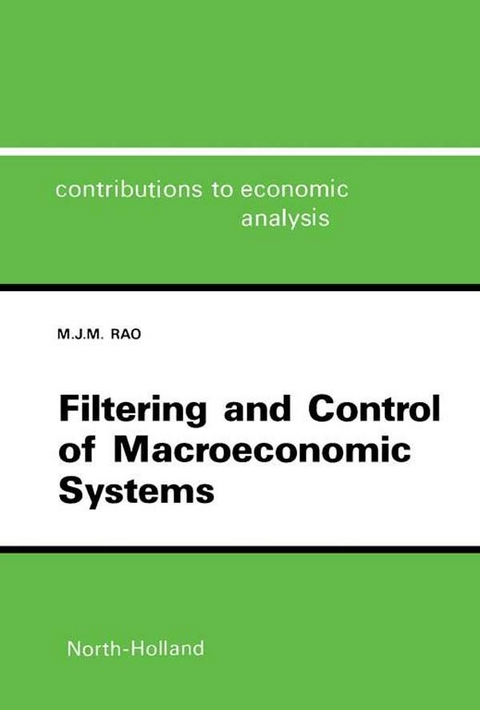
Advances in computer technology, coupled with the sophistication of econometric modelling, have enabled rapid progress in the formulation and solution of optimal control and filtering programmes, especially in the sphere of macroeconomic policy designing.These developments in systems methodology have prompted the need for an interface between optimal control theory and dynamic macroeconomic analysis. The implications of this convergence have already aroused a great deal of research, but it remains to be seen whether policy makers in most developing countries will consider actually incorporating these techniques into planning. The author argues that control and systems theory can be of immense help in stabilizing those economies plagued by cyclical and structural problems. By demonstrating the applicability of control & filter theory to short-term macroeconomic planning, this book illuminates the impressive array of problems that can thereby be solved, and helps foster a closer working relationship between economists and control theorists. The work deals specifically with the construction of a Kalman filter mechanism, for deriving short-term optimal economic policies under conditions of uncertainty. It specifies and resolves a macroeconometric model which is linked to a unique observation sub-system of a given economy, congruent with the errors in information signalling which are prevalent within the data base context of most developing countries. An evaluation of control settings contrasts short and long-term economic policies. This indicates that an economy may `overheat' under protracted settings of instrument values around their optimal levels if the constraints on the system, in the form of external shocks, are too great to allow reaching all targets simultaneously using feasible instrument paths.
Front Cover 1
Filtering and Control of Macroeconomic Systems: A Control System Incorporating the Kalman Filter for the Indian Economy 4
Table of Contents 12
Copyright Page 5
Introduction to the series 6
Dedication 8
PREFACE 10
CHAPTER 1. INTRODUCTION 14
1.1 Preface 14
1.2 Short-Term Economic Policy And Optimal Control Theory 14
1.3 Scope Of The Study 15
1.4 Optimal Control Theory 16
1.5 Outline Of The Study 20
CHAPTER 2. FILTERING AND CONTROL OF STOCHASTIC SYSTEMS 22
2.1 Prologue 22
2.2 Control And Filter Theory In Economic Regulation 23
2.3 The Optimum Linear Filter 25
2.4 Optimal Control Theory 30
2.5 Control Systems And Quantitative Economic Policy 34
2.6 Conclusions 36
CHAPTER 3. AN ANNUAL NONLINEAR MODEL OF THE INDIAN ECONOMY 38
3· 1 Introduction 38
3.2 Macroeconometric Research In India: A Synthesis 39
3.3 Model Of The Indian Economy: Preliminaries 41
3.4 Estimates Of Model Structure 47
3.5 The Model 79
3.6 Conclusions 81
CHAPTER 4. STRUCTURAL ANALYSIS OF THE MODEL 84
4.1 Introduction 84
4.2 The Nature Of Structural Analysis 84
4.3 The Reduced Form Of The Model 84
4.4 Dynamic Policy Multipliers 99
4.5 Multiplier Analysis 107
4.6 Elasticities 112
4.7 Simulation 114
4.8 Conclusions 142
CHAPTER 5. RESOLUTION AND STATE SPACE REPRESENTATION OF THE MODEL 144
5.1 Introduction 144
5.2 The Resolution Of The Model 144
5.3 State Space Representation Of The Econometric Model 156
5.4 Conclusions 159
CHAPTER 6. OPTIMAL FILTERING AND STATE RECONSTRUCTION 162
6.1 Introduction 162
6.2 Some Economic Applications Of The Kalman Filter 162
6.3 The Observation Mechanism 168
6.4 The Error Covariance Matrices 177
6.5 The Initial Conditions 180
6.6 The Covariance Matrix 183
6.7 The Predictor-Corrector Matrix 183
6.8 Observations On The Filter 187
6.9 Conclusions 189
CHAPTER 7. OPTIMAL CONTROL AND MACROECONOMIC PLANNING: THE INDIAN CONTEXT 190
7.1 Introduction 190
7.2 Proportional-Plus-Integral Control 190
7.3 System State Estimation And Control Action Determination 192
7.4 Econometric Models And Macroeconomic Policy Formulation 193
7.5 Setting Up The Experiment 195
7.7 A Summing-Up 224
7.8 Conclusions 225
CHAPTER 8. CONCLUSIONS 226
8.1 Optimal Control: Some Findings 226
8.2 Economic Significance Of The Results: Robust Policies 227
8.3 Long-Term Economie Planning in India: Control Settings 230
8.4 Control Theory And Economic Policy Planning In India 233
8.5 Contributions Of The Study 239
8.6 Alternative Methodologies 240
8.7 Epilogue 241
APPENDIX A: THE OPTIMUM LINEAR DISCRETE FILTER 242
APPENDIX B: THE DISCRETE MAXIMUM PRINCIPLE 252
APPENDIX C: CONTROLLABILITY AND OBSERVABILITY 258
ANNEXURE DATA USED IN THE ESTIMATION PROCESS 268
REFERENCES 274
AUTHOR INDEX 286
SUBJECT INDEX 290
Introduction
1.1 Preface
The objective of this study is to consider short-term Indian economic policy from the viewpoint of modern systems and control theory. The principal concern of policy planners in India has been to regulate the economy such that it progresses in a satisfactory manner. However, thirty-five years of macroeconomic planning has indicated, beyond the shadow of a doubt, that large scale perturbations have occurred very frequently in the Indian economy and, as our knowledge about the functioning of the economy and the effects of instruments has been far from perfect, it has been found impossible to prescribe precise compensatory action. In the absence of such countercyclical policy, the spontaneous regaining of equilibrium has been ruled out and the economy has thereby suffered swings of considerable amplitudes at great costs. This study is principally an attempt to try and use stochastic control theory for macroeconomic regulation, so that the inherent pitfalls of adopting policies of an intuitive nature are ruled out.
1.2 Short-Term Economic Policy And Optimal Control Theory
The principal objective of control theory has been to try and improve system performance through the regulator concept, especially when uncertainty is involved. The feedback control policy leads to a simple method for determining optimal control actions, given appropriate statistics based on available information. The determination of these statistics, namely, the conditional mean and the error covariance matrix of the system state, takes place separately. The relationship between the system state and the information data is explicitly kept in view. The observations of economic activity are assumed to contain observation errors, including changing or fragmentary information, and the incorporation of such indicators into the system is achieved through the Kalman filter. The filter provides minimum-variance, unbiased estimates of the system state, conditional on the available information.
The strategy of, what has been termed in the literature, feedback control is adopted in order to obtain the optimal control actions. This type of control has been defined as the policy where controls are ‘some deterministic function of the current and past observations on the system state variables and of past employed controls’ (Aoki 1967). In such a policy, the information comprising previous control actions and system observations available uptil the present moment when control action is to be specified is utilized in computing the control actions. Such a determination of the optimal control trajectory is achieved in two separate and sequential steps. In the first, the estimation of the system state based on available information is obtained, and subsequently, the optimal control action is determined from a deterministic system, which is obtained from the corresponding stochastic system by invoking the Certainty Equivalence Principle (Simon 1956, Theil 1964), implying thereby the replacing of all the random quantities by their conditional expectations.
As more information accumulates, the conditional expectations need to be updated in order to apply the Certainty Equivalence Principle. The Kalman filter (Kalman 1960, Kalman and Bucy 1961) is a very convenient technique to revise optimally the estimates based on past information in the light of new information alone. In effect, the conditional mean and the error covariance of the system state summarize all the accumulated information, as far as the determination of the optimal control is concerned. The Kalman filter enables their updating recursively and past information need not be used again nor stored, since its effect is summarized in the earlier estimates. Similarly, the results of Meditch (1967) facilitate the recursive revision of the past conditional statistics with the coming of fresh information. The optimal control actions resulting from the closed-loop policy depend not only on the latest observation but also on the past observations. The policy attaches appropriate weights to the sequence of observations, and the outcome is that the optimal control action is a weighted average of the latest and past observed errors in prediction. This feature is technically called the proportional-plus-integral control, and it results in smoother control actions and adds to overall stability.
1.3 Scope Of The Study
Under the present Indian practice, economic regulatory policies tend to be heavily biased towards current rather than current and past observations of the state of the economy. Moreover, they have a tendency to overlook the fact that more decisions will have to be taken later on in the light of new information. These drawbacks are overcome under the present framework. Moreover, while the usual economic literature assumes, rather naively, that the current state of the system is completely known, so that all uncertainty is concentrated in the future, the use of stochastic control theory allows for the systematic treatment of the more realistic case when information is scarce, contradictory and inexact. It is here that the Kalman filter comes in to make the most of the available information. Vishwakarma (1974) was one of the first to apply these elegant prediction and control algorithms developed by Kalman and Bucy to a macroeconomic regulatory problem, within a sort of quasi-Monte Carlo framework. This study is an attempt to apply it in a more rigourous and extensive manner well suited for the Indian context.
The mathematical analysis of linear closed-loop control leads to important results such as the separability of prediction from policy determination and certainty equivalence, even if the poor quality of the data is taken into account. This formally justifies the similar separation carried out by Tinbergen (1956) and his concentration on a deterministic analysis.
The application of optimal control techniques to solve short-term economic problems presupposes that it is possible to construct and operate a plausible mathematical model of the economy. Based on the analogy between the structures of certain economic and physical problems, there is a prima facie case for applying optimal control to such a model of the economy to help analyze, probe and ultimately control the dynamic behaviour of the economic system (Ball 1978). The very essence of the optimal, as opposed to the automatic, control problem is that one does not know in advance what exactly one would like to happen; and since economic analysis is concerned for the most part with the exercise of choice, given constraints, the possibility of transferring optimal choice technology from the physical to economic systems via optimal control theory appears to be very appealing. This is the basic essence of the study.
1.4 Optimal Control Theory
1.4.1 Problem formulation
A macroeconomic model attempts to describe the dynamics of an economy over T periods. The model consists of a system of n difference equations relating; n endogenous variables x(i,t), denoted by the vector x(t) ∈ Rn and describing the state of the economy; s control variables u1(j,t), denoted by the vector u1(t) ∈ Rs and describing the instruments of economic policy at the disposal of the planner to guide the trajectory of the economy towards a specified optimal state; m exogenous variables u2(k,t), denoted by the vector u2(t) ∈ Rm and describing those variables whose values are uncontrollable but are assumed to be known (the existence of such uncontrollable exogenous variables is invariably the case with most econometric models) and which are expected to affect the values of the endogenous variables; parameters describing the structure of the economy and its relationship with the environment; and residual random variables (which from now on we assume specified and incorporated in the functional form of the equations).
To explain the value x(i,t) taken by the ith endogenous variable at period t from the series of past historical data, econometricians estimate equations taking into account the values taken by other variables at period t as well as earlier periods. The foremost past period taken into account in the equation explaining the ith endogenous variable is called the lag of the ith equation. In general, a macroeconomic model comprises behavioural (or reaction) equations explaining endogenous variables and accounting identities expressing ex-post equilibrium conditions enforced at each period. The latter are not explicitly solved for one endogenous variable in terms of the others. Thus, a model in structural form can be described by the system of equations
(1.1)
(1.2a)
(1.2b)
(1.2c)
where p,q and r are the maximal lags with respect to the endogenous, control and exogenous variables, respectively; and h(i) are given parameters such that (1, if the ith equation is solved with respect to x(i,t) h(i)=(
(0, otherwise.
We also assume that eq.(1.1) satisfies the following regularity conditions:
(i) The function f(i,t) is continually differentiable with...
| Erscheint lt. Verlag | 22.10.2013 |
|---|---|
| Sprache | englisch |
| Themenwelt | Mathematik / Informatik ► Mathematik ► Finanz- / Wirtschaftsmathematik |
| Wirtschaft ► Allgemeines / Lexika | |
| Wirtschaft ► Volkswirtschaftslehre ► Ökonometrie | |
| ISBN-10 | 1-4832-9007-7 / 1483290077 |
| ISBN-13 | 978-1-4832-9007-2 / 9781483290072 |
| Informationen gemäß Produktsicherheitsverordnung (GPSR) | |
| Haben Sie eine Frage zum Produkt? |
 PDF (Adobe DRM)
Größe: 28,5 MB
Kopierschutz: Adobe-DRM
Adobe-DRM ist ein Kopierschutz, der das eBook vor Mißbrauch schützen soll. Dabei wird das eBook bereits beim Download auf Ihre persönliche Adobe-ID autorisiert. Lesen können Sie das eBook dann nur auf den Geräten, welche ebenfalls auf Ihre Adobe-ID registriert sind.
Details zum Adobe-DRM
Dateiformat: PDF (Portable Document Format)
Mit einem festen Seitenlayout eignet sich die PDF besonders für Fachbücher mit Spalten, Tabellen und Abbildungen. Eine PDF kann auf fast allen Geräten angezeigt werden, ist aber für kleine Displays (Smartphone, eReader) nur eingeschränkt geeignet.
Systemvoraussetzungen:
PC/Mac: Mit einem PC oder Mac können Sie dieses eBook lesen. Sie benötigen eine
eReader: Dieses eBook kann mit (fast) allen eBook-Readern gelesen werden. Mit dem amazon-Kindle ist es aber nicht kompatibel.
Smartphone/Tablet: Egal ob Apple oder Android, dieses eBook können Sie lesen. Sie benötigen eine
Geräteliste und zusätzliche Hinweise
Buying eBooks from abroad
For tax law reasons we can sell eBooks just within Germany and Switzerland. Regrettably we cannot fulfill eBook-orders from other countries.
 EPUB (Adobe DRM)
Kopierschutz: Adobe-DRM
Adobe-DRM ist ein Kopierschutz, der das eBook vor Mißbrauch schützen soll. Dabei wird das eBook bereits beim Download auf Ihre persönliche Adobe-ID autorisiert. Lesen können Sie das eBook dann nur auf den Geräten, welche ebenfalls auf Ihre Adobe-ID registriert sind.
Details zum Adobe-DRM
Dateiformat: EPUB (Electronic Publication)
EPUB ist ein offener Standard für eBooks und eignet sich besonders zur Darstellung von Belletristik und Sachbüchern. Der Fließtext wird dynamisch an die Display- und Schriftgröße angepasst. Auch für mobile Lesegeräte ist EPUB daher gut geeignet.
Systemvoraussetzungen:
PC/Mac: Mit einem PC oder Mac können Sie dieses eBook lesen. Sie benötigen eine
eReader: Dieses eBook kann mit (fast) allen eBook-Readern gelesen werden. Mit dem amazon-Kindle ist es aber nicht kompatibel.
Smartphone/Tablet: Egal ob Apple oder Android, dieses eBook können Sie lesen. Sie benötigen eine
Geräteliste und zusätzliche Hinweise
Buying eBooks from abroad
For tax law reasons we can sell eBooks just within Germany and Switzerland. Regrettably we cannot fulfill eBook-orders from other countries.
aus dem Bereich