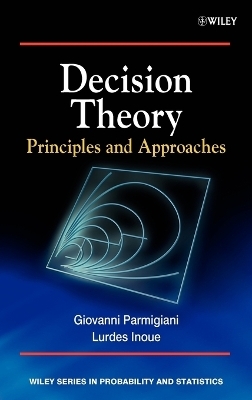
Decision Theory
John Wiley & Sons Inc (Verlag)
9780471496571 (ISBN)
Decision theory provides a formal framework for making logical choices in the face of uncertainty. Given a set of alternatives, a set of consequences, and a correspondence between those sets, decision theory offers conceptually simple procedures for choice. This book presents an overview of the fundamental concepts and outcomes of rational decision making under uncertainty, highlighting the implications for statistical practice.
The authors have developed a series of self contained chapters focusing on bridging the gaps between the different fields that have contributed to rational decision making and presenting ideas in a unified framework and notation while respecting and highlighting the different and sometimes conflicting perspectives.
This book:
* Provides a rich collection of techniques and procedures.
* Discusses the foundational aspects and modern day practice.
* Links foundations to practical applications in biostatistics, computer science, engineering and economics.
* Presents different perspectives and controversies to encourage readers to form their own opinion of decision making and statistics.
Decision Theory is fundamental to all scientific disciplines, including biostatistics, computer science, economics and engineering. Anyone interested in the whys and wherefores of statistical science will find much to enjoy in this book.
Giovanni Parmigiani is the author of Decision Theory: Principles and Approaches, published by Wiley. Lurdes Yoshiko Tani Inoue is a Brazilian-born statistician of Japanese descent, who specializes in Bayesian inference. She works as a professor of biostatistics in the University of Washington School of Public Health.
Preface.
Acknowledgments.
1 Introduction.
1.1 Controversies.
1.2 A guided tour of decision theory.
Part One: Foundations.
2 Coherence.
2.1 The "Dutch Book" theorem.
2.2 Temporal coherence.
2.3 Scoring rules and the axioms of probabilities.
2.4 Exercises.
3 Utility.
3.1 St. Petersburg paradox.
3.2 Expected utility theory and the theory of means.
3.3 The expected utility principle.
3.4 The von Neumann-Morgenstern representation theorem.
3.5 Allais' criticism.
3.6 Extensions.
3.7 Exercises.
4 Utility in action.
4.1 The "standard gamble".
4.2 Utility of money.
4.3 Utility functions for medical decisions.
4.4 Exercises.
5 Ramsey and Savage.
5.1 Ramsey's theory.
5.2 Savage's theory.
5.3 Allais revisited.
5.4 Ellsberg paradox.
5.5 Exercises.
6 State independence.
6.1 Horse lotteries.
6.2 State-dependent utilities.
6.3 State-independent utilities.
6.4 Anscombe-Aumann representation theorem.
6.5 Exercises.
Part Two Statistical Decision Theory.
7 Decision functions.
7.1 Basic concepts.
7.2 Data-based decisions.
7.3 The travel insurance example.
7.4 Randomized decision rules.
7.5 Classification and hypothesis tests.
7.6 Estimation.
7.7 Minimax-Bayes connections.
7.8 Exercises.
8 Admissibility.
8.1 Admissibility and completeness.
8.2 Admissibility and minimax.
8.3 Admissibility and Bayes.
8.4 Complete classes.
8.5 Using the same ± level across studies with different sample sizes is inadmissible.
8.6 Exercises.
9 Shrinkage.
9.1 The Stein effect.
9.2 Geometric and empirical Bayes heuristics.
9.3 General shrinkage functions.
9.4 Shrinkage with different likelihood and losses.
9.5 Exercises.
10 Scoring rules.
10.1 Betting and forecasting.
10.2 Scoring rules.
10.3 Local scoring rules.
10.4 Calibration and refinement.
10.5 Exercises.
11 Choosing models.
11.1 The "true model" perspective.
11.2 Model elaborations.
11.3 Exercises.
Part Three Optimal Design.
12 Dynamic programming.
12.1 History.
12.2 The travel insurance example revisited.
12.3 Dynamic programming.
12.4 Trading off immediate gains and information.
12.5 Sequential clinical trials.
12.6 Variable selection in multiple regression.
12.7 Computing.
12.8 Exercises.
13 Changes in utility as information.
13.1 Measuring the value of information.
13.2 Examples.
13.3 Lindley information.
13.4 Minimax and the value of information.
13.5 Exercises.
14 Sample size.
14.1 Decision-theoretic approaches to sample size.
14.2 Computing.
14.3 Examples.
14.4 Exercises.
15 Stopping.
15.1 Historical note.
15.2 A motivating example.
15.3 Bayesian optimal stopping.
15.4 Examples.
15.5 Sequential sampling to reduce uncertainty.
15.6 The stopping rule principle.
15.7 Exercises.
Appendix.
A.1 Notation.
A.2 Relations.
A.3 Probability (density) functions of some distributions.
A.4 Conjugate updating.
References.
Index.
| Erscheint lt. Verlag | 14.4.2009 |
|---|---|
| Reihe/Serie | Wiley Series in Probability and Statistics |
| Verlagsort | New York |
| Sprache | englisch |
| Maße | 163 x 233 mm |
| Gewicht | 794 g |
| Themenwelt | Mathematik / Informatik ► Mathematik ► Wahrscheinlichkeit / Kombinatorik |
| ISBN-13 | 9780471496571 / 9780471496571 |
| Zustand | Neuware |
| Informationen gemäß Produktsicherheitsverordnung (GPSR) | |
| Haben Sie eine Frage zum Produkt? |
aus dem Bereich