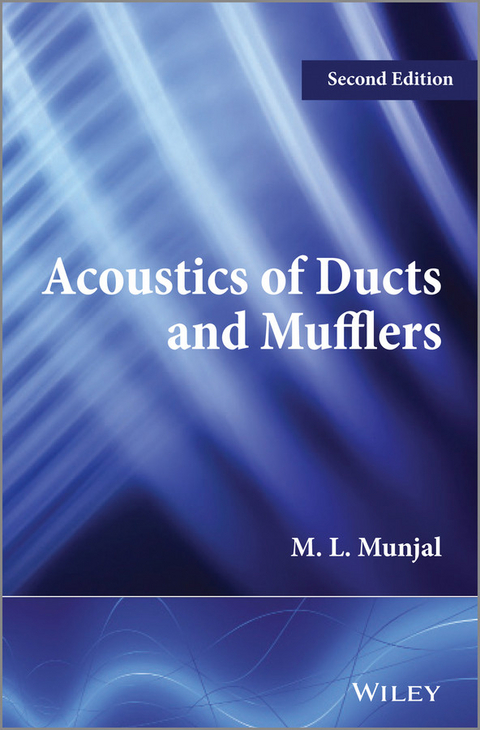
Acoustics of Ducts and Mufflers (eBook)
John Wiley & Sons (Verlag)
978-1-118-44308-8 (ISBN)
Engine exhaust noise pollutes the street environment and ventilation fan noise enters dwellings along with fresh air. People have become conscious of their working environment. Governments of most countries have responded to popular demand with mandatory restrictions on sound emitted by automotive engines, and a thorough knowledge of acoustics of ducts and mufflers is needed for the design of efficient muffler configurations. This fully updated Second Edition of Acoustics of Ducts and Mufflers deals with propagation, reflection and dissipation/absorption of sound along ducts/pipes/tubes, area discontinuities, perforated elements and absorptive linings that constitute the present-day mufflers and silencers designed to control noise of exhaust and intake systems of automotive engines, diesel-generator sets, compressors and HVAC systems.
It includes equations, figures, tables, references, and solved examples and unsolved exercises with answers, so it can be used as a text book as well as a reference book. It also offers a complete presentation and analysis of the major topics in sound suppression and noise control for the analysis and design of acoustical mufflers, air conditioning and ventilation duct work. Both the fundamentals and the latest technology are discussed, with an emphasis on applications. Deals with reactive mufflers, dissipative silencers, the frequency-domain approach, and the time-domain approach.
- Fully updated second edition of the premier reference book on muffler and lined duct acoustical performance, in one complete volume
- Presents original new research on topics including baffle silencers and louvers, 3D analytical techniques, and flow-acoustic analysis of multiply-connected perforated-element mufflers
- Includes a general design procedure to help muffler designers in the automotive industry, exhaust noise being a major component of automobile and traffic noise pollution
- Written by an expert with four decades' experience in teaching to graduate students, publishing extensively in reputed international journals, and consulting with industry for noise control as well as designing for quietness
Dr. M. L. Munjal is a Mechanical Engineer specializing in Engineering Acoustics. Over a four-decade career at the Indian Institute of Science, he has published over 190 papers in refereed journals, carried out over 100 industrial consultancy projects, and has run graduate courses on 'Industrial Noise Control' and 'Acoustics of Ducts and Mufflers'. He is Chairman of the National Committee for Noise Pollution Control that advises on noise control measures and legislations in India. He is also a Distinguished International Member of the Institute of Noise Control Engineering, USA, and Honorary Fellow of the International Institute of Acoustics and Vibration. He has been a member of the Editorial Board of several journals including the International Journal of Acoustics and Vibration.
Fully updated second edition of the premier reference book on muffler and lined duct acoustical performance Engine exhaust noise pollutes the street environment and ventilation fan noise enters dwellings along with fresh air. People have become conscious of their working environment. Governments of most countries have responded to popular demand with mandatory restrictions on sound emitted by automotive engines, and a thorough knowledge of acoustics of ducts and mufflers is needed for the design of efficient muffler configurations. This fully updated Second Edition of Acoustics of Ducts and Mufflers deals with propagation, reflection and dissipation/absorption of sound along ducts/pipes/tubes, area discontinuities, perforated elements and absorptive linings that constitute the present-day mufflers and silencers designed to control noise of exhaust and intake systems of automotive engines, diesel-generator sets, compressors and HVAC systems. It includes equations, figures, tables, references, and solved examples and unsolved exercises with answers, so it can be used as a text book as well as a reference book. It also offers a complete presentation and analysis of the major topics in sound suppression and noise control for the analysis and design of acoustical mufflers, air conditioning and ventilation duct work. Both the fundamentals and the latest technology are discussed, with an emphasis on applications. Deals with reactive mufflers, dissipative silencers, the frequency-domain approach, and the time-domain approach. Fully updated second edition of the premier reference book on muffler and lined duct acoustical performance, in one complete volume Presents original new research on topics including baffle silencers and louvers, 3D analytical techniques, and flow-acoustic analysis of multiply-connected perforated-element mufflers Includes a general design procedure to help muffler designers in the automotive industry, exhaust noise being a major component of automobile and traffic noise pollution Written by an expert with four decades experience in teaching to graduate students, publishing extensively in reputed international journals, and consulting with industry for noise control as well as designing for quietness
Dr. M. L. Munjal is a Mechanical Engineer specializing in Engineering Acoustics. Over a four-decade career at the Indian Institute of Science, he has published over 190 papers in refereed journals, carried out over 100 industrial consultancy projects, and has run graduate courses on 'Industrial Noise Control' and 'Acoustics of Ducts and Mufflers'. He is Chairman of the National Committee for Noise Pollution Control that advises on noise control measures and legislations in India. He is also a Distinguished International Member of the Institute of Noise Control Engineering, USA, and Honorary Fellow of the International Institute of Acoustics and Vibration. He has been a member of the Editorial Board of several journals including the International Journal of Acoustics and Vibration.
1
Propagation of Waves in Ducts
Exhaust noise of internal combustion engines is known to be the biggest pollutant of the present-day urban environment. Fortunately, however, this noise can be reduced sufficiently (to the level of the noise from other automotive sources, or even lower) by means of a well-designed muffler (also called a silencer). Mufflers are conventionally classified as dissipative or reflective, depending on whether the acoustic energy is dissipated into heat or is reflected back by area discontinuities.
However, no practical muffler or silencer is completely reactive or completely dissipative. Every muffler contains some elements with impedance mismatch and some with acoustic dissipation. In fact, combination mufflers are getting increasingly popular with designers.
Dissipative mufflers consist of ducts lined on the inside with an acoustically absorptive material. When used on an engine, such mufflers lose their performance with time because the acoustic lining gets clogged with unburnt carbon particles or undergoes thermal cracking. Recently, however, better fibrous materials such as sintered metal composites have been developed that resist clogging and thermal cracking and are not so costly. Besides, long strand unglued glass fibers can stand high temperatures. Nevertheless, no such problems are encountered in ventilation ducts, which conduct clean and cool air. The fan noise that would propagate through these ducts can well be reduced during propagation if the walls of the conducting duct are acoustically treated. For these reasons the use of dissipative mufflers is much more common in air-conditioning systems.
Reflective mufflers, being nondissipative, are also called reactive mufflers. A reflective muffler consists of a number of tubular elements of different transverse dimensions joined together so as to cause, at every junction, impedance mismatch and hence reflection of a substantial part of the incident acoustic energy back to the source. Most of the mufflers currently used on internal combustion engines, where the exhaust mass flux varies strongly, though periodically, with time, are of the reflective or reactive type. In fact, even the muffler of an air-conditioning system is generally provided with a couple of reflective elements at one or both ends of the acoustically dissipative duct.
Clearly, a tube or pipe or duct is the most basic and essential element of either type of muffler. A study of the propagation of waves in ducts is therefore central to the analysis of a muffler for its acoustic performance (transmission characteristics). This chapter is devoted to the derivation and solution of equations for plane waves and three-dimensional waves along rectangular ducts, circular tubes and elliptical shells without and with mean flow, without and with viscous friction, with rigid unlined walls and compliant or acoustically lined walls. We start with the simplest case and move gradually to the more general and involved cases.
1.1 Plane Waves in an Inviscid Stationary Medium
In the ideal case of a rigid-walled tube with sufficiently small cross dimensions* filled with a stationary ideal (nonviscous) fluid, small-amplitude waves travel as plane waves. The acoustic pressure perturbation (on the ambient static pressure) p and particle velocity u at all points of a cross-section are the same. The wave front or phase surface, defined as a surface at all points of which p and u have the same amplitude and phase, is a plane normal to the direction of wave propagation, which in the case of a tube is the longitudinal axis.
The basic linearized equations for the case are:
Mass continuity
Dynamical equilibrium
Energy equation (isentropicity)
where
Equation 1.3 implies that
The equation of dynamical equilibrium is also referred to as momentum balance equation, or simply, momentum equation. Similarly, the equation for mass continuity is commonly called continuity equation.
Substituting Equation 1.4 in Equation 1.1 and eliminating u from Equations 1.1 and 1.2 by differentiating the first with respect to (w.r.t.) t, the second with respect to z, and subtracting, yields
This linear, one-dimensional (that is, involving one space coordinate), homogeneous partial differential equation with constant coefficients (co is independent of z and t) admits a general solution:
If the time dependence is assumed to be of the exponential form , then the solution (1.6) becomes
The first part of this solution equals and also at . Therefore, it represents a progressive wave moving forward unattenuated and unaugmented with a velocity co. Similarly, it can be readily observed that the second part of the solution represents a progressive wave moving in the opposite direction with the same velocity, co.
Thus, co is the velocity of wave propagation, Equation 1.5 is a wave equation, and solution (1.7) represents a standing wave defined as superposition of two progressive waves with amplitudes C1 and C2 moving in opposite directions.
Equation 1.5 is called the classical one-dimensional wave equation, and the velocity of wave propagation co is also called phase velocity or sound speed. As acoustic pressure p is linearly related to particle velocity u or, for that matter, velocity potential defined by the relations
(1.8)
the dependent variable in Equation 1.5 could as well be u or . In view of this generality, the wave character of Equation 1.5 lies in the differential operator
(1.9)
which is called the classical one-dimensional wave operator.
Upon factorizing this wave operator as
(1.10)
one may realize that the forward-moving wave [the first part of solution (1.6) or (1.7)] is the solution of the equation
(1.11)
and the backward-moving wave [the second part of solution (1.6) or (1.7)] is the solution of the equation
(1.12)
Equation 1.7 can be rearranged as
where
As particle velocity u also satisfies the same wave equation, one can write
Substituting Equations 1.13 and 1.14 in the dynamical equilibrium equation (1.2) yields
and therefore
where is the characteristic impedance of the medium, defined as the ratio of the acoustic pressure and particle velocity of a plane progressive wave.
For a plane wave moving along a tube, one could also define a volume velocity vv (= Su) and mass velocity
where S is the area of cross-section of the tube. The corresponding values of characteristic impedance (defined now as the ratio of the acoustic pressure and the said velocity of a plane progressive wave) would then be as follows:
(1.17b)
(1.17c)
For the latter two cases, the characteristic impedance involves the tube area S. As it is not a property of the medium alone, it would be more appropriate to call it characteristic impedance of the tube. For tubes conducting hot exhaust gases, it is more appropriate to deal with acoustic mass velocity v. The corresponding characteristic impedance is denoted in these pages by the symbol Y for convenience:
Equations 1.15, 1.16 and 1.18 yield the following expression for acoustic mass velocity:
Subscript 0 with Y and k indicates nonviscous conditions. Constants C1 and C2 in Equations 1.13 and 1.19 are to be determined by the boundary conditions imposed by the elements that precede and follow the particular tubular element under investigation. This has to be deferred to the next chapter, where we deal with a system of elements or an acoustic filter.
1.2 Three-Dimensional Waves in an Inviscid Stationary Medium
In order to appreciate the limitations of the plane wave theory, it is necessary to consider the general 3D (three-dimensional) wave propagation in tubes. The basic linearized equations corresponding to Equations 1.1 and 1.2 for waves in stationary nonviscous medium are obtained by replacing with the 3D gradient operator . Thus,
The third equation is the same as Equations 1.3 or 1.4. On making use of this equation in Equation 1.20, differentiating Equation 1.20 w.r.t. to t, taking divergence of Equation 1.21 and subtracting, one gets the required 3D...
| Erscheint lt. Verlag | 4.2.2014 |
|---|---|
| Sprache | englisch |
| Themenwelt | Informatik ► Weitere Themen ► CAD-Programme |
| Technik ► Architektur | |
| Technik ► Fahrzeugbau / Schiffbau | |
| Technik ► Maschinenbau | |
| Schlagworte | automotive engineering • Bauentwurf • Fahrzeugtechnik • Kraftfahrzeugtechnik • Maschinenbau • mechanical engineering • M.L. Munjal, automotive, acoustics, ducts, mufflers, exhaust, intake noise, internal combustion engines, sound suppression, noise control, NVH, HVAC, diesel-generator sets, compressors • Physics • Physics of Acoustics • Physik • Physik des Schalls • Schalldämmung • Schalldämmung |
| ISBN-10 | 1-118-44308-X / 111844308X |
| ISBN-13 | 978-1-118-44308-8 / 9781118443088 |
| Informationen gemäß Produktsicherheitsverordnung (GPSR) | |
| Haben Sie eine Frage zum Produkt? |
 EPUB (Adobe DRM)
Größe: 8,0 MB
Kopierschutz: Adobe-DRM
Adobe-DRM ist ein Kopierschutz, der das eBook vor Mißbrauch schützen soll. Dabei wird das eBook bereits beim Download auf Ihre persönliche Adobe-ID autorisiert. Lesen können Sie das eBook dann nur auf den Geräten, welche ebenfalls auf Ihre Adobe-ID registriert sind.
Details zum Adobe-DRM
Dateiformat: EPUB (Electronic Publication)
EPUB ist ein offener Standard für eBooks und eignet sich besonders zur Darstellung von Belletristik und Sachbüchern. Der Fließtext wird dynamisch an die Display- und Schriftgröße angepasst. Auch für mobile Lesegeräte ist EPUB daher gut geeignet.
Systemvoraussetzungen:
PC/Mac: Mit einem PC oder Mac können Sie dieses eBook lesen. Sie benötigen eine
eReader: Dieses eBook kann mit (fast) allen eBook-Readern gelesen werden. Mit dem amazon-Kindle ist es aber nicht kompatibel.
Smartphone/Tablet: Egal ob Apple oder Android, dieses eBook können Sie lesen. Sie benötigen eine
Geräteliste und zusätzliche Hinweise
Zusätzliches Feature: Online Lesen
Dieses eBook können Sie zusätzlich zum Download auch online im Webbrowser lesen.
Buying eBooks from abroad
For tax law reasons we can sell eBooks just within Germany and Switzerland. Regrettably we cannot fulfill eBook-orders from other countries.
 PDF (Adobe DRM)
Kopierschutz: Adobe-DRM
Adobe-DRM ist ein Kopierschutz, der das eBook vor Mißbrauch schützen soll. Dabei wird das eBook bereits beim Download auf Ihre persönliche Adobe-ID autorisiert. Lesen können Sie das eBook dann nur auf den Geräten, welche ebenfalls auf Ihre Adobe-ID registriert sind.
Details zum Adobe-DRM
Dateiformat: PDF (Portable Document Format)
Mit einem festen Seitenlayout eignet sich die PDF besonders für Fachbücher mit Spalten, Tabellen und Abbildungen. Eine PDF kann auf fast allen Geräten angezeigt werden, ist aber für kleine Displays (Smartphone, eReader) nur eingeschränkt geeignet.
Systemvoraussetzungen:
PC/Mac: Mit einem PC oder Mac können Sie dieses eBook lesen. Sie benötigen eine
eReader: Dieses eBook kann mit (fast) allen eBook-Readern gelesen werden. Mit dem amazon-Kindle ist es aber nicht kompatibel.
Smartphone/Tablet: Egal ob Apple oder Android, dieses eBook können Sie lesen. Sie benötigen eine
Geräteliste und zusätzliche Hinweise
Buying eBooks from abroad
For tax law reasons we can sell eBooks just within Germany and Switzerland. Regrettably we cannot fulfill eBook-orders from other countries.
aus dem Bereich