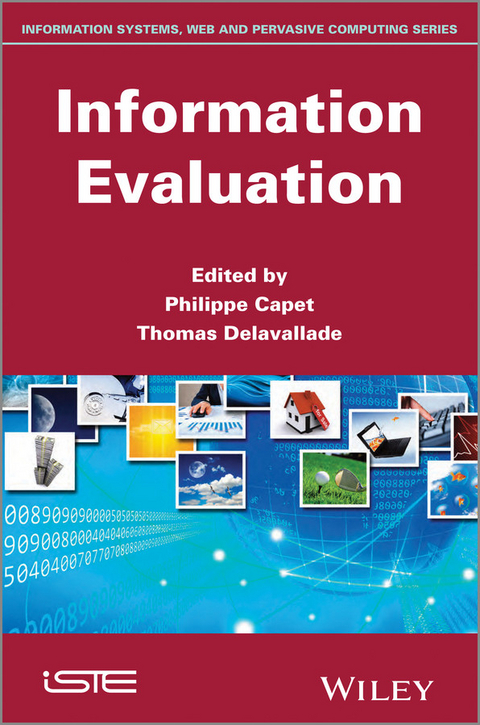
Information Evaluation (eBook)
336 Seiten
John Wiley & Sons (Verlag)
978-1-118-89899-4 (ISBN)
passive. Depending on its origin and content, from our personal
beliefs and convictions, we bestow upon this piece of information,
spontaneously or after reflection, a certain amount of confidence.
Too much confidence shows a degree of naivety, whereas an absolute
lack of it condemns us as being paranoid. These two attitudes are
symmetrically detrimental, not only to the proper perception of
this information but also to its use. Beyond these two extremes,
each person generally adopts an intermediate position when faced
with the reception of information, depending on its provenance and
credibility. We still need to understand and explain how these
judgements are conceived, in what context and to what end.
Spanning the approaches offered by philosophy, military
intelligence, algorithmics and information science, this book
presents the concepts of information and the confidence placed in
it, the methods that militaries, the first to be aware of the need,
have or should have adopted, tools to help them, and the prospects
that they have opened up. Beyond the military context, the book
reveals ways to evaluate information for the good of other fields
such as economic intelligence, and, more globally, the
informational monitoring by governments and businesses.
Contents
1. Information: Philosophical Analysis and Strategic
Applications, Mouhamadou El Hady Ba and Philippe Capet.
2. Epistemic Trust, Gloria Origgi.
3. The Fundamentals of Intelligence, Philippe Lemercier.
4. Information Evaluation in the Military Domain: Doctrines,
Practices and Shortcomings, Philippe Capet and Adrien Revault
d'Allonnes.
5. Multidimensional Approach to Reliability Evaluation of
Information Sources, Frédéric Pichon, Christophe
Labreuche, Bertrand Duqueroie and Thomas Delavallade.
6. Uncertainty of an Event and its Markers in Natural Language
Processing,
Mouhamadou El Hady Ba, Stéphanie Brizard, Tanneguy Dulong and
Bénédicte Goujon.
7. Quantitative Information Evaluation: Modeling and Experimental
Evaluation,
Marie-Jeanne Lesot, Frédéric Pichon and Thomas
Delavallade.
8. When Reported Information Is Second Hand, Laurence Cholvy.
9. An Architecture for the Evolution of Trust: Definition and
Impact of the Necessary Dimensions of Opinion Making, Adrien
Revault d'Allonnes.
About the Authors
Philippe Capet is a project manager and research engineer at
Ektimo, working mainly on information management and control in
military contexts.
Thomas Delavallade is an advanced studies engineer at Thales
Communications & Security, working on social media mining in
the context of crisis management, cybersecurity and the fight
against cybercrime.
Philippe Capet is a project manager and research engineer at Ektimo, working mainly on information management and control in military contexts. Thomas Delavallade is an advanced studies engineer at Thales Communications & Security, working on social media mining in the context of crisis management, cybersecurity and the fight against cybercrime.
1. Information: Philosophical Analysis and Strategic Applications, Mouhamadou El Hady Ba and Philippe Capet.
2. Epistemic Trust, Gloria Origgi.
3. The Fundamentals of Intelligence, Philippe Lemercier.
4. Information Evaluation in the Military Domain: Doctrines, Practices and Shortcomings, Philippe Capet and Adrien Revault d'Allonnes.
5. Multidimensional Approach to Reliability Evaluation of Information Sources, Frédéric Pichon, Christophe Labreuche, Bertrand Duqueroie and Thomas Delavallade.
6. Uncertainty of an Event and its Markers in Natural Language Processing,
Mouhamadou El Hady Ba, Stéphanie Brizard, Tanneguy Dulong and Bénédicte Goujon.
7. Quantitative Information Evaluation: Modeling and Experimental Evaluation,
Marie-Jeanne Lesot, Frédéric Pichon and Thomas Delavallade.
8. When Reported Information Is Second Hand, Laurence Cholvy.
9. An Architecture for the Evolution of Trust: Definition and Impact of the Necessary Dimensions of Opinion Making, Adrien Revault d'Allonnes.
| Erscheint lt. Verlag | 7.1.2014 |
|---|---|
| Sprache | englisch |
| Themenwelt | Mathematik / Informatik ► Informatik ► Theorie / Studium |
| Schlagworte | Computer Science • Informatik • Informationstechnologie • Information Technologies |
| ISBN-10 | 1-118-89899-0 / 1118898990 |
| ISBN-13 | 978-1-118-89899-4 / 9781118898994 |
| Informationen gemäß Produktsicherheitsverordnung (GPSR) | |
| Haben Sie eine Frage zum Produkt? |
 EPUB (Adobe DRM)
Größe: 3,6 MB
Kopierschutz: Adobe-DRM
Adobe-DRM ist ein Kopierschutz, der das eBook vor Mißbrauch schützen soll. Dabei wird das eBook bereits beim Download auf Ihre persönliche Adobe-ID autorisiert. Lesen können Sie das eBook dann nur auf den Geräten, welche ebenfalls auf Ihre Adobe-ID registriert sind.
Details zum Adobe-DRM
Dateiformat: EPUB (Electronic Publication)
EPUB ist ein offener Standard für eBooks und eignet sich besonders zur Darstellung von Belletristik und Sachbüchern. Der Fließtext wird dynamisch an die Display- und Schriftgröße angepasst. Auch für mobile Lesegeräte ist EPUB daher gut geeignet.
Systemvoraussetzungen:
PC/Mac: Mit einem PC oder Mac können Sie dieses eBook lesen. Sie benötigen eine
eReader: Dieses eBook kann mit (fast) allen eBook-Readern gelesen werden. Mit dem amazon-Kindle ist es aber nicht kompatibel.
Smartphone/Tablet: Egal ob Apple oder Android, dieses eBook können Sie lesen. Sie benötigen eine
Geräteliste und zusätzliche Hinweise
Zusätzliches Feature: Online Lesen
Dieses eBook können Sie zusätzlich zum Download auch online im Webbrowser lesen.
Buying eBooks from abroad
For tax law reasons we can sell eBooks just within Germany and Switzerland. Regrettably we cannot fulfill eBook-orders from other countries.
 PDF (Adobe DRM)
Kopierschutz: Adobe-DRM
Adobe-DRM ist ein Kopierschutz, der das eBook vor Mißbrauch schützen soll. Dabei wird das eBook bereits beim Download auf Ihre persönliche Adobe-ID autorisiert. Lesen können Sie das eBook dann nur auf den Geräten, welche ebenfalls auf Ihre Adobe-ID registriert sind.
Details zum Adobe-DRM
Dateiformat: PDF (Portable Document Format)
Mit einem festen Seitenlayout eignet sich die PDF besonders für Fachbücher mit Spalten, Tabellen und Abbildungen. Eine PDF kann auf fast allen Geräten angezeigt werden, ist aber für kleine Displays (Smartphone, eReader) nur eingeschränkt geeignet.
Systemvoraussetzungen:
PC/Mac: Mit einem PC oder Mac können Sie dieses eBook lesen. Sie benötigen eine
eReader: Dieses eBook kann mit (fast) allen eBook-Readern gelesen werden. Mit dem amazon-Kindle ist es aber nicht kompatibel.
Smartphone/Tablet: Egal ob Apple oder Android, dieses eBook können Sie lesen. Sie benötigen eine
Geräteliste und zusätzliche Hinweise
Buying eBooks from abroad
For tax law reasons we can sell eBooks just within Germany and Switzerland. Regrettably we cannot fulfill eBook-orders from other countries.
aus dem Bereich