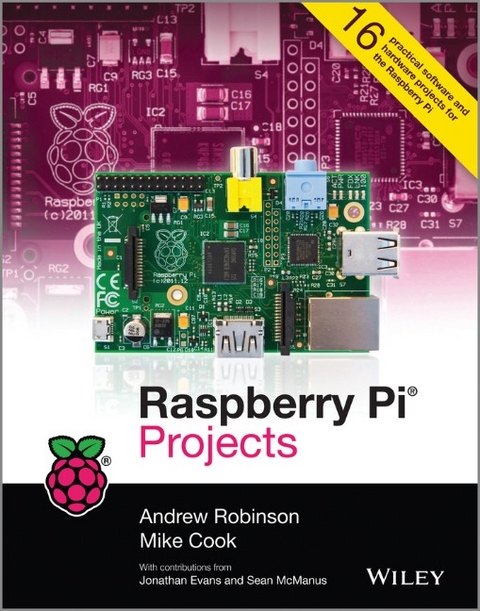
Raspberry Pi Projects (eBook)
John Wiley & Sons (Verlag)
978-1-118-55556-9 (ISBN)
Learn to build software and hardware projects featuring the Raspberry Pi!
Raspberry Pi represents a new generation of computers that encourages the user to play and to learn and this unique book is aimed at the beginner Raspberry Pi user who is eager to get started creating real-world projects. Taking you on a journey of creating 16 practical projects, this fun and informative resource introduces you to the skills you need to have in order to make the most of the Pi. The book begins with a quick look at how to get the Pi up and running and then encourages you to dive into the array of exciting software and hardware projects.
- Features projects that use Python, which is Raspberry Pi's programming language of choice
- Includes projects for creating an information center for e-mail, Twitter, Facebook, weather, train times, and more
- Shows you how to recreate Pong and Pacman or write Tic Tac Toe
- Teaches you how to use Raspberry Pi's general purpose input/output port in order to speak to external hardware devices
- Walks you through setting up computer-controlled slot car racing, a swipe card door lock, disco lights, and more
Raspberry Pi Projects is an excellent way to dig deeper into the capabilities of the Pi and to have great fun while doing it.
Learn to build software and hardware projects featuring the Raspberry Pi! Congratulations on becoming a proud owner of a Raspberry Pi! Following primers on getting your Pi up and running and programming with Python, the authors walk you through 16 fun projects of increasing sophistication that let you develop your Raspberry Pi skills. Among other things you will: Write simple programs, including a tic-tac-toe game Re-create vintage games similar to Pong and Pac-Man Construct a networked alarm system with door sensors and webcams Build Pi-controlled gadgets including a slot car racetrack and a door lock Create a reaction timer and an electronic harmonograph Construct a Facebook-enabled Etch A Sketch-type gadget and a Twittering toy Raspberry Pi Projects is an excellent way to dig deeper into the capabilities of the Pi and to have great fun while doing it.
Dr Andrew Robinson (Manchester, UK) worked at the University of Manchester School of Computer Science, where they have just launched the Great British Raspberry Pi Bake Off, a competition to get people making projects with the Pi. Andrew has quickly become a leading expert on the Pi and its astounding capabilities, including guest posts on raspberrypi.org, the official mouthpiece of Raspberry Pi. He is the creator of PiFace, which makes interfacing with the Raspberry Pi significantly easier. He is currently utilizing the Raspberry Pi as part of the team behind the BBC's Springwatch. Mike Cook is is the co-author of Raspberry Pi For Dummies. Mike is a veteran tech author and a freelance consultant for all things to do with Physical Computing. A former Lecturer in Physics at Manchester Metropolitan University, he has written more than three hundred computing and electronics articles for the pages of computer magazines since the 1980s. Mike patrols the forums as Grumpy Mike, though he is anything but!
Introduction
When we’re young, making things is second nature – painting a picture, inventing a game, telling a story, building a rocket from a washing-up liquid bottle that we’re convinced will fly all the way to the moon. Childhood is all about adventure, discovery – the quest for something new.
Although these joys don’t fade with age, it can become harder to find space and time for play and discovery as “real life” takes over. But yet, some of the greatest inventions and discoveries of history were the result of curious people not being afraid to “have a go”, often tinkering away in their own homes or garden sheds rather than high-tech well-funded engineering companies.
What’s this got to do with a book on things to do with a Raspberry Pi?
Well, after reading and having a go at some of the projects in this book you might discover the pleasure of making something with a computer can bring. Computing offers a fantastic world of new and untapped opportunities for adventure and creativity. It touches so many areas of our lives (game consoles, set top boxes and smartphones are all computers) that you can combine it with almost any other passion or hobby.
You’ll see why a sprinkling of computing is beneficial for everyone, and that a moment of personal creativity on the kitchen table can have a much bigger impact. You’ll also discover the story behind a particular credit-card sized computer.
A History of Making
World-changing inventions can come from unconventional places.
Orville and Wilbur Wright were two ordinary brothers from Ohio who owned a bicycle shop. Fascinated with the workings of these simple machines, they became convinced that they could build a flying machine. And they did. In 1903, they launched the world’s first aeroplane. Nearly a century later, as HIV/AIDS swept through Africa, Trevor Baylis, an ex-stuntman, became convinced he could help. He sat in his suburban garden shed and invented an inexpensive and durable wind-up radio for use across Africa to spread simple health messages and undoubtedly prevented many, many deaths. Steve Jobs and Steve Wozniak, the founders of Apple, both learned about electronics and computers from experimenting in their bedrooms and family garages. These are just three examples that show the worldwide impact on millions tinkering at home can have.
Many inventors can clearly imagine what they want to make, but might not know how to build it. But, spurred on by the joy of creativity, they teach themselves the skills needed to build what they could imagine. Wozniak and Jobs developed their skills this way, taking apart existing appliances, figuring out how they work and putting them back together. Sometimes the appliances would be enhanced by tinkering, and sometimes they’d no longer work at all! But they weren’t put off; sometimes it was just about discovering how something worked, or the journey to overcome technical adversity, rather than producing a polished product.
Consumer Computing
It is ironic that the birth of Apple computers was a result of poking around in the innards of appliances. Nowadays, computers are sold as sleek, refined aluminium caskets of magic, sealing in opportunities to experiment and discover how they actually work. In a continual quest to add value to their products, manufacturers lure customers with the promise of easy-to-use products and an effortless user experience with your every need taken care of.
Unfortunately it’s not been a smooth journey. Rarely do modern computer systems do exactly what users want. How often are we left frustrated by a computer system failing, consoled by the manufacturer’s line that “that will be fixed in the next update” or “you need to buy the next version if you want it to do that”? For the technologically fearless, these statements are more like rallying cries, an excuse to tinker until the computer does what they really want. But these days, there are few people brave or skilled enough to roll their sleeves up and get inside.
Why Everyone Should Learn About Computing
Computers really are everywhere, pervading every aspect of our lives. As well as the laptop, desktop and smartphone, just think about the computers behind life support systems and medical records in our hospitals, in banking and shopping keeping the economy going, in manufacturing and our food-supply chain. They are key for our communications, powering digital TV and radio and mobile phone networks, as well as the Internet. With computers so integral to the functioning of our media, commerce and government, it seems odd that so many of us are ignorant of how they work.
Given how widespread the reliance on computers is, think how much we could all benefit from a little bit more understanding. Business leaders and politicians could make more informed decisions on projects involving computers, and the man-on-the-street would be less likely to fall prey to online scams or be duped by overimpressive advertising claims about products. They’d have the skills to make computers work for them to improve their lives.
I see similarities between computing and cooking. Cooking has recipes, which is about following steps. It is about making meals, consisting of sets of dishes. To make an apple pie, you need to break down the task into manageable elements (making the pastry, coring the apples, baking for just the right amount of time), all of which add to a complete (and hopefully tasty) apple pie. This is an example of abstraction, and is key to mastering computing. The problem-solving and logical-thinking techniques, such as managing abstraction, that are developed in computing are valuable to other aspects of life.
We teach our children how to cook, not because we want to train them to become professional chefs, but because we view it as an essential life skill. Without it, we condemn our children to a lifetime of preheating ready meals, often unfulfilling and expensive. For many people, learning the basic skills is the start of a lifelong love of cooking. They see it as an outlet for their creativity, perhaps starting with a recipe and adapting it to make it their own. It’s a social occupation, a chance to show achievements and discuss techniques, challenges and adventures around a lively dinner table.
I’d argue that learning to use computers has parallels with learning to cook. Everyone needs the basic skills. Some may use those skills to go on to become professional programmers, but I’d hope that for most people it is an opportunity for creativity, as well as a survival skill in today’s modern environment.
However, given the need for more people to learn more about how computers work and the reliance on them, it’s also ironic that getting into computing has become more difficult with modern computers. That is, until a certain credit-card–sized computer came along. . . .
Enter the Raspberry Pi
For most people, beginning to experiment on a £1000 laptop, putting precious data at risk is a daunting prospect. I’d think twice before putting all my digital photos, my music collection and my online banking at risk! Games consoles and some phones actively prevent people from creating their own games and apps, presumably to protect revenue by forcing consumer to buy manufacturer’s products.
With the desire to share the fun of computing and the need for more people to know how computers worked, Eben Upton created a small, cheap computer on his kitchen table. With the help of Dr. Rob Mullins, Professor Alan Mycroft and Jack Lang from Cambridge University; Pete Lomas, an expert in hardware; and David Braben, the Raspberry Pi Foundation was born, a charity that set out to promote the study of computer science and related topics, especially at the school level, and to put the fun back into learning computing.
The Raspberry Pi Foundation aimed to open up the world of computing by creating a hardware device that was pocket-money affordable, so it was accessible to everyone, and there’d be no need to worry about experimenting with it. It was unboxed to make it easy to tinker with.
In 2011, after five years’ intense kitchen-table engineering, the first prototype Raspberry Pi computers were produced. After a feature about the Raspberry Pi on technology journalist Rory Cellan-Jones’s blog went viral the Foundation wondered if they were at the early stages of something bigger than they were expecting.
After some clever engineering to allow the Raspberry Pi to be built cheaply enough to be sold for $25, an initial batch of 10,000 went on sale on 29th February 2012 at 6 a.m. A few minutes later, they had sold out. Eighteen months later, 1.75 million had been sold worldwide.
About This Book
During the development of the Raspberry Pi I’d been working on public engagement projects at the University of Manchester to encourage more people into computing.
I’d been following the Raspberry Pi from an early stage, and thought it had great potential. Like thousands of other engineers, I was also very excited by the technology crammed in this tiny PCB of components. I was also aware that for most people less familiar with computers, the same PCB wouldn’t be particularly exciting, and perhaps a scary mass of wires, components and metal. Like the Foundation, I wanted to share the wonder and joy computing could bring.
The big advantage of the Raspberry Pi was that it could be put it in places you couldn’t put a PC. I wanted the Raspberry Pi to be relevant to what people are interested in. To make it easy to connect to the Raspberry Pi, I came up...
| Erscheint lt. Verlag | 10.1.2014 |
|---|---|
| Sprache | englisch |
| Themenwelt | Mathematik / Informatik ► Informatik ► Theorie / Studium |
| Informatik ► Weitere Themen ► Hardware | |
| Schlagworte | Allg. Hardware • Computer Hardware (general) • Computer-Ratgeber • End-User Computing • Hardware • Raspberry Pi, what is Raspberry Pi, how to use Raspberry Pi, books on Raspberry Pi, beginner guide to Raspberry Pi, how to get started with Raspberry Pi, Raspberry Pi projects, projects for Raspberry Pi, what can Raspberry Pi do, sample Raspberry Pi projects, learn Raspberry Pi |
| ISBN-10 | 1-118-55556-2 / 1118555562 |
| ISBN-13 | 978-1-118-55556-9 / 9781118555569 |
| Informationen gemäß Produktsicherheitsverordnung (GPSR) | |
| Haben Sie eine Frage zum Produkt? |
 EPUB (Adobe DRM)
Kopierschutz: Adobe-DRM
Adobe-DRM ist ein Kopierschutz, der das eBook vor Mißbrauch schützen soll. Dabei wird das eBook bereits beim Download auf Ihre persönliche Adobe-ID autorisiert. Lesen können Sie das eBook dann nur auf den Geräten, welche ebenfalls auf Ihre Adobe-ID registriert sind.
Details zum Adobe-DRM
Dateiformat: EPUB (Electronic Publication)
EPUB ist ein offener Standard für eBooks und eignet sich besonders zur Darstellung von Belletristik und Sachbüchern. Der Fließtext wird dynamisch an die Display- und Schriftgröße angepasst. Auch für mobile Lesegeräte ist EPUB daher gut geeignet.
Systemvoraussetzungen:
PC/Mac: Mit einem PC oder Mac können Sie dieses eBook lesen. Sie benötigen eine
eReader: Dieses eBook kann mit (fast) allen eBook-Readern gelesen werden. Mit dem amazon-Kindle ist es aber nicht kompatibel.
Smartphone/Tablet: Egal ob Apple oder Android, dieses eBook können Sie lesen. Sie benötigen eine
Geräteliste und zusätzliche Hinweise
Buying eBooks from abroad
For tax law reasons we can sell eBooks just within Germany and Switzerland. Regrettably we cannot fulfill eBook-orders from other countries.
aus dem Bereich