Fractal Geometry (eBook)
John Wiley & Sons (Verlag)
978-1-118-76286-8 (ISBN)
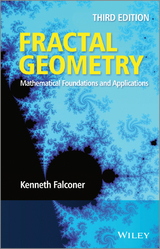
The seminal text on fractal geometry for students and researchers: extensively revised and updated with new material, notes and references that reflect recent directions.
Interest in fractal geometry continues to grow rapidly, both as a subject that is fascinating in its own right and as a concept that is central to many areas of mathematics, science and scientific research. Since its initial publication in 1990 Fractal Geometry: Mathematical Foundations and Applications has become a seminal text on the mathematics of fractals. The book introduces and develops the general theory and applications of fractals in a way that is accessible to students and researchers from a wide range of disciplines.
Fractal Geometry: Mathematical Foundations and Applications is an excellent course book for undergraduate and graduate students studying fractal geometry, with suggestions for material appropriate for a first course indicated. The book also provides an invaluable foundation and reference for researchers who encounter fractals not only in mathematics but also in other areas across physics, engineering and the applied sciences.
- Provides a comprehensive and accessible introduction to the mathematical theory and applications of fractals
- Carefully explains each topic using illustrative examples and diagrams
- Includes the necessary mathematical background material, along with notes and references to enable the reader to pursue individual topics
- Features a wide range of exercises, enabling readers to consolidate their understanding
- Supported by a website with solutions to exercises and additional material http://www.wileyeurope.com/fractal
Kenneth Falconer, University of St Andrews, UK
Kenneth Falconer, University of St Andrews, UK.
"Falconer's book is excellent in many respects and
the reviewer strongly recommends it. May every university library
own a copy, or three! And if you're a student reading this,
go check it out today!." (Mathematical Association
of America, 11 June 2014)
Introduction
In the past, mathematics has been concerned largely with sets and functions to which the methods of classical calculus can be applied. Sets or functions that are not sufficiently smooth or regular have tended to be ignored as ‘pathological’ and not worthy of study. Certainly, they were regarded as individual curiosities and only rarely were thought of as a class to which a general theory might be applicable.
In recent years, this attitude has changed. It has been realised that a great deal can be said, and is worth saying, about the mathematics of non-smooth objects. Moreover, irregular sets provide a much better representation of many natural phenomena than do the figures of classical geometry. Fractal geometry provides a general framework for the study of such irregular sets.
We begin by looking briefly at a number of simple examples of fractals, and note some of their features.
The middle third Cantor set is one of the best known and most easily constructed fractals; nevertheless, it displays many typical fractal characteristics. It is constructed from a unit interval by a sequence of deletion operations (see Figure 0.1). Let be the interval [0, 1]. (Recall that denotes the set of real numbers such that .) Let be the set obtained by deleting the middle third of , so that consists of the two intervals and . Deleting the middle thirds of these intervals gives ; thus, comprises the four intervals . We continue in this way, with obtained by deleting the middle third of each interval in . Thus, consists of intervals each of length . The middle third Cantor set F consists of the numbers that are in for all k; mathematically, is the intersection . The Cantor set may be thought of as the limit of the sequence of sets as k tends to infinity. It is obviously impossible to draw the set itself, with its infinitesimal detail, so ‘pictures of ’ tend to be pictures of one of the , which are a good approximation to when k is reasonably large (see Figure 0.1).
Figure 0.1 Construction of the middle third Cantor set , by repeated removal of the middle third of intervals. Note that and , the left and right parts of , are copies of scaled by a factor .
At first glance, it might appear that we have removed so much of the interval [0, 1] during the construction of , that nothing remains. In fact, is an infinite (and indeed uncountable) set, which contains infinitely many numbers in every neighbourhood of each of its points. The middle third Cantor set consists precisely of those numbers in [0, 1] whose base-3 expansion does not contain the digit 1, that is, all numbers with or 2 for each i. To see this, note that to get from , we remove those numbers with ; to get from , we remove those numbers with and so on.
Figure 0.2 (a) Construction of the von Koch curve . At each stage, the middle third of each interval is replaced by the other two sides of an equilateral triangle. (b) Three von Koch curves fitted together to form a snowflake curve.
We list some of the features of the middle third Cantor set ; as we shall see, similar features are found in many fractals.
- is self-similar. It is clear that the part of in the interval and the part of in are both geometrically similar to , scaled by a factor . Again, the parts of in each of the four intervals of are similar to but scaled by a factor , and so on. The Cantor set contains copies of itself at many different scales.
- The set has a ‘fine structure’; that is, it contains detail at arbitrarily small scales. The more we enlarge the picture of the Cantor set, the more gaps become apparent to the eye.
- Although has an intricately detailed structure, the actual definition of is very straightforward.
- is obtained by a recursive procedure. Our construction consisted of repeatedly removing the middle thirds of intervals. Successive steps give increasingly good approximations to the set .
- The geometry of is not easily described in classical terms: neither is it the locus of the points that satisfy some simple geometric condition nor is it the set of solutions of any simple equation.
- It is awkward to describe the local geometry of —near each of its points are a large number of other points, separated by gaps of varying lengths.
- Although is in some ways quite a large set (it is uncountably infinite), its size is not quantified by the usual measures such as length—by any reasonable definition has length zero.
Our second example, the von Koch curve, will also be familiar to many readers (see Figure 0.2). We let be a line segment of unit length. The set consists of the four segments obtained by removing the middle third of and replacing it by the other two sides of the equilateral triangle based on the removed segment. We construct by applying the same procedure to each of the segments in and so on. Thus, comes from replacing the middle third of each straight line segment of by the other two sides of an equilateral triangle. When k is large, the curves and differ only in fine detail and as k tends to be infinity, the sequence of polygonal curves approaches a limiting curve , called the von Koch curve.
The von Koch curve has features in many ways similar to those listed for the middle third Cantor set. It is made up of four ‘quarters’ each similar to the whole, but scaled by a factor . The fine structure is reflected in the irregularities at all scales; nevertheless, this intricate structure stems from a basically simple construction. Whilst it is reasonable to call F a curve, it is much too irregular to have tangents in the classical sense. A simple calculation shows that is of length ; letting k tend to infinity implies that F has infinite length. On the other hand, F occupies zero area in the plane, so neither length nor area provides a very useful description of the size of F.
Figure 0.3 Construction of the Sierpiski triangle .
Many other sets may be constructed using such recursive procedures. For example, the Sierpiski triangle or gasket is obtained by repeatedly removing (inverted) equilateral triangles from an initial equilateral triangle of unit side length (see Figure 0.3). (For many purposes, it is better to think of this procedure as repeatedly replacing an equilateral triangle by three triangles of half the height.) A plane analogue of the Cantor set, a ‘Cantor dust’, is illustrated in Figure 0.4. At each stage, each remaining square is divided into 16 smaller squares of which four are kept and the rest discarded. (Of course, other arrangements or numbers of squares could be used to get different sets.) It should be clear that such examples have properties similar to those mentioned in connection with the Cantor set and the von Koch curve. The example depicted in Figure 0.5 is constructed using two different similarity ratios.
Figure 0.4 Construction of a ‘Cantor dust’ .
Figure 0.5 Construction of a self-similar fractal with two different similarity ratios.
Figure 0.6 A Julia set.
There are many other types of construction, some of which will be discussed in detail later in the book, that also lead to sets with these sorts of properties. The highly intricate structure of the Julia set illustrated in Figure 0.6 stems from the single quadratic function for a suitable constant . Although the set is not strictly self-similar in the sense that the Cantor set and von Koch curve are, it is ‘quasi-self-similar’ in that arbitrarily small portions of the set can be magnified and then distorted smoothly to coincide with a large part of the set.
Figure 0.7 shows the graph of the function ; the infinite summation leads to the graph having a fine structure, rather than being a smooth curve to which classical calculus is applicable.
Some of these constructions may be ‘randomised’. Figure 0.8 shows a ‘random von Koch curve’—a coin was tossed at each step in the construction to determine on which side of the curve to place the new pair of line segments. This random curve certainly has a fine structure, but the strict self-similarity of the von Koch curve has been replaced by a ‘statistical self-similarity’.
Figure 0.7 Graph of .
These are all examples of sets that are commonly referred to as fractals. (The word ‘fractal’ was coined by Mandelbrot in his fundamental essay from the Latin fractus, meaning broken, to describe objects that were too irregular to fit into a traditional geometrical setting.) Properties such as those listed for the Cantor set are characteristic of fractals, and it is sets with such properties that we will have in mind throughout the book. Certainly, any fractal worthy of the name will have a fine structure, that is, detail at all scales. Many fractals have some degree of self-similarity—they are made up of parts that resemble the whole in some way. Sometimes, the resemblance may be weaker than strict geometrical similarity; for example, the similarity may be approximate or statistical.
Methods of classical geometry and calculus are...
| Erscheint lt. Verlag | 31.12.2013 |
|---|---|
| Sprache | englisch |
| Themenwelt | Mathematik / Informatik ► Mathematik ► Analysis |
| Mathematik / Informatik ► Mathematik ► Geometrie / Topologie | |
| Technik | |
| Schlagworte | Applied Mathematics in Science • Chaos / Fractal / Dynamical Systems • Chaos, Fraktale u. dynamische Systeme • Discrete Mathematics • Diskrete Mathematik • fractal applications in finance • fractal applications in science • Fractal Geometry • Fractal Geometry textbook • fractal porosity • fractals and conformal invariance • fractal textbook • Fraktalgeometrie • Kenneth Falconer • Mathematics • Mathematik • Mathematik in den Naturwissenschaften • multifractal theory • noncommutative fractal geometry • random fractals |
| ISBN-10 | 1-118-76286-X / 111876286X |
| ISBN-13 | 978-1-118-76286-8 / 9781118762868 |
| Informationen gemäß Produktsicherheitsverordnung (GPSR) | |
| Haben Sie eine Frage zum Produkt? |
 EPUB (Adobe DRM)
Kopierschutz: Adobe-DRM
Adobe-DRM ist ein Kopierschutz, der das eBook vor Mißbrauch schützen soll. Dabei wird das eBook bereits beim Download auf Ihre persönliche Adobe-ID autorisiert. Lesen können Sie das eBook dann nur auf den Geräten, welche ebenfalls auf Ihre Adobe-ID registriert sind.
Details zum Adobe-DRM
Dateiformat: EPUB (Electronic Publication)
EPUB ist ein offener Standard für eBooks und eignet sich besonders zur Darstellung von Belletristik und Sachbüchern. Der Fließtext wird dynamisch an die Display- und Schriftgröße angepasst. Auch für mobile Lesegeräte ist EPUB daher gut geeignet.
Systemvoraussetzungen:
PC/Mac: Mit einem PC oder Mac können Sie dieses eBook lesen. Sie benötigen eine
eReader: Dieses eBook kann mit (fast) allen eBook-Readern gelesen werden. Mit dem amazon-Kindle ist es aber nicht kompatibel.
Smartphone/Tablet: Egal ob Apple oder Android, dieses eBook können Sie lesen. Sie benötigen eine
Geräteliste und zusätzliche Hinweise
Buying eBooks from abroad
For tax law reasons we can sell eBooks just within Germany and Switzerland. Regrettably we cannot fulfill eBook-orders from other countries.
aus dem Bereich