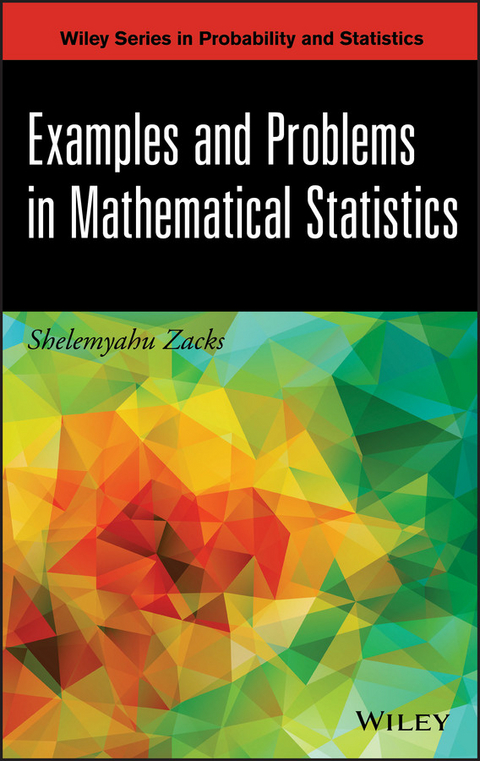
Examples and Problems in Mathematical Statistics (eBook)
John Wiley & Sons (Verlag)
978-1-118-60600-1 (ISBN)
Provides the necessary skills to solve problems in mathematical statistics through theory, concrete examples, and exercises With a clear and detailed approach to the fundamentals of statistical theory, Examples and Problems in Mathematical Statistics uniquely bridges the gap between theory andapplication and presents numerous problem-solving examples that illustrate the relatednotations and proven results. Written by an established authority in probability and mathematical statistics, each chapter begins with a theoretical presentation to introduce both the topic and the important results in an effort to aid in overall comprehension. Examples are then provided, followed by problems, and finally, solutions to some of the earlier problems. In addition, Examples and Problems in Mathematical Statistics features: Over 160 practical and interesting real-world examples from a variety of fields including engineering, mathematics, and statistics to help readers become proficient in theoretical problem solving More than 430 unique exercises with select solutions Key statistical inference topics, such as probability theory, statistical distributions, sufficient statistics, information in samples, testing statistical hypotheses, statistical estimation, confidence and tolerance intervals, large sample theory, and Bayesian analysis Recommended for graduate-level courses in probability and statistical inference, Examples and Problems in Mathematical Statistics is also an ideal reference for applied statisticians and researchers.
SHELEMYAHU ZACKS, PHD, is Distinguished Professor in the Department of Mathematical Sciences at Binghamton University. He has published several books and more than 170 journal articles on the design and analysis of experiments, statistical control of stochastic processes, statistical decision theory, sequential analysis, reliability, statistical methods in logistics, and sampling from finite populations. A Fellow of the American Statistical Association, Institute of Mathematical Sciences, and American Association for the Advancement of Sciences, Dr. Zacks is the author of Stage& #45;Wise Adaptive Designs, also published by Wiley.
CHAPTER 1
Basic Probability Theory
PART I: THEORY
It is assumed that the reader has had a course in elementary probability. In this chapter we discuss more advanced material, which is required for further developments.
1.1 OPERATIONS ON SETS
Let denote a sample space. Let E1, E2 be subsets of . We denote the union by E1 E2 and the intersection by E1 E2. = − E denotes the complement of E. By DeMorgan’s laws = 1 2 and = 1 2.
Given a sequence of sets {En, n ≥ 1} (finite or infinite), we define
(1.1.1)
Furthermore, and are defined as
(1.1.2)
If a point of belongs to En, it belongs to infinitely many sets En. The sets , En and , En always exist and
(1.1.3)
If , En = , En, we say that a limit of {En, n ≥ 1} exists. In this case,
(1.1.4)
A sequence {En, n ≥ 1} is called monotone increasing if En En+1 for all n ≥ 1. In this case . The sequence is monotone decreasing if En En+1, for all n ≥ 1. In this case . We conclude this section with the definition of a partition of the sample space. A collection of sets = {E1, …, Ek} is called a finite partition of if all elements of are pairwise disjoint and their union is , i.e., Ei Ej = for all i ≠ j; Ei, Ej ; and . If contains a countable number of sets that are mutually exclusive and , we say that is a countable partition.
1.2 ALGEBRA AND σ–FIELDS
Let be a sample space. An algebra is a collection of subsets of satisfying
(1.2.1)
We consider = . Thus, (i) and (ii) imply that . Also, if E1, E2 then E1 E2 .
The trivial algebra is 0 = {, }. An algebra 1 is a subalgebra of 2 if all sets of 1 are contained in 2. We denote this inclusion by 1 2. Thus, the trivial algebra 0 is a subalgebra of every algebra . We will denote by (), the algebra generated by all subsets of (see Example 1.1).
If a sample space has a finite number of points n, say 1 ≤ n < ∞, then the collection of all subsets of is called the discrete algebra generated by the elementary events of . It contains 2n events.
Let be a partition of having k, 2 ≤ k, disjoint sets. Then, the algebra generated by , (), is the algebra containing all the 2k − 1 unions of the elements of and the empty set.
An algebra on is called a σ–field if, in addition to being an algebra, the following holds.
We will denote a σ–field by . In a σ–field the supremum, infinum, limsup, and liminf of any sequence of events belong to . If is finite, the discrete algebra () is a σ–field. In Example 1.3 we show an algebra that is not a σ–field.
The minimal σ–field containing the algebra generated by {(-∞, x], -∞ < x < ∞ } is called the Borel σ–field on the real line .
A sample space , with a σ–field , (, ) is called a measurable space.
The following lemmas establish the existence of smallest σ–field containing a given collection of sets.
Lemma 1.2.1 Let be a collection of subsets of a sample space . Then, there exists a smallest σ–field (), containing the elements of .
Proof. The algebra of all subsets of , () obviously contains all elements of . Similarly, the σ–field containing all subsets of , contains all elements of . Define the σ–field () to be the intersection of all σ–fields, which contain all elements of . Obviously, () is an algebra. QED
A collection of subsets of is called a monotonic class if the limit of any monotone sequence in belongs to .
If is a collection of subsets of , let * () denote the smallest monotonic class containing .
Lemma 1.2.2. A necessary and sufficient condition of an algebra to be a σ–field is that it is a monotonic class.
Proof. (i) Obviously, if is a σ–field, it is a monotonic class.
(ii) Let be a monotonic class.
Let En , n ≥ 1. Define . Obviously Bn Bn+1 for all n ≥ 1. Hence . But . Thus, , En . Similarly, En . Thus, is a σ–field. QED
Theorem 1.2.1. Let be an algebra. Then * () = (), where () is the smallest σ–field containing .
Proof. See Shiryayev (1984, p. 139).
The measurable space (, ), where is the real line and = (), called the Borel measurable space, plays a most important role in the theory of statistics. Another important measurable space is (n, n), n ≥ 2, where n = × × ··· × is the Euclidean n–space, and n = × ··· × is the smallest σ–field containing n, , and all n–dimensional rectangles I = I1 × ··· × In, where
The measurable space (∞, ∞) is used as a basis for probability models of experiments with infinitely many trials. ∞ is the space of ordered sequences x = (x1, x2, …), −∞ < xn < ∞, n = 1, 2, …. Consider the cylinder sets
and
where Bi are Borel sets, i.e., Bi . The smallest σ–field containing all these cylinder sets, n ≥ 1, is (∞). Examples of Borel sets in (∞) are
or
1.3 PROBABILITY SPACES
Given a measurable space (, ), a probability model ascribes a countably additive function P on , which assigns a probability P{A} to all sets A . This function should satisfy the following properties.
(1.3.1)
(1.3.2)
Recall that if A B then P {A} ≤ P{B}, and P{} = 1 − P{A}. Other properties will be given in the examples and problems. In the sequel we often write AB for A B.
Theorem 1.3.1. Let (, , P) be a probability space, where is a σ–field of subsets of and P a probability function....
| Erscheint lt. Verlag | 17.12.2013 |
|---|---|
| Reihe/Serie | Wiley Series in Probability and Statistics |
| Wiley Series in Probability and Statistics | Wiley Series in Probability and Statistics |
| Sprache | englisch |
| Themenwelt | Mathematik / Informatik ► Mathematik ► Angewandte Mathematik |
| Mathematik / Informatik ► Mathematik ► Statistik | |
| Mathematik / Informatik ► Mathematik ► Wahrscheinlichkeit / Kombinatorik | |
| Technik | |
| Schlagworte | Angewandte Wahrscheinlichkeitsrechnung u. Statistik • Applied Probability & Statistics • Approach • authority • clear • Electrical & Electronics Engineering • Elektrotechnik u. Elektronik • established • Exercises • fundamentals • GAP • important • Kriminologie • Mathematical • Necessary • Numerical Methods & Algorithms • Numerische Methoden u. Algorithmen • numerous problemsolving • Probability • Probability & Mathematical Statistics • Problems • Skills • Statistical • Statistics • Statistik • theory • topic • uniquely • Wahrscheinlichkeitsrechnung u. mathematische Statistik |
| ISBN-10 | 1-118-60600-0 / 1118606000 |
| ISBN-13 | 978-1-118-60600-1 / 9781118606001 |
| Informationen gemäß Produktsicherheitsverordnung (GPSR) | |
| Haben Sie eine Frage zum Produkt? |
 EPUB (Adobe DRM)
Größe: 22,1 MB
Kopierschutz: Adobe-DRM
Adobe-DRM ist ein Kopierschutz, der das eBook vor Mißbrauch schützen soll. Dabei wird das eBook bereits beim Download auf Ihre persönliche Adobe-ID autorisiert. Lesen können Sie das eBook dann nur auf den Geräten, welche ebenfalls auf Ihre Adobe-ID registriert sind.
Details zum Adobe-DRM
Dateiformat: EPUB (Electronic Publication)
EPUB ist ein offener Standard für eBooks und eignet sich besonders zur Darstellung von Belletristik und Sachbüchern. Der Fließtext wird dynamisch an die Display- und Schriftgröße angepasst. Auch für mobile Lesegeräte ist EPUB daher gut geeignet.
Systemvoraussetzungen:
PC/Mac: Mit einem PC oder Mac können Sie dieses eBook lesen. Sie benötigen eine
eReader: Dieses eBook kann mit (fast) allen eBook-Readern gelesen werden. Mit dem amazon-Kindle ist es aber nicht kompatibel.
Smartphone/Tablet: Egal ob Apple oder Android, dieses eBook können Sie lesen. Sie benötigen eine
Geräteliste und zusätzliche Hinweise
Zusätzliches Feature: Online Lesen
Dieses eBook können Sie zusätzlich zum Download auch online im Webbrowser lesen.
Buying eBooks from abroad
For tax law reasons we can sell eBooks just within Germany and Switzerland. Regrettably we cannot fulfill eBook-orders from other countries.
 PDF (Adobe DRM)
Kopierschutz: Adobe-DRM
Adobe-DRM ist ein Kopierschutz, der das eBook vor Mißbrauch schützen soll. Dabei wird das eBook bereits beim Download auf Ihre persönliche Adobe-ID autorisiert. Lesen können Sie das eBook dann nur auf den Geräten, welche ebenfalls auf Ihre Adobe-ID registriert sind.
Details zum Adobe-DRM
Dateiformat: PDF (Portable Document Format)
Mit einem festen Seitenlayout eignet sich die PDF besonders für Fachbücher mit Spalten, Tabellen und Abbildungen. Eine PDF kann auf fast allen Geräten angezeigt werden, ist aber für kleine Displays (Smartphone, eReader) nur eingeschränkt geeignet.
Systemvoraussetzungen:
PC/Mac: Mit einem PC oder Mac können Sie dieses eBook lesen. Sie benötigen eine
eReader: Dieses eBook kann mit (fast) allen eBook-Readern gelesen werden. Mit dem amazon-Kindle ist es aber nicht kompatibel.
Smartphone/Tablet: Egal ob Apple oder Android, dieses eBook können Sie lesen. Sie benötigen eine
Geräteliste und zusätzliche Hinweise
Buying eBooks from abroad
For tax law reasons we can sell eBooks just within Germany and Switzerland. Regrettably we cannot fulfill eBook-orders from other countries.
aus dem Bereich