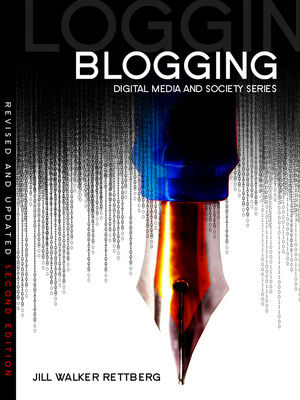
Blogging (eBook)
John Wiley & Sons (Verlag)
978-0-7456-7131-4 (ISBN)
Jill Walker Rettberg discusses the ways blogs are integrated into today’s mainstream social media ecology, where comments and links from Twitter and Facebook may be more important than the network between blogs that was significant five years ago, and questions the shift towards increased commercialization and corporate control of blogs. The new edition also analyses how smart phones with cameras and social media have led a shift towards more visual emphasis in blogs, with photographs and graphics increasingly foregrounded.
Authored by a scholar-blogger, this engaging book is packed with examples that show how blogging and related genres are changing media and communication. It gives definitions and explains how blogs work, shows how blogs relate to the historical development of publishing and communication and looks at the ways blogs structure social networks.
Jill Walker Rettberg is professor of digital culture at University of Bergen.
Thoroughly revised and updated, this new edition of Blogging provides an accessible study of a now everyday phenomenon and places it in a historical, theoretical and contemporary context. The second edition takes into account the most recent research and developments and provides current analyses of new tools for microblogging and visual blogging. Jill Walker Rettberg discusses the ways blogs are integrated into today s mainstream social media ecology, where comments and links from Twitter and Facebook may be more important than the network between blogs that was significant five years ago, and questions the shift towards increased commercialization and corporate control of blogs. The new edition also analyses how smart phones with cameras and social media have led a shift towards more visual emphasis in blogs, with photographs and graphics increasingly foregrounded. Authored by a scholar-blogger, this engaging book is packed with examples that show how blogging and related genres are changing media and communication. It gives definitions and explains how blogs work, shows how blogs relate to the historical development of publishing and communication and looks at the ways blogs structure social networks.
Jill Walker Rettberg is professor of digital culture at University of Bergen.
Acknowledgements vii
Introduction 1
1 What is a Blog? 5
A brief history of weblogs 6
How blogs have adapted to a social media ecosystem 14
Three blogs 17
Defining blogs 30
2 From Bards to Blogs 36
Orality and literacy 37
The introduction of print 41
Print, blogging and reading 44
Printed precedents of blogs 45
The Late Age of Print 47
A modern public sphere? 50
Hypertext and computer lib 53
Technological determinism or cultural shaping of technology?
57
3 Blogs, Communities and Networks 62
Social network theory 66
Distributed conversations 69
Technology for distributed communities 72
Facebook and Twitter as microblogs 76
Publicly articulated relationships 82
Colliding networks 83
Emerging social networks 86
4 Citizen Journalists? 90
Bloggers' perception of themselves 93
When it matters whether a blogger is a journalist 94
Objectivity, authority and credibility 97
First-hand reports: blogging from a war zone 101
First-hand reports: chance witnesses 104
Bloggers as independent journalists and opinionists 107
Gatewatching 108
Symbiosis 112
5 Blogs as Narratives 115
Goal-oriented narratives 116
Ongoing and episodic narration 118
Blogs as self-exploration 127
Fictions or hoaxes? Kaycee Nicole and lonelygirl15 129
6 Blogging Brands 135
The human voice 136
Advertisements and sponsored posts on blogs 139
Micropatronage 145
Sponsored posts and pay-to-post 147
Exploitation and alienation? 152
Corporate blogs 155
Engaging bloggers 161
Corporate blogging gone wrong 164
7 The Future of Blogging 169
Implicit participation and the perils of personalized media
170
References 176
Blogs Mentioned 186
Index 189
"A landmark in social cyberspace studies - and much more than
that. It's about the way today's popular culture is
actually part of large-scale change in the way culture is produced.
Jill Walker Rettberg has written a deep and broad book about the
real meaning of blogging as evidence for and a driver of an epochal
cultural shift. She deftly uses her own experience as a renowned
blogger, examined through the expert eye of an experienced
communication researcher, to reveal the psychological, social,
political and historical meaning of the blogging phenomenon. She
brings media studies, ethnology, literary studies, marketing,
journalism and sociology together into a brilliant explanatory
framework."
Howard Rheingold, author of Smart Mobs
"Blogging has become an essential backbone of social media. Jill
Walker Rettberg's book brilliantly documents, analyses and
situates blogging, constructing an indispensable account of
blogging's history and future in light of social network
sites, mobile practices and other media-sharing platforms. This is
a key piece of scholarship for anyone trying to understand the
intersection of technology and society."
danah boyd, Microsoft Research New England, and the Berkman
Center for Internet and Society, Harvard University
"A solid, unbiased, and unfettered introduction to the social
aspects of blogging. Recommended."
Choice
CHAPTER TWO
From Bards to Blogs
Blogs are part of a fundamental shift in how we communicate. Not too long ago, our media culture was dominated by a small number of media producers that distributed their publications and broadcasts to large, relatively passive audiences. Today, newspapers and television stations are adapting to a new reality, where ordinary people create media and share their creations online. We have moved from a culture dominated by mass media, using one-to-many communication, to one where participatory media, using many-to-many communication, is becoming the norm.
Blogs tend to be understood in terms of how they are different to the mass media that dominated the twentieth century. This is especially true in the media’s presentation of blogs, which repeatedly attempts to understand blogs as a (possibly flawed) form of journalism. Journalism is a profession with conventions that have evolved alongside the technology of mass publication and mass broadcasting and that are contingent on both this technology and on the commercial system of selling newspapers and broadcast media to both consumers and to advertisers. We’ll return to the question of blogs and journalism in chapter 4.
If we step back a little further, and look at the larger picture of communication and publication through the ages, blogs make more sense than if we see them strictly from the point of view of mass media. Rather than simply being a form born in opposition to mass media, blogs have aspects in common with many other forms of communication during the last centuries.
The mass media are not a very old phenomenon. Before the introduction of print, mass distribution was impossible. True, kings might hire scores of scribes to write out their instructions in many copies to be spread throughout the kingdom, but most books and written materials only existed in a limited number of copies. If you wanted to read a particular book, you would have to travel to the monastery or nobleman’s library in which it was kept, and ask for permission to read it. As print became commonplace throughout the sixteenth century and onwards, a great shift occurred in our understanding of what literature and information was. When we learnt to record and broadcast sound, and later moving images, sounds and images became governed by the same logic of distribution and ownership as print had been.
This chapter traces the history of communication and publication as it relates to blogs. The histories of technological innovations such as writing, print and the Web are intertwined with philosophical understandings of the importance of communication, such as Plato’s resistance to the written word, the different values assigned to dissemination and dialogue, ideas of the public sphere and, in our own century, the visionary ideas of how computers might change our culture. Towards the end of the chapter, I’ll discuss how these cultural and technological aspects can be thought of as influencing each other, either seeing one as leading the way or seeing them as mutual participants in a process of co-construction.
Orality and literacy
There were at least two major shifts in communication prior to the advent of broadcast media and, more recently, the internet. First came the introduction of writing; later, the introduction of print and the subsequent ability to mass produce identical copies of a work. We often forget that writing is a technology in itself, even without the printing press or the computer. When writing was first introduced, it was met both with excitement and with a great deal of scepticism.
Looking back to the transition from orality to literacy – from a purely oral culture to one in which writing played an important part – can be useful in understanding the cultural meaning of blogging. Our transition from print to electronic media has been characterized by the scholar Walter Ong as a secondary orality, a return in some ways to a culture more like that of the Ancient Greeks than of the post-Gutenberg society (Ong 1982). By electronic media, Ong meant radio and television, not the internet, writing as he was before the internet was generally available to the public. Some aspects of blogging are certainly very similar to oral cultures: blogs are conversational and social, they are constantly changing and their tone tends to be less formal and closer to everyday speech than is the general tone of print writing.
Plato’s dialogues, written in the first half of the fourth century BC, deal with precisely the transition from speech to writing as the privileged form of discourse. His dialogues are written descriptions of oral conversations between Socrates and various students, and so the arguments Plato makes are presented as belonging to Socrates, Plato’s teacher. The dialogue Phaedrus takes writing itself as its main topic. You may have heard of one of Plato’s objections to writing: it will destroy memory. People won’t bother to memorize facts, speeches or stories if they can easily access them in writing. Another objection Plato makes to writing is far more relevant to blogging. Plato complains that a written text is basically unresponsive. If you ask a person what he means by what he just said, he will answer you. If you try to ask a text a question, however, it will ‘preserve a solemn silence’ (Plato 1999) and cannot defend itself. Even if a text is proven to be false, the words will stay the same, while a living person might not continue to make the same false claim.
With the internet, this is no longer true of writing. Blogs can be and frequently are edited, with corrections being made after a post’s initial publication. Most blogs allow comments; this means that you can ask a question of these texts, and, quite probably, the text will respond – or rather, its writer, the blogger, will answer your question. If the blogger herself does not answer, other readers are likely to do so, either in the comments to the blog itself, or in their own blogs. In this sense, blogs appear to be closer to the reciprocity of oral communication that Plato appreciates than to the unresponsiveness of writing. Perhaps, then, blogs are part of the secondary orality that Walter Ong wrote of.
A third objection Plato raises against writing is the way in which writing allows words to be distributed without the writer’s presence. Words should not be cast out indiscriminately, Plato argues; they should be like seeds planted carefully in a mind that is ready for them, and they should be nurtured through conversation, in dialogue. Spreading words indiscriminately is wasteful, and a serious scholar would not do so: ‘Then he will not seriously incline to “write” his thoughts “in water” with pen and ink, sowing words which can neither speak for themselves nor teach the truth adequately to others’ (Plato 1999). Plato writes himself, of course, rendering his argument ambiguous at best, but this objection to writing was persistent. Up until medieval times, courts of law held witnesses to be more reliable than documents such as contracts, thinking witnesses ‘more credible than texts because they could be challenged and made to defend their statements, which texts could not’ (Ong 1982: 96).
Plato wrote dialogues, and he praises dialogue as a form of communication that is more valuable than dissemination, such as writing or a public speech given to a large audience. In much writing on new media and the internet, the dialogic nature of the Web is similarly lauded. However, in his history of communication, John Durham Peters seeks to dispel the ‘often uncritical celebration of dialogue’, writing that ‘[d]ialogue is only one communicative script among many. The lament over the end of conversation and the call for refreshed dialogue alike miss the virtues inherent in nonreciprocal forms of action and culture’ (Peters 1999: 35).
Peters sees Plato and Jesus as western culture’s primordial spokesmen for dialogue and dissemination respectively. While Plato argues in Phaedrus that one who would share his ideas should do so in person and in a close dialogue, Jesus told the Parable of the Sower, who distributed his seed indiscriminately, spreading out a message to the masses:
A farmer went out to sow his seed. As he was scattering the seed, some fell along the path, and the birds came and ate it up. Some fell on rocky places, where it did not have much soil. It sprang up quickly, because the soil was shallow. But when the sun came up, the plants were scorched, and they withered because they had no root. Other seed fell among thorns, which grew up and choked the plants. Still other seed fell on good soil, where it produced a crop – a hundred, sixty or thirty times what was sown. He who has ears, let him hear. (Matthew 13: 3–9)
As Peters points out, Plato argues for the exact opposite strategy, mocking the careless farmer who plants his seeds in unfitting soil:
Would a husbandman, who is a man of sense, take the seeds, which he values and which he wishes to bear fruit, and in sober seriousness plant them during the heat of summer, in some garden of Adonis, that he may rejoice when he sees them in eight days appearing in beauty? At least he would do so, if at all, only for the sake of amusement and pastime. But when he is in earnest he sows in fitting soil, and practises husbandry, and is satisfied if in eight...
| Erscheint lt. Verlag | 23.12.2013 |
|---|---|
| Reihe/Serie | Digital Media and Society |
| DMS - Digital Media and Society | DMS - Digital Media and Society |
| Sprache | englisch |
| Themenwelt | Geisteswissenschaften ► Sprach- / Literaturwissenschaft ► Literaturwissenschaft |
| Geisteswissenschaften ► Sprach- / Literaturwissenschaft ► Sprachwissenschaft | |
| Mathematik / Informatik ► Informatik ► Web / Internet | |
| Sozialwissenschaften ► Kommunikation / Medien ► Journalistik | |
| Sozialwissenschaften ► Kommunikation / Medien ► Medienwissenschaft | |
| Schlagworte | Age • Bards • Blog • Blogs • Brief • Communication & Media Studies • Communities • Conversations • Cultural • ecosystem • History • Introduction • Journalism • Journalismus • Kommunikation u. Medienforschung • Late • media • Modern • Network • Print • printed precedents • Public sphere • relationships • Social • Technology • Three • VII • Weblogs |
| ISBN-10 | 0-7456-7131-4 / 0745671314 |
| ISBN-13 | 978-0-7456-7131-4 / 9780745671314 |
| Informationen gemäß Produktsicherheitsverordnung (GPSR) | |
| Haben Sie eine Frage zum Produkt? |
 EPUB (Adobe DRM)
Kopierschutz: Adobe-DRM
Adobe-DRM ist ein Kopierschutz, der das eBook vor Mißbrauch schützen soll. Dabei wird das eBook bereits beim Download auf Ihre persönliche Adobe-ID autorisiert. Lesen können Sie das eBook dann nur auf den Geräten, welche ebenfalls auf Ihre Adobe-ID registriert sind.
Details zum Adobe-DRM
Dateiformat: EPUB (Electronic Publication)
EPUB ist ein offener Standard für eBooks und eignet sich besonders zur Darstellung von Belletristik und Sachbüchern. Der Fließtext wird dynamisch an die Display- und Schriftgröße angepasst. Auch für mobile Lesegeräte ist EPUB daher gut geeignet.
Systemvoraussetzungen:
PC/Mac: Mit einem PC oder Mac können Sie dieses eBook lesen. Sie benötigen eine
eReader: Dieses eBook kann mit (fast) allen eBook-Readern gelesen werden. Mit dem amazon-Kindle ist es aber nicht kompatibel.
Smartphone/Tablet: Egal ob Apple oder Android, dieses eBook können Sie lesen. Sie benötigen eine
Geräteliste und zusätzliche Hinweise
Buying eBooks from abroad
For tax law reasons we can sell eBooks just within Germany and Switzerland. Regrettably we cannot fulfill eBook-orders from other countries.
aus dem Bereich