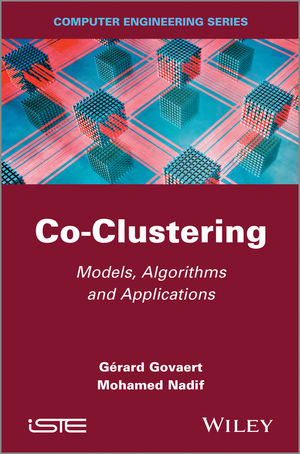
Co-Clustering (eBook)
G&eeacute;rard Govaert is Professor at University of Technology, Compiègne, France. Mohamed Nadif is Professor at University of Paris-Descartes, France.
Acknowledgment xi
Introduction xiii
I.1. Types and representation of data xiii
I.1.1. Binary data xiv
I.1.2. Categorical data xiv
I.1.3. Continuous data xv
I.1.4. Contingency table xvii
I.1.5. Data representations xix
I.2. Simultaneous analysis xx
I.2.1. Data analysis xx
I.2.2. Co-clustering xxii
I.2.3. Applications xxiii
I.3. Notation xxvii
I.4. Different approaches xxviii
I.4.1. Two-mode partitioning xxviii
I.4.2. Two-mode hierarchical clustering xxxvii
I.4.3. Direct or block clustering xxxix
I.4.4. Biclustering xxxix
I.4.5. Other structures and other aims xliv
I.5. Model-based co-clustering xlvi
I.6. Outline xlix
Chapter 1. Cluster Analysis 1
1.1. Introduction 1
1.2. Miscellaneous clustering methods 4
1.2.1. Hierarchical approach 4
1.2.2. The k-means algorithm 5
1.2.3. Other approaches 7
1.3. Model-based clustering and the mixture model 11
1.4. EM algorithm 15
1.4.1. Complete data and complete-data likelihood 16
1.4.2. Principle 17
1.4.3. Application to mixture models 18
1.4.4. Properties 19
1.4.5. EM: an alternating optimization algorithm 19
1.5. Clustering and the mixture model 20
1.5.1. The two approaches 20
1.5.2. Classification likelihood 21
1.5.3. The CEM algorithm 22
1.5.4. Comparison of the two approaches 22
1.5.5. Fuzzy clustering 24
1.6. Gaussian mixture model 26
1.6.1. The model 26
1.6.2. CEM algorithm 28
1.6.3. Spherical form, identical proportions and volumes 29
1.6.4. Spherical form, identical proportions but differing volumes 30
1.6.5. Identical covariance matrices and proportions 31
1.7. Binary data 32
1.7.1. Binary mixture model 32
1.7.2. Parsimonious model 33
1.7.3. Examples of application 35
1.8. Categorical variables 36
1.8.1. Multinomial mixture model 36
1.8.2. Parsimonious model 38
1.9. Contingency tables 41
1.9.1. MNDKI2 algorithm 41
1.9.2. Model-based approach 43
1.9.3. Illustration 47
1.10. Implementation 49
1.10.1. Choice of model and of the number of classes 51
1.10.2. Strategies for use 51
1.10.3. Extension to particular situations 52
1.11. Conclusion 53
Chapter 2. Model-Based Co-Clustering 55
2.1. Metric approach 55
2.2. Probabilistic models 57
2.3. Latent block model 59
2.3.1. Definition 59
2.3.2. Link with the mixture model 61
2.3.3. Log-likelihoods 62
2.3.4. A complex model 63
2.4. Maximum likelihood estimation and algorithms 67
2.4.1. Variational EM approach 69
2.4.2. Classification EM approach 72
2.4.3. Stochastic EM-Gibbs approach 73
2.5. Bayesian approach 75
2.6. Conclusion and miscellaneous developments 76
Chapter 3. Co-Clustering of Binary and Categorical Data 79
3.1. Example and notation 80
3.2. Metric approach 82
3.3. Bernoulli latent block model and algorithms 84
3.3.1. The model 84
3.3.2. Model identifiability 85
3.3.3. Binary LBVEM and LBCEM algorithms 86
3.4. Parsimonious Bernoulli LBMs 90
3.5. Categorical data 91
3.6. Bayesian inference 93
3.7. Model selection 96
3.7.1. The integrated completed log-likelihood (ICL) 96
3.7.2. Penalized information criteria 97
3.8. Illustrative experiments 98
3.8.1. Townships 98
3.8.2. Mero 101
3.9. Conclusion 105
Chapter 4. Co-Clustering of Contingency Tables 107
4.1. Measures of association 108
4.1.1. Phi-squared coefficient 109
4.1.2. Mutual information 111
4.2. Contingency table associated with a couple of partitions 113
4.2.1. Associated distributions 113
4.2.2. Associated measures of association 116
4.3. Co-clustering of contingency table 119
4.3.1. Two equivalent approaches 119
4.3.2. Parameter modification of criteria 121
4.3.3. Co-clustering with the phi-squared coefficient 124
4.3.4. Co-clustering with the mutual information 129
4.4. Model-based co-clustering 131
4.4.1. Block model for contingency tables 133
4.4.2. Poisson latent block model 137
4.4.3. Poisson LBVEM and LBCEM algorithms 138
4.5. Comparison of all algorithms 140
4.5.1. CROKI2 versus CROINFO 142
4.5.2. CROINFO versus Poisson LBCEM 142
4.5.3. Poisson LBVEM versus Poisson LBCEM 144
4.5.4. Behavior of CROKI2, CROINFO, LBCEM and LBVEM 147
4.6. Conclusion 149
Chapter 5. Co-Clustering of Continuous Data 151
5.1. Metric approach 152
5.1.1. Measure of information 153
5.1.2. Summarized data associated with partitions 153
5.1.3. Objective function 156
5.1.4. CROEUC algorithm 157
5.2. Gaussian latent block model 159
5.2.1. The model 159
5.2.2. Gaussian LBVEM and LBCEM algorithms 160
5.2.3. Parsimonious Gaussian latent block models 161
5.3. Illustrative example 163
5.4. Gaussian block mixture model 168
5.4.1. The model 169
5.4.2. GBEM algorithm 170
5.5. Numerical experiments 173
5.5.1. GBEM versus CROEUC and EM 174
5.5.2. Effect of the size of data 175
5.6. Conclusion 175
Bibliography 177
Index 199
| Erscheint lt. Verlag | 11.12.2013 |
|---|---|
| Sprache | englisch |
| Themenwelt | Informatik ► Datenbanken ► Data Warehouse / Data Mining |
| Mathematik / Informatik ► Informatik ► Programmiersprachen / -werkzeuge | |
| Informatik ► Theorie / Studium ► Algorithmen | |
| Mathematik / Informatik ► Mathematik | |
| Technik ► Elektrotechnik / Energietechnik | |
| Technik ► Nachrichtentechnik | |
| Schlagworte | Co-Clustering • Co-occurrence Data • Electrical & Electronics Engineering • Elektrotechnik u. Elektronik • latent block model • maximum likelihood and classification maximum likelihood • Mohamed Nadif • Numerical Methods & Algorithms • Numerische Methoden u. Algorithmen • Numerisches Verfahren • tri-factorization approach |
| ISBN-13 | 9781118649503 / 9781118649503 |
| Informationen gemäß Produktsicherheitsverordnung (GPSR) | |
| Haben Sie eine Frage zum Produkt? |
 PDF (Adobe DRM)
Größe: 2,7 MB
Kopierschutz: Adobe-DRM
Adobe-DRM ist ein Kopierschutz, der das eBook vor Mißbrauch schützen soll. Dabei wird das eBook bereits beim Download auf Ihre persönliche Adobe-ID autorisiert. Lesen können Sie das eBook dann nur auf den Geräten, welche ebenfalls auf Ihre Adobe-ID registriert sind.
Details zum Adobe-DRM
Dateiformat: PDF (Portable Document Format)
Mit einem festen Seitenlayout eignet sich die PDF besonders für Fachbücher mit Spalten, Tabellen und Abbildungen. Eine PDF kann auf fast allen Geräten angezeigt werden, ist aber für kleine Displays (Smartphone, eReader) nur eingeschränkt geeignet.
Systemvoraussetzungen:
PC/Mac: Mit einem PC oder Mac können Sie dieses eBook lesen. Sie benötigen eine
eReader: Dieses eBook kann mit (fast) allen eBook-Readern gelesen werden. Mit dem amazon-Kindle ist es aber nicht kompatibel.
Smartphone/Tablet: Egal ob Apple oder Android, dieses eBook können Sie lesen. Sie benötigen eine
Geräteliste und zusätzliche Hinweise
Buying eBooks from abroad
For tax law reasons we can sell eBooks just within Germany and Switzerland. Regrettably we cannot fulfill eBook-orders from other countries.
 EPUB (Adobe DRM)
Kopierschutz: Adobe-DRM
Adobe-DRM ist ein Kopierschutz, der das eBook vor Mißbrauch schützen soll. Dabei wird das eBook bereits beim Download auf Ihre persönliche Adobe-ID autorisiert. Lesen können Sie das eBook dann nur auf den Geräten, welche ebenfalls auf Ihre Adobe-ID registriert sind.
Details zum Adobe-DRM
Dateiformat: EPUB (Electronic Publication)
EPUB ist ein offener Standard für eBooks und eignet sich besonders zur Darstellung von Belletristik und Sachbüchern. Der Fließtext wird dynamisch an die Display- und Schriftgröße angepasst. Auch für mobile Lesegeräte ist EPUB daher gut geeignet.
Systemvoraussetzungen:
PC/Mac: Mit einem PC oder Mac können Sie dieses eBook lesen. Sie benötigen eine
eReader: Dieses eBook kann mit (fast) allen eBook-Readern gelesen werden. Mit dem amazon-Kindle ist es aber nicht kompatibel.
Smartphone/Tablet: Egal ob Apple oder Android, dieses eBook können Sie lesen. Sie benötigen eine
Geräteliste und zusätzliche Hinweise
Buying eBooks from abroad
For tax law reasons we can sell eBooks just within Germany and Switzerland. Regrettably we cannot fulfill eBook-orders from other countries.
aus dem Bereich