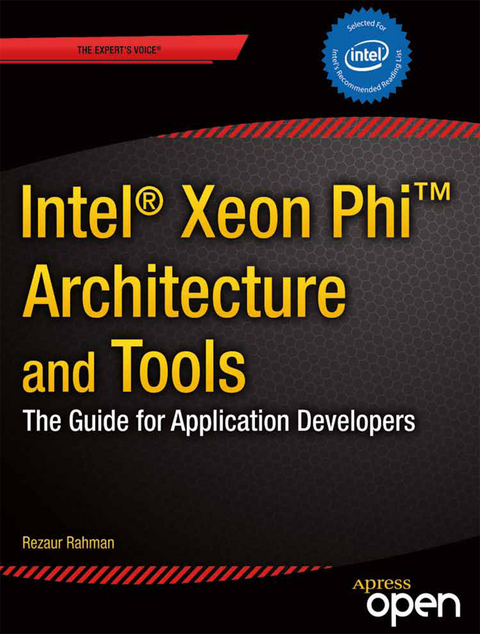
Intel Xeon Phi Coprocessor Architecture and Tools (eBook)
XXI, 232 Seiten
Apress (Verlag)
978-1-4302-5927-5 (ISBN)
Rezaur Rahmanis a Senior Staff Engineer in the Intel Software and Services Group. He played a key role in the inception and development of the Xeon Phi coprocessor for technical computing applications by demonstrating the viability of applying Intel s manycore graphics processor codenamed Larrabee to solving technical computing problems. He led the worldwide technical enabling team for Intel Xeon Phi products, focused on porting and optimizing applications on the Xeon Phi coprocessor for hundreds of technical computing customers. He has worked internally with hardware architects and Intel compiler and tools teams to optimize and add features to improve the performance of Intel Many Integrated Core (MIC) and Xeon Phi software and hardware components. With 25 years experience in computer architecture and software design, Rahman contributes his expertise in technical code optimization, performance tuning, and hardware microarchitectural analysis in the HPC domain to various industry standardization groups such as the World Wide Web Consortium (W3C). Rahman holds a master s degree in computer science from Texas A&M University and a bachelor s in electrical engineering from Bangladesh University of Engineering and Technology.
1. Introduction to Xeon Phi Architecture
2. Programming Xeon Phi
3. Xeon Phi Vector Architecture and Instruction Set
4. Xeon Phi Core Microarchitecture
5. Xeon Phi Cache and Memory Subsystem
6. Xeon Phi PCIe Bus Data Transfer and Power Management
7. Xeon Phi System Software
8. Xeon Phi Application Development Tools
9. Xeon Phi Application Design and Implementation Considerations
10. Application Performance Tuning on Xeon Phi
11. Algorithms and Data Structures for Xeon Phi
12. Xeon Phi Application Development on Windows OS
13. OpenCL on Intel
14. Shared Memory Programming on Intel Xeon Phi
| Erscheint lt. Verlag | 26.9.2013 |
|---|---|
| Verlagsort | Berkeley |
| Sprache | englisch |
| Themenwelt | Mathematik / Informatik ► Informatik ► Software Entwicklung |
| Informatik ► Weitere Themen ► Hardware | |
| ISBN-10 | 1-4302-5927-2 / 1430259272 |
| ISBN-13 | 978-1-4302-5927-5 / 9781430259275 |
| Informationen gemäß Produktsicherheitsverordnung (GPSR) | |
| Haben Sie eine Frage zum Produkt? |
 EPUB (Adobe DRM)
Kopierschutz: Adobe-DRM
Adobe-DRM ist ein Kopierschutz, der das eBook vor Mißbrauch schützen soll. Dabei wird das eBook bereits beim Download auf Ihre persönliche Adobe-ID autorisiert. Lesen können Sie das eBook dann nur auf den Geräten, welche ebenfalls auf Ihre Adobe-ID registriert sind.
Details zum Adobe-DRM
Dateiformat: EPUB (Electronic Publication)
EPUB ist ein offener Standard für eBooks und eignet sich besonders zur Darstellung von Belletristik und Sachbüchern. Der Fließtext wird dynamisch an die Display- und Schriftgröße angepasst. Auch für mobile Lesegeräte ist EPUB daher gut geeignet.
Systemvoraussetzungen:
PC/Mac: Mit einem PC oder Mac können Sie dieses eBook lesen. Sie benötigen eine
eReader: Dieses eBook kann mit (fast) allen eBook-Readern gelesen werden. Mit dem amazon-Kindle ist es aber nicht kompatibel.
Smartphone/Tablet: Egal ob Apple oder Android, dieses eBook können Sie lesen. Sie benötigen eine
Geräteliste und zusätzliche Hinweise
Buying eBooks from abroad
For tax law reasons we can sell eBooks just within Germany and Switzerland. Regrettably we cannot fulfill eBook-orders from other countries.
aus dem Bereich