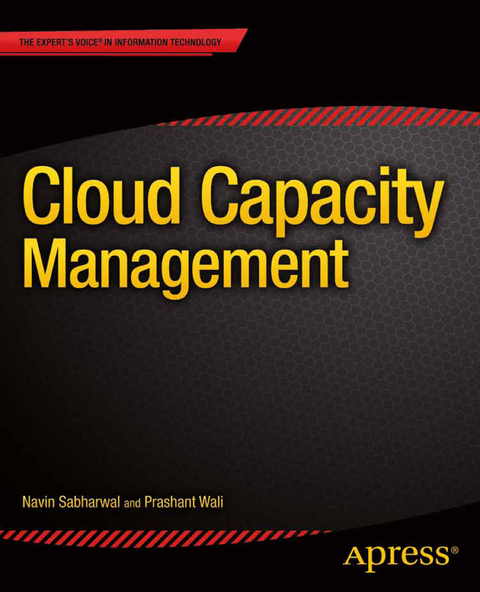
Cloud Capacity Management (eBook)
XVIII, 184 Seiten
Apress (Verlag)
9781430249245 (ISBN)
This involves a high level of abstraction and virtualization to facilitate rapid and on demand provisioning of services. The conventional IT service models take a traditional approach when planning for service capacity to provide optimum services levels which has huge cost implications for service providers.
This book addresses the gap areas between traditional capacity management practices and cloud service models. It also showcases capacity management process design and implementation in a cloud computing domain using ITSM best practices. This book is a blend of ITSM best practices and infrastructure capacity planning and optimization implementation in various cloud scenarios.
Cloud Capacity Management addresses the basics of cloud computing, its various models, and their impact on capacity planning. This book also highlights the infrastructure capacity management implementation process in a cloud environment showcasing inherent capabilities of tool sets available and the various techniques for capacity planning and performance management. Techniques like dynamic resource scheduling, scaling, load balancing, and clustering etc are explained for implementing capacity management.
NavinSabharwal is an innovator, thought leader, author, andconsultant in the areas of reporting and Analytics, RDBMS technologiesincluding SQL Server, Oracle, MySQL, big data technologies, Hadoop, MongoDB,and SAP HANA. Navin has been using big data technologies in creating productsand services in the areas of IT service management, product development, cloudcomputing, cloud lifecycle management, and social network product development.He has created niche award-winning products and solutions and has filednumerous patents in diverse fields such as IT services, assessment engines,ranking algorithms, capacity planning engines, and knowledge management. Navinholds a Master’s in Information Technology and is a Certified ProjectManagement Professional.
Cloud Capacity Management helps readers in understanding what the cloud, IaaS, PaaS, SaaS are, how they relate to capacity planning and management and which stakeholders are involved in delivering value in the cloud value chain. It explains the role of capacity management for a creator, aggregator, and consumer of cloud services and how to provision for it in a 'pay as you use model'. This involves a high level of abstraction and virtualization to facilitate rapid and on demand provisioning of services. The conventional IT service models take a traditional approach when planning for service capacity to provide optimum services levels which has huge cost implications for service providers. This book addresses the gap areas between traditional capacity management practices and cloud service models. It also showcases capacity management process design and implementation in a cloud computing domain using ITSM best practices. This book is a blend of ITSM best practices and infrastructure capacity planning and optimization implementation in various cloud scenarios. Cloud Capacity Management addresses the basics of cloud computing, its various models, and their impact on capacity planning. This book also highlights the infrastructure capacity management implementation process in a cloud environment showcasing inherent capabilities oftool sets available and the various techniques for capacity planning and performance management. Techniques like dynamic resource scheduling, scaling, load balancing, and clustering etc are explained for implementing capacity management.
NavinSabharwal is an innovator, thought leader, author, andconsultant in the areas of reporting and Analytics, RDBMS technologiesincluding SQL Server, Oracle, MySQL, big data technologies, Hadoop, MongoDB,and SAP HANA. Navin has been using big data technologies in creating productsand services in the areas of IT service management, product development, cloudcomputing, cloud lifecycle management, and social network product development.He has created niche award-winning products and solutions and has filednumerous patents in diverse fields such as IT services, assessment engines,ranking algorithms, capacity planning engines, and knowledge management. Navinholds a Master’s in Information Technology and is a Certified ProjectManagement Professional.
1. Understanding Cloud Computing
2. Cloud Stakeholders and Value Chain
3. Technology that Drives the Cloud
4. Introduction to Capacity Management
5. Cloud Capacity Management
6. Capacity Planning
7. Determining Capacity Requirements for New Services
8. Capacity Management Design
9. Capacity Plan
10. Ongoing Capacity Management for Existing or Live Services
11. Capacity Monitoring
12. Capacity Analysis, Tuning, and Review
13. Capacity Management Database and Integrations
14. Capacity Management Concepts
15. Appendix A: Capacity Plan Template
16. Appendix B: Capacity Implementation Case Study
| Erscheint lt. Verlag | 26.8.2013 |
|---|---|
| Zusatzinfo | XVIII, 184 p. 90 illus. |
| Verlagsort | Berkeley |
| Sprache | englisch |
| Themenwelt | Mathematik / Informatik ► Informatik ► Netzwerke |
| Mathematik / Informatik ► Informatik ► Software Entwicklung | |
| Informatik ► Weitere Themen ► Hardware | |
| ISBN-13 | 9781430249245 / 9781430249245 |
| Informationen gemäß Produktsicherheitsverordnung (GPSR) | |
| Haben Sie eine Frage zum Produkt? |
 PDF (Wasserzeichen)
DRM: Digitales Wasserzeichen
Dieses eBook enthält ein digitales Wasserzeichen und ist damit für Sie personalisiert. Bei einer missbräuchlichen Weitergabe des eBooks an Dritte ist eine Rückverfolgung an die Quelle möglich.
Dateiformat: PDF (Portable Document Format)
Mit einem festen Seitenlayout eignet sich die PDF besonders für Fachbücher mit Spalten, Tabellen und Abbildungen. Eine PDF kann auf fast allen Geräten angezeigt werden, ist aber für kleine Displays (Smartphone, eReader) nur eingeschränkt geeignet.
Systemvoraussetzungen:
PC/Mac: Mit einem PC oder Mac können Sie dieses eBook lesen. Sie benötigen dafür einen PDF-Viewer - z.B. den Adobe Reader oder Adobe Digital Editions.
eReader: Dieses eBook kann mit (fast) allen eBook-Readern gelesen werden. Mit dem amazon-Kindle ist es aber nicht kompatibel.
Smartphone/Tablet: Egal ob Apple oder Android, dieses eBook können Sie lesen. Sie benötigen dafür einen PDF-Viewer - z.B. die kostenlose Adobe Digital Editions-App.
Buying eBooks from abroad
For tax law reasons we can sell eBooks just within Germany and Switzerland. Regrettably we cannot fulfill eBook-orders from other countries.
aus dem Bereich