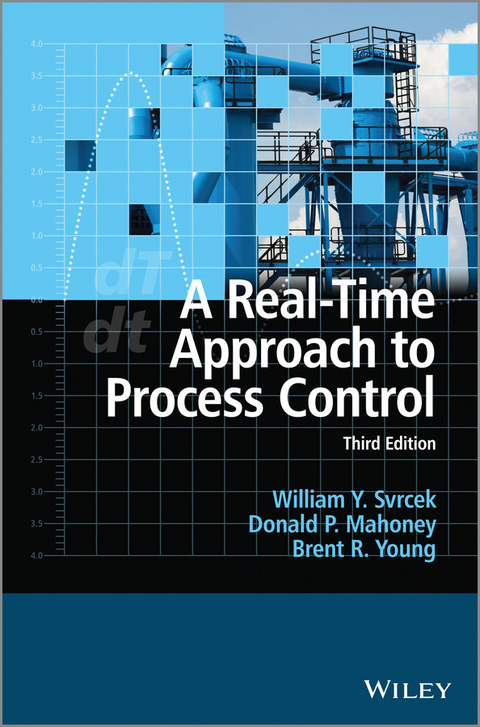
A Real-Time Approach to Process Control (eBook)
John Wiley & Sons (Verlag)
978-1-118-68473-3 (ISBN)
With resources at a premium, and ecological concerns paramount, the need for clean, efficient and low-cost processes is one of the most critical challenges facing chemical engineers. The ability to control these processes, optimizing one, two or several variables has the potential to make more substantial savings in time, money and resources than any other single factor.
Building on the success of the previous editions, this new third edition of A Real-Time Approach to Process Control employs both real industry practice and process control education without the use of complex or highly mathematical techniques, providing a more practical and applied approach.
Updated throughout, this edition:
• Includes a brand new chapter on Model predictive Control (MPC)
• Now includes wireless and web-based technologies
• Covers bio-related systems
• Details the new multivariable control measure developed by the authors
• Includes PowerPoint slides and solutions to Workshop problems on the accompanying website: http://www.wiley.com/go/svrcek-real-time-3e
From the reviews of previous editions:
“Would appeal to practising engineers due to its “hands on” feel for the subject matter. But more importantly, the authors present these concepts as fundamentals of chemical engineering, in a way that is consistent with how professor teach at the universities.” –Chemical Engineering Process (CEP)
“The book has been beautifully crafted” –Engineering Subject Centre
“Provides a refreshing approach to the presentation of process analysis and control” –The Chemical Engineer
With resources at a premium, and ecological concerns paramount, the need for clean, efficient and low-cost processes is one of the most critical challenges facing chemical engineers. The ability to control these processes, optimizing one, two or several variables has the potential to make more substantial savings in time, money and resources than any other single factor. Building on the success of the previous editions, this new third edition of A Real-Time Approach to Process Control employs both real industry practice and process control education without the use of complex or highly mathematical techniques, providing a more practical and applied approach. Updated throughout, this edition: Includes a brand new chapter on Model predictive Control (MPC) Now includes wireless and web-based technologies Covers bio-related systems Details the new multivariable control measure developed by the authors Includes PowerPoint slides and solutions to Workshop problems on the accompanying website: http://www.wiley.com/go/svrcek-real-time-3e From the reviews of previous editions: Would appeal to practising engineers due to its hands on feel for the subject matter. But more importantly, the authors present these concepts as fundamentals of chemical engineering, in a way that is consistent with how professor teach at the universities. Chemical Engineering Process (CEP) The book has been beautifully crafted Engineering Subject Centre Provides a refreshing approach to the presentation of process analysis and control The Chemical Engineer
William Y. Svrcek, Department of Chemical and Petroleum Engineering, University of Calgary, Canada Donald P. Mahoney, Chemical Industry Business Solutions, SAP AG, USA Brent R. Young, Department of Chemical and Materials Engineering, University of Auckland, New Zealand
1
A Brief History of Process Control and Process Simulation
In order to gain an appreciation for process control and process simulation it is important to have some understanding of the history and motivation behind the development of both process control and process simulation. Rudimentary control systems have been used for centuries to help humans use tools and machinery more efficiently, effectively and safely. However, only in the last century has significant time and effort been devoted to developing a greater understanding of controls and sophisticated control systems, a requirement of the increased complexity of the processes to be controlled. The expansion of the controls field has driven the growth of steady-state and dynamic process simulation from relative obscurity to the indispensable and commonplace tool that it is today, in particular in the development of operator training systems and the validation of complex control strategies.
1.1 Process Control
Feedback control can be traced back as far as the early third century BC [1,2]. During this period, Ktesibios of Alexandria employed a float valve similar to the one found in today's automobile carburettors to regulate the level in the water clocks of that time [3]. Three centuries later, Heron of Alexandria described another float valve water level regulator similar to that used in toilet water tanks [1]. Arabic water clock builders used this same control device as late as 1206. The Romans also made use of this first control device in regulating the water levels in their aqueducts. The level-regulating device or float valve remained unknown to Europeans and was reinvented in the eighteenth century to regulate the water levels in steam boilers and home water tanks.
The Europeans did, however, invent a number of feedback control devices, namely the thermostat or bimetallic temperature regulator, the safety relief valve, and the windmill fantail. In 1620, Cornelis Drebbel [3], a Dutch engineer, used a bimetallic temperature regulator to control the temperature of a furnace. Denis Papin [3], in 1681, used weights on a pressure cooker to regulate the pressure in the vessel. In 1745, Edmund Lee [1] attached a fantail at right angles to the main sail of a windmill, thus always keeping the main windmill drive facing into the wind. It was not until the Industrial Revolution, particularly in England, that feedback devices became more numerous and varied.
One-port automata (open loop) evolved as part of the Industrial Revolution and focused on a flow of commands that mechanized the functions of a human operator. In 1801, Joseph Farcot [4] fed punched cards past a row of needles to program patterns on a loom, and in 1796, David Wilkinson [5] developed a copying lathe with a cutting tool positioned by a follower on a model. Oliver Evans [3] built a water-powered flourmill near Philadelphia, in 1784, using bucket and screw conveyors to eliminate manual intervention. Similarly, biscuit making was automated for the Royal Navy in 1833, and meat processing was mechanized in America during the late 1860s. Henry Ford used the same concept for his 1910 automobile assembly plant automation. Unit operations, pioneered by Allen Rogers of the Pratt Institute [5] and Arthur D. Little of MIT [5], led to continuous chemical processing and extensive automation during the 1920s.
The concept of feedback evolved along with the development of steam power and steam-powered ships. The valve operator of Humphrey Potter [6] utilized piston displacement on a Newcomen engine to perform a deterministic control function. However, the fly ball governor designed by James Watt [7] in 1769 modulated steam flow to overcome unpredictable disturbances and became the archetype for single-loop regulatory controllers. Feedback was accompanied by a perplexing tendency to overshoot the desired operating level, particularly as controller sensitivity increased. The steam-powered steering systems of the ships of the mid-1800s used a human operator to supply feedback, but high rudder positioning gain caused the ship to zigzag along its course. In 1867, Macfarlane Gray [1] corrected the problem with a linkage that closed the steering valve as the rudder approached the desired set point. In 1872, Leon Farcot [1] designed a hydraulic system such that a displacement representing rudder position was subtracted from the steering position displacement, and the difference was used to operate the valve. The helmsman could then indicate a rudder position, which would be achieved and maintained by the servo motor.
Subsequent refinements of the servo principle were largely empirical until Minorsky [8], in 1922, published an analytical study of ship steering which considered the use of proportional, derivative and second derivative controllers for steering ships and demonstrated how stability could be determined from the differential equations. In 1934 Hazen [9] introduced the term ‘servomechanism’ for position control devices and discussed the design of control systems capable of close tracking of a changing set point. Nyquist [10] developed a general and relatively simple procedure for determining the stability of feedback systems from the open loop response, based on a study of feedback amplifiers.
Experience with and the theories of mechanical and electrical systems were, therefore, available when World War II created a massive impetus for weapon controls. While the eventual social benefit of this and subsequent military efforts is not without merit, the nature of the incentives emphasizes the irony seen by Elting Morison [11]. Just as we attain a means of ‘control over our resistant natural environment we find we have produced in the means themselves an artificial environment of such complexity that we cannot control it’.
Although the basic principles of feedback control can be applied to chemical processing plants as well as to amplifiers or mechanical systems, chemical engineers were slow to adapt the wealth of control literature from other disciplines for the design of process control schemes. The unfamiliar terminology was one major reason for the delay, but there was also the basic difference between chemical processes and servomechanisms, which delayed the development of process control theory and its implementation. Chemical plants normally operate with a constant set point, and large-capacity elements help to minimize the effect of disturbances, whereas these would tend to slow the response of servomechanisms. Time delay or transport lag is frequently a major factor in process control, yet it is rarely mentioned in the literature on servomechanisms. In process control systems, interacting first-order elements and distributed resistances are much more common than second-order elements found in the control of mechanical and electrical systems. These differences made many of the published examples of servomechanism design of little use to those interested in process control.
A few theoretical papers on process control did appear during the 1930s. Notable among these was the paper by Grebe, Boundy and Cermak [12] that discussed the problem of pH control and showed the advantages of using derivative action to improve controller response. Callender, Hartree, and Porter [13] showed the effect of time delay on the stability and speed of response of a control system. However, it was not until the mid-1950s that the first texts on process control were published by Young, in 1954 [14], and Ceaglske, in 1956 [15]. These early classical process control texts used techniques that were suitable prior to the availability of computers, namely frequency response, Laplace transforms, transfer function representation and linearization. Between the late 1950s and the 1970s many texts appeared, generally following the pre-computing classical approach, notably those by Eckman [16], Campbell [17], Coughanowr and Koppel [18], Luyben [19], Harriott [20], Murrill [21] and Shinskey [22]. Process control became an integral part of every chemical engineering curriculum.
Present-day process control texts that include Marlin [23], Seborg et al. [24], Smith [25], Smith and Corripio [26], Riggs [27] and Luyben and Luyben [28] have to some extent used a real-time approach via modelling of the process and its control structure using MATLAB Simulink [29] and Maple [30] to provide a solution to the set of differential equations, thus viewing the real-time transient behaviour of the process and its control system.
A book by King [31] titled Process Control: A Practical Approach is aimed at the practising controls engineer. It, like this text, focuses on the practical aspects of process control. This book is an excellent addition to the practising controls engineer's library.
The availability of minicomputers in the late 1950s and early 1960s provided the impetus for the use of these computers for centralized process control (DC). For instance the IBM 1800 of that time was equipped with a hardware interface that could convert measured temperatures, flows and so on (analog signals) to the required digital signals (PID). A number of early installations were only digital computer-based data loggers (Figure 1.1). The first computer-based central control system [2] was installed in 1959 at the Texaco Port Arthur, Texas refinery, and was based on an RW-300 from Ramo-Woolridge (Figure 1.2). During the following decade a number of centralized digital control systems were installed in chemical plants and refineries [32]. These installations for the most part were supervisory (Figure 1.3) because these...
| Erscheint lt. Verlag | 6.12.2013 |
|---|---|
| Sprache | englisch |
| Themenwelt | Mathematik / Informatik ► Informatik ► Grafik / Design |
| Informatik ► Weitere Themen ► CAD-Programme | |
| Naturwissenschaften ► Chemie ► Technische Chemie | |
| Technik ► Umwelttechnik / Biotechnologie | |
| Schlagworte | applied fundamentals of process control • Brent Young • chemical engineering • Chemische Verfahrenstechnik • Control Process & Measurements • Control Systems Technology • Donald Mahoney • dynamic simulation • Electrical & Electronics Engineering • Elektrotechnik u. Elektronik • Maschinenbau • mechanical engineering • Mess- u. Regeltechnik • Process Control • process development • Process dynamics • Real-Time Approach to Process Control • real-time control • real-time control strategies • real-time control strategy development • Real-time process control • Regelungstechnik • Verfahrensentwicklung • William Svrcek |
| ISBN-10 | 1-118-68473-7 / 1118684737 |
| ISBN-13 | 978-1-118-68473-3 / 9781118684733 |
| Informationen gemäß Produktsicherheitsverordnung (GPSR) | |
| Haben Sie eine Frage zum Produkt? |
 EPUB (Adobe DRM)
Größe: 11,8 MB
Kopierschutz: Adobe-DRM
Adobe-DRM ist ein Kopierschutz, der das eBook vor Mißbrauch schützen soll. Dabei wird das eBook bereits beim Download auf Ihre persönliche Adobe-ID autorisiert. Lesen können Sie das eBook dann nur auf den Geräten, welche ebenfalls auf Ihre Adobe-ID registriert sind.
Details zum Adobe-DRM
Dateiformat: EPUB (Electronic Publication)
EPUB ist ein offener Standard für eBooks und eignet sich besonders zur Darstellung von Belletristik und Sachbüchern. Der Fließtext wird dynamisch an die Display- und Schriftgröße angepasst. Auch für mobile Lesegeräte ist EPUB daher gut geeignet.
Systemvoraussetzungen:
PC/Mac: Mit einem PC oder Mac können Sie dieses eBook lesen. Sie benötigen eine
eReader: Dieses eBook kann mit (fast) allen eBook-Readern gelesen werden. Mit dem amazon-Kindle ist es aber nicht kompatibel.
Smartphone/Tablet: Egal ob Apple oder Android, dieses eBook können Sie lesen. Sie benötigen eine
Geräteliste und zusätzliche Hinweise
Buying eBooks from abroad
For tax law reasons we can sell eBooks just within Germany and Switzerland. Regrettably we cannot fulfill eBook-orders from other countries.
 PDF (Adobe DRM)
Kopierschutz: Adobe-DRM
Adobe-DRM ist ein Kopierschutz, der das eBook vor Mißbrauch schützen soll. Dabei wird das eBook bereits beim Download auf Ihre persönliche Adobe-ID autorisiert. Lesen können Sie das eBook dann nur auf den Geräten, welche ebenfalls auf Ihre Adobe-ID registriert sind.
Details zum Adobe-DRM
Dateiformat: PDF (Portable Document Format)
Mit einem festen Seitenlayout eignet sich die PDF besonders für Fachbücher mit Spalten, Tabellen und Abbildungen. Eine PDF kann auf fast allen Geräten angezeigt werden, ist aber für kleine Displays (Smartphone, eReader) nur eingeschränkt geeignet.
Systemvoraussetzungen:
PC/Mac: Mit einem PC oder Mac können Sie dieses eBook lesen. Sie benötigen eine
eReader: Dieses eBook kann mit (fast) allen eBook-Readern gelesen werden. Mit dem amazon-Kindle ist es aber nicht kompatibel.
Smartphone/Tablet: Egal ob Apple oder Android, dieses eBook können Sie lesen. Sie benötigen eine
Geräteliste und zusätzliche Hinweise
Buying eBooks from abroad
For tax law reasons we can sell eBooks just within Germany and Switzerland. Regrettably we cannot fulfill eBook-orders from other countries.
aus dem Bereich