


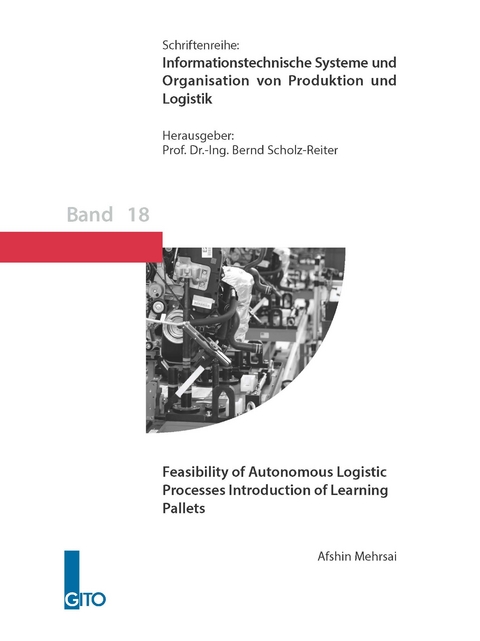
Feasibility of Autonomous Logistic Processes Introduction of Learning Pallets
Seiten
2013
|
1., Erstauflage
Gito (Verlag)
9783955450564 (ISBN)
Gito (Verlag)
9783955450564 (ISBN)
The current dynamic circumstances in supply networks and
production environments cause several challenges for indus-
tries. To manage these dynamics, a new paradigm of autonomy
for processes and objects is underlined by scholars. This paradigm is perceived from two aspects: autonomous logistic processes and autonomous logistic objects. Therefore, this research is divided into conceptual and empirical parts. The part of autonomous logistic processes deals with planning and scheduling tasks, while under the autonomous processes the autonomous objects are supposed to deal with real-time control of material flow. The discrete event simulation ap-proach is employed to explore several methodologies which can bring the notion of intelligent decisions to auto-nomous objects in logistics. Evolutionary algorithms like genetic algorithm as well as fuzzy logic and artificial neural networks are experimented here. Besides, queuing theory is exploited to analyze assembly networks in production logistics.
production environments cause several challenges for indus-
tries. To manage these dynamics, a new paradigm of autonomy
for processes and objects is underlined by scholars. This paradigm is perceived from two aspects: autonomous logistic processes and autonomous logistic objects. Therefore, this research is divided into conceptual and empirical parts. The part of autonomous logistic processes deals with planning and scheduling tasks, while under the autonomous processes the autonomous objects are supposed to deal with real-time control of material flow. The discrete event simulation ap-proach is employed to explore several methodologies which can bring the notion of intelligent decisions to auto-nomous objects in logistics. Evolutionary algorithms like genetic algorithm as well as fuzzy logic and artificial neural networks are experimented here. Besides, queuing theory is exploited to analyze assembly networks in production logistics.
| Erscheint lt. Verlag | 5.12.2013 |
|---|---|
| Reihe/Serie | Informationstechnische Systeme und Organisation von Produktion und Logistik ; 18 |
| Verlagsort | Berlin |
| Sprache | englisch |
| Maße | 147 x 207 mm |
| Gewicht | 468 g |
| Einbandart | Paperback |
| Themenwelt | Mathematik / Informatik ► Informatik |
| Wirtschaft | |
| Schlagworte | ERP • Fertigungsmanagement • IT • Logistik • Supply Chain Management • Unternehmensführung und Organisation |
| ISBN-13 | 9783955450564 / 9783955450564 |
| Zustand | Neuware |
| Informationen gemäß Produktsicherheitsverordnung (GPSR) | |
| Haben Sie eine Frage zum Produkt? |
Mehr entdecken
aus dem Bereich



aus dem Bereich
Buch | Softcover (2024)
BILDNER Verlag
CHF 55,85
Schritt für Schritt einfach erklärt
Buch | Hardcover (2024)
Markt + Technik (Verlag)
CHF 20,90
das Praxishandbuch
Buch | Hardcover (2024)
Markt + Technik Verlag
CHF 27,90


