


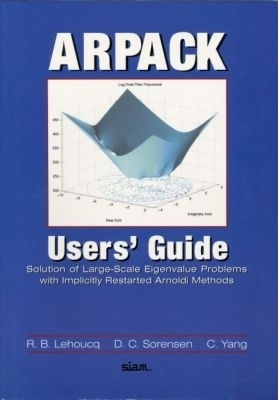
ARPACK Users' Guide
Society for Industrial & Applied Mathematics,U.S. (Verlag)
9780898714074 (ISBN)
- Titel z.Zt. nicht lieferbar
- Versandkostenfrei
- Auch auf Rechnung
- Artikel merken
Other important topics covered include:
Treatment of the non-Hermitian problem.
Explanation of the theory behind Krylov subspace projection methods, implicit restarting, and spectral transformation.
Explanation of the implicitly restarted Arnoldi method (IRAM).
Descriptions of the various templates (driver routines) to interface an application with ARPACK to solve a wide variety of problems.
ARPACK is a collection of Fortran 77 subroutines designed to solve large-scale eigenvalue problems. It provides state-of-the-art software for solving large (sparse) Hermitian, non-Hermitian, standard, or generalized eigenvalue problems from significant application areas. It is one of the few software packages to successfully address the non-Hermitian problem. Practitioners will be able to better understand the full capabilities of ARPACK (ARnoldi PACKage) and grasp the underlying theory more thoroughly with this book.
List of Figures
List of Tables
Preface
Chapter 1: Introduction to ARPACK. Important Features
Getting Started
Reverse Communication Interface
Availability
Installation
Documentation
Dependence on LAPACK and BLAS
Expected Performance
P_ARPACK
Contributed Additions
Trouble Shooting and Problems
Chapter 2: Getting Started with ARPACK. Directory Structure and Contents
Getting Started
An Example for a Symmetric Eigenvalue Problem
Chapter 3: General Use of ARPACK. Naming Conventions, Precisions, and Types
Shift and Invert Spectral Transformation Mode
Reverse Communication Structure for Shift-Invert
Using the Computational Modes
Computational Modes for Real Symmetric Problems
Postprocessing for Eigenvectors Using dseupd
Computational Modes for Real Nonsymmetric Problems
Postprocessing for Eigenvectors Using dneupd
Computational Modes for Complex Problems
Postprocessing for Eigenvectors Using zneupd
Chapter 4: The Implicitly Restarted Arnoldi Method. Structure of the Eigenvalue Problem
Krylov Subspaces and Projection Methods
The Arnoldi Factorization
Restarting the Arnoldi Method
The Generalized Eigenvalue Problem
Stopping Criterion
Chapter 5: Computational Routines. ARPACK subroutines
LAPACK routines used by ARPACK
BLAS routines used by ARPACK
Appendix A: Templates and Driver Routines. Symmetric Drivers
Real Nonsymmetric Drivers
Complex Drivers
Band Drivers
The Singular Value Decomposition
Appendix B: Tracking the Progress of ARPACK. Obtaining Trace Output
Check-Pointing ARPACK
Appendix C: The XYaupd ARPACK Routines
DSAUPD
DNAUPD
ZNAUPD
Bibliography
Index.
| Erscheint lt. Verlag | 30.4.1998 |
|---|---|
| Reihe/Serie | Software Environments and Tools |
| Verlagsort | New York |
| Sprache | englisch |
| Maße | 151 x 228 mm |
| Gewicht | 360 g |
| Themenwelt | Informatik ► Office Programme ► Outlook |
| Mathematik / Informatik ► Informatik ► Theorie / Studium | |
| Mathematik / Informatik ► Mathematik ► Algebra | |
| ISBN-13 | 9780898714074 / 9780898714074 |
| Zustand | Neuware |
| Informationen gemäß Produktsicherheitsverordnung (GPSR) | |
| Haben Sie eine Frage zum Produkt? |
aus dem Bereich


