


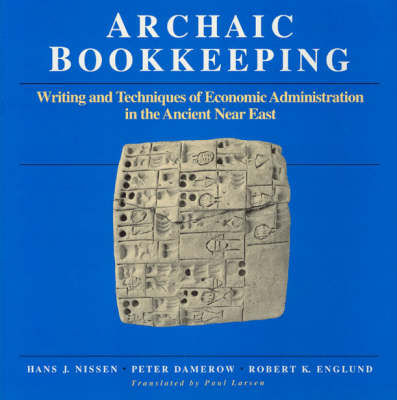
Archaic Bookkeeping
Early Writing and Techniques of Economic Administration in the Ancient Near East
Seiten
1994
|
2nd ed.
University of Chicago Press (Verlag)
978-0-226-58659-5 (ISBN)
University of Chicago Press (Verlag)
978-0-226-58659-5 (ISBN)
- Titel ist leider vergriffen;
keine Neuauflage - Artikel merken
Brings together current scholarship on the earliest true writing system, the proto-cuneiform script, invented by the Babylonians at the end of the fourth millennium BC. The authors consider how the development of written records affected patterns of thought and the concept of number.
This work brings together current scholarship on the earliest true writing system in human history. Invented by the Babylonians at the end of the fourth millennium BC, this script, called proto-cuneiform, survives in the form of clay tablets that have until now posed formidable barriers to interpretation. Many tablets, excavated in fragments from ancient dump sites, lack a clear context. In addition, the purpose of the earliest tablets was not to record language but to monitor the administration of local economies by means of a numerical system. Using the latest philological research and new methods of computer analysis, the authors have deciphered much of the numerical information. In reconstructing both the social context and the function of the notation, they consider how the development of our earliest written records affected patterns of thought, the concept of number and the administration of household economies. "Archaic Bookkeeping" should interest specialists in Near Eastern civilizations, ancient history, the history of silence and mathematics, and cognitive psychology.
This work brings together current scholarship on the earliest true writing system in human history. Invented by the Babylonians at the end of the fourth millennium BC, this script, called proto-cuneiform, survives in the form of clay tablets that have until now posed formidable barriers to interpretation. Many tablets, excavated in fragments from ancient dump sites, lack a clear context. In addition, the purpose of the earliest tablets was not to record language but to monitor the administration of local economies by means of a numerical system. Using the latest philological research and new methods of computer analysis, the authors have deciphered much of the numerical information. In reconstructing both the social context and the function of the notation, they consider how the development of our earliest written records affected patterns of thought, the concept of number and the administration of household economies. "Archaic Bookkeeping" should interest specialists in Near Eastern civilizations, ancient history, the history of silence and mathematics, and cognitive psychology.
| Erscheint lt. Verlag | 10.2.1994 |
|---|---|
| Übersetzer | Paul Larsen |
| Zusatzinfo | Illustrations |
| Sprache | englisch |
| Themenwelt | Geschichte ► Hilfswissenschaften ► Paläografie |
| Geisteswissenschaften ► Sprach- / Literaturwissenschaft ► Sprachwissenschaft | |
| Mathematik / Informatik ► Mathematik | |
| ISBN-10 | 0-226-58659-6 / 0226586596 |
| ISBN-13 | 978-0-226-58659-5 / 9780226586595 |
| Zustand | Neuware |
| Informationen gemäß Produktsicherheitsverordnung (GPSR) | |
| Haben Sie eine Frage zum Produkt? |
Mehr entdecken
aus dem Bereich


aus dem Bereich
Schnelle Hilfe bei häufigen Fehlern
Buch | Softcover (2021)
UTB (Verlag)
CHF 25,20
Philology, Fiction, and Folklore
Buch | Hardcover (2024)
Oxford University Press (Verlag)
CHF 78,55


