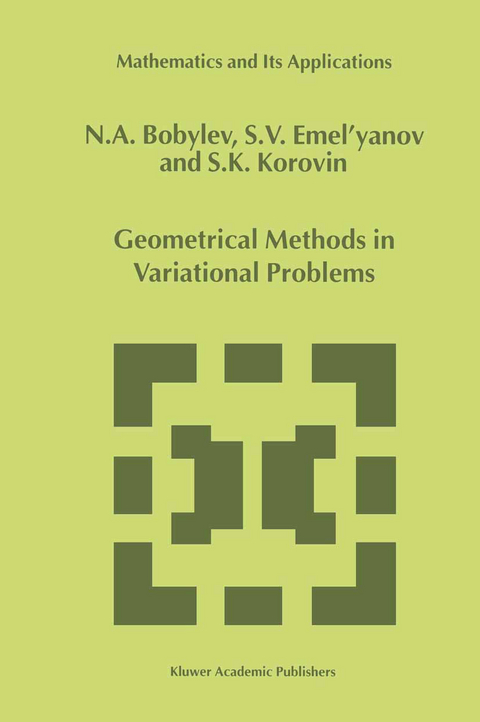
Geometrical Methods in Variational Problems
Springer (Verlag)
978-94-010-5955-8 (ISBN)
Bernoulli, J. Bernoulli, Legendre, Jacobi, Kepler, La- grange, and Weierstrass.
1 Preliminaries.- 1.1 Metric and Normed Spaces.- 1.2 Compactness.- 1.3 Linear Functional and Dual Spaces.- 1.4 Linear Operators.- 1.5 Nonlinear Operators and Functionals.- 1.6 Contraction Mapping Principle, Implicit Function Theorem, and Differential Equations on a Banach Space.- 2 Minimization of Nonlinear Functionals.- 2.1 Extrema of Smooth Functionals.- 2.2 Extremum of Lipschitzian and Convex Functionals.- 2.3 Weierstass Theorems.- 2.4 Monotonicity.- 2.5 Variational Principles.- 2.6 Additional Remarks.- 3 Homotopic Methods in Variational Problems.- 3.1 Deformations of Functionals on Hilbert Spaces.- 3.2 Deformations of Functionals on Banach Spaces.- 3.3 Global Deformations of Functionals.- 3.4 Deformation of Problems of the Calculus of Variations.- 3.5 Deformations of Lipschitzian Functions.- 3.6 Global Deformations of Lipschitzian Functions.- 3.7 Deformations of Mathematical Programming Problems.- 3.8 Deformations of Lipschitzian Functionals.- 3.9 Additional Remarks.- 4 Topological Characteristics of Extremals of Variational Problems.- 4.1 Smooth Manifolds and Differential Forms.- 4.2 Degree of Mapping.- 4.3 Rotation of Vector Fields in Finite-Dimensional Spaces.- 4.4 Vector Fields in Infinite-Dimensional Spaces.- 4.5 Computation of the Topological Index.- 4.6 Topological Index of Zero of an Isolated Minimum.- 4.7 Euler Characteristic and the Topological Index of an Isolated Critical Set.- 4.8 Topological Index of Extremals of Problems of the Calculus of Variations.- 4.9 Topological Index of Optimal Controls.- 4.10 Topological Characteristic s of Critical Points of Nonsmooth Functionals.- 4.11 Additional Remarks.- 5 Applications.- 5.1 Existence Theorems.- 5.2 Bounds of the Number of Solutions to Variational Problems.- 5.3 Applications of the Homotopic Method.- 5.4 Study of Degenerate Extremals.- 5.5 Morse Lemmas.- 5.6 Well-Posedness of Variational Problems. Ulam Problem.- 5.7 Gradient Procedures.- 5.8 Bifurcation of Extremals of Variational Problems.- 5.9 Eigenvalues of Potential Operators.- 5.10 Additional Remarks.- Bibliographical Comments.- References.
| Reihe/Serie | Mathematics and Its Applications ; 485 | Mathematics and Its Applications ; 485 |
|---|---|
| Zusatzinfo | XVI, 543 p. |
| Verlagsort | Dordrecht |
| Sprache | englisch |
| Maße | 160 x 240 mm |
| Themenwelt | Mathematik / Informatik ► Mathematik ► Analysis |
| Mathematik / Informatik ► Mathematik ► Angewandte Mathematik | |
| Mathematik / Informatik ► Mathematik ► Finanz- / Wirtschaftsmathematik | |
| ISBN-10 | 94-010-5955-1 / 9401059551 |
| ISBN-13 | 978-94-010-5955-8 / 9789401059558 |
| Zustand | Neuware |
| Informationen gemäß Produktsicherheitsverordnung (GPSR) | |
| Haben Sie eine Frage zum Produkt? |
aus dem Bereich