C++ Programming
Course Technology Inc (Verlag)
978-1-285-85275-1 (ISBN)
- Titel erscheint in neuer Auflage
- Artikel merken
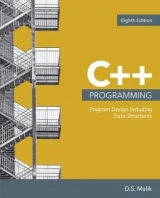
C++ PROGRAMMING: PROGRAM DESIGN INCLUDING DATA STRUCTURES, Sixth Edition remains the definitive text for the CS1/CS2 course sequence. D.S. Malik's time-tested, student-centered methodology uses a strong focus on problem-solving and full-code examples to vividly demonstrate the how and why of applying programming concepts and utilizing C++ to work through a problem. This new edition includes updated end-of-chapter exercises, new debugging exercises, an earlier introduction to variables and a streamlined discussion of user-discussion of user-defined functions. Malik's text ensures students learn how to apply the C++ programming language, and are motivated to understand the “why?” behind key C++ concepts.
D.S. Malik is a Professor of Mathematics and the first recipient and current holder of The Frederick H. and Anna K. Scheerer Endowed Chair in Mathematics at Creighton University. Dr. Malik received his Ph.D. from Ohio University in 1985 and has published more than 50 papers and 18 books on abstract algebra, applied mathematics, graph theory, fuzzy automata theory and languages, fuzzy logic and its applications, programming, data structures, and discrete mathematics..
1. An Overview of Computers and Programming Languages.
2. Basic Elements of C++.
3. Input/Output.
4. Control Structures I (Selection).
5. Control Structures II (Repetition).
6. User-Defined Function.
7. Namespaces, the class string, and User-Defined Simple Data Types.
8. Arrays.
9. Records (structs).
10. Classes and Data Abstraction.
11. Inheritance and Composition.
12. Pointers, Classes, Virtual Functions, and Abstract Classes.
13. Operator Overloading and Templates.
14. Exception Handling.
15. Recursion.
16. Linked Lists.
17. Stacks and Queue.
18. Searching and Sorting Algorithms.
19. Binary Trees.
20. Graph Algorithms.
21. Standard Template Library.
Appendices.
A. Reserved Words.
B. Operator Precedence.
C. Character Sets.
D. Operators Overloading.
E. Additional C++ Topics.
F. Header Files.
G. Memory Size on a System and Random Number Generators.
H. Answers to Odd Numbered Exercises.
| Verlagsort | Boston, MA |
|---|---|
| Sprache | englisch |
| Maße | 190 x 232 mm |
| Gewicht | 2260 g |
| Themenwelt | Mathematik / Informatik ► Informatik ► Programmiersprachen / -werkzeuge |
| ISBN-10 | 1-285-85275-3 / 1285852753 |
| ISBN-13 | 978-1-285-85275-1 / 9781285852751 |
| Zustand | Neuware |
| Informationen gemäß Produktsicherheitsverordnung (GPSR) | |
| Haben Sie eine Frage zum Produkt? |
aus dem Bereich