Zum Hauptinhalt springen
Nicht aus der Schweiz? Besuchen Sie lehmanns.de
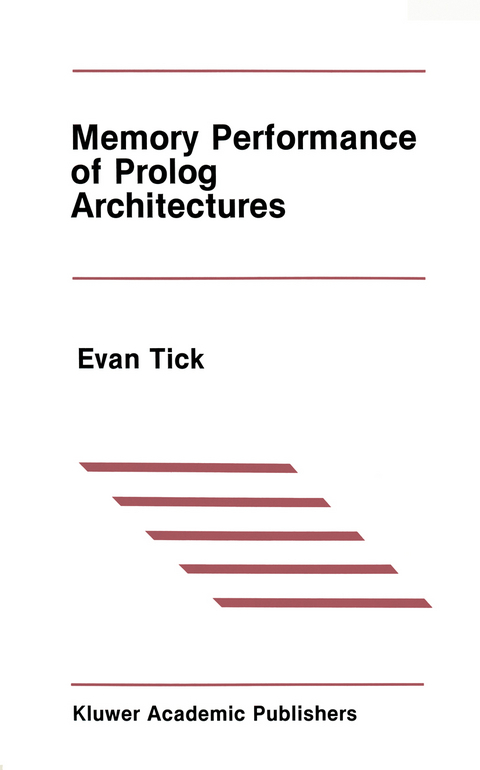
Memory Performance of Prolog Architectures - Evan Tick

Memory Performance of Prolog Architectures

(Autor)

Buch | Softcover
232 Seiten
2011
Springer-Verlag New York Inc.
9781461292029 (ISBN)
CHF 224,65 inkl. MwSt
  • Versand in 10-15 Tagen
  • Versandkostenfrei
  • Auch auf Rechnung
  • Artikel merken
One suspects that the people who use computers for their livelihood are growing more "sophisticated" as the field of computer science evolves. This view might be defended by the expanding use of languages such as C and Lisp in contrast to the languages such as FORTRAN and COBOL. This hypothesis is false however - computer languages are not like natural languages where successive generations stick with the language of their ancestors. Computer programmers do not grow more sophisticated - programmers simply take the time to muddle through the increasingly complex language semantics in an attempt to write useful programs. Of course, these programmers are "sophisticated" in the same sense as are hackers of MockLisp, PostScript, and Tex - highly specialized and tedious languages. It is quite frustrating how this myth of sophistication is propagated by some industries, universities, and government agencies. When I was an undergraduate at MIT, I distinctly remember the convoluted questions on exams concerning dynamic scoping in Lisp - the emphasis was placed solely on a "hacker's" view of computation, i. e. , the control and manipulation of storage cells. No consideration was given to the logical structure of programs. Within the past five years, Ada and Common Lisp have become programming language standards, despite their complexity (note that dynamic scoping was dropped even from Common Lisp). Of course, most industries' selection of programming languages are primarily driven by the requirement for compatibility (with previous software) and performance.

1. Introduction.- 1.1. What is Prolog?.- 1.2. Why Prolog?.- 1.3. Previous Work.- 1.4. Book Outline.- 2. Prolog Architectures.- 2.1. Canonical Prolog Architectures.- 2.2. Environment Stacking Architectures.- 2.3. Restricted AND-Parallel Prolog Architecture.- 2.4. Summary.- 3. Prolog Architecture Measurements.- 3.1. Methodology.- 3.2. Benchmarks.- 3.3. WAM Referencing Characteristics.- 3.4. CIF Referencing Characteristics.- 3.5. PWAM Referencing Characteristics.- 3.6. Summary.- 4. Uniprocessor Memory Organizations.- 4.1. Memory Model.- 4.2. Data Referencing.- 4.3. Instruction Referencing.- 4.4. Local Memory Configurations.- 4.5. Main Memory Design.- 4.6. Summary.- 5. Multiprocessor Memory Organizations.- 5.1. Memory Model.- 5.2. The Consistency Problem.- 5.3. Coherent Cache Measurements.- 5.4. Shared Memory Design.- 5.5. Summary.- 6. Conclusions and Future Research.- 6.1. Conclusions.- 6.2. Future Research.- Appendix A. Glossary of Notation.- Appendix B. Lcode Instruction Set Summary.- Appendix C Local Memory Management Algorithms.- References.

Reihe/Serie The Springer International Series in Engineering and Computer Science ; 40
Zusatzinfo XXII, 232 p.
Verlagsort New York, NY
Sprache englisch
Maße 155 x 235 mm
Themenwelt Mathematik / Informatik Informatik Theorie / Studium
ISBN-13 9781461292029 / 9781461292029
Zustand Neuware
Informationen gemäß Produktsicherheitsverordnung (GPSR)
Haben Sie eine Frage zum Produkt?
Mehr entdecken
aus dem Bereich
was jeder über Informatik wissen sollte

von Timm Eichstädt; Stefan Spieker

Buch | Softcover (2024)
Springer Vieweg (Verlag)
CHF 53,15
Grundlagen – Anwendungen – Perspektiven

von Matthias Homeister

Buch | Softcover (2022)
Springer Vieweg (Verlag)
CHF 53,15
Teil 2 der gestreckten Abschlussprüfung Fachinformatiker/-in …

von Dirk Hardy; Annette Schellenberg; Achim Stiefel

Buch | Softcover (2025)
Europa-Lehrmittel (Verlag)
CHF 37,90