Zum Hauptinhalt springen
Nicht aus der Schweiz? Besuchen Sie lehmanns.de
Self-Stabilizing Systems -

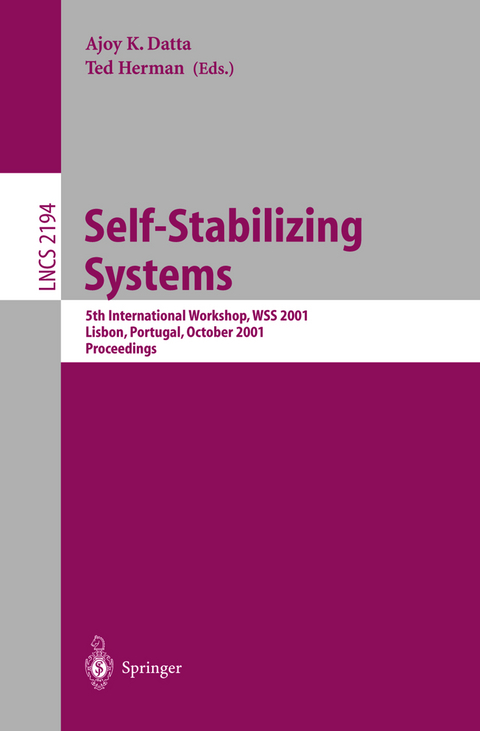
Self-Stabilizing Systems

5th International Workshop, WSS 2001, Lisbon, Portugal, October 1-2, 2001 Proceedings

Ajoy K. Datta, Ted Herman (Herausgeber)

Buch | Softcover
VIII, 236 Seiten
2001
Springer Berlin (Verlag)
978-3-540-42653-0 (ISBN)
CHF 74,85 inkl. MwSt
Physicalsystemswhichrightthemselvesafterbeingdisturbedevokeourcuriosity becausewe wantto understand howsuchsystemsareableto reactto unexpected stimuli. Themechanismsareallthe morefascinatingwhensystemsarecomposed of small, simple units, and the ability of the system to self-stabilize emerges out of its components. Faithful computer simulations of such physical systems exhibit the self-stabilizing property, but in the realm of computing, particularly for distributed systems, wehavegreaterambition. We imaginethat all manner of software, ranging from basic communication protocols to high-level applications, could enjoy self-corrective properties. Self-stabilizing software o?ers a unique, non-traditional approach to the c- cial problem of transient fault tolerance. Many successful instances of modern fault-tolerant networks are based on principles of self-stabilization. Surprisingly, the most widely accepted technical de?nition of a self-stabilizing system does not refer to faults: it is the property that the system can be started in any i- tial state, possibly an "illegal state," and yet the system guarantees to behave properly in ?nite time. This, and similar de?nitions, break many traditional approaches to program design, in which the programmer by habit makes - sumptions about initial conditions. The composition of self-stabilizing systems, initially seen as a daunting challenge, has been transformed into a mana- able task, thanks to an accumulation of discoveries by many investigators. - search on various topics in self-stabilization continues to supply new methods for constructing self-stabilizing systems, determines limits and applicability of the paradigm of self-stabilization, and connects self-stabilization to related areas of fault tolerance anddistributed computing.

Cooperating Mobile Agents and Stabilization.- Cross-Over Composition - Enforcement of Fairness under Unfair Adversary.- Easy Stabilization with an Agent.- Stabilization of Routing in Directed Networks.- Dijkstra's Self-Stabilizing Algorithm in Unsupportive Environments.- Communication Adaptive Self-Stabilizing Group Membership Service.- (Im)Possibilities of Predicate Detection in Crash-Affected Systems.- The Theory of Weak Stabilization.- On the Security and Vulnerability of PING.- A New Efficient Tool for the Design of Self-Stabilizing ?-Exclusion Algorithms: The Controller.- Self-Stabilizing Agent Traversal.- A Composite Stabilizing Data Structure.- Stabilizing Causal Deterministic Merge.- Fast Self-Stabilizing Depth-First Token Circulation.- On a Space-Optimal Distributed Traversal Algorithm.

Erscheint lt. Verlag 19.9.2001
Reihe/Serie Lecture Notes in Computer Science
Zusatzinfo VIII, 236 p.
Verlagsort Berlin
Sprache englisch
Maße 155 x 235 mm
Gewicht 349 g
Themenwelt Mathematik / Informatik Informatik Netzwerke
Schlagworte Adaptive Self-Stabilization • Adaptive Systems • Algorithm analysis and problem complexity • Communication • distributed algorithms • Distributed Systems • Error-correcting codes • Fault-Tolerant Systems • Hardcover, Softcover / Informatik, EDV/Datenkommunikation, Netzwerke • HC/Informatik, EDV/Datenkommunikation, Netzwerke • HC/Informatik, EDV/Informatik • Routing • Self-Stabilization • Self-Stabilizing Systems
ISBN-10 3-540-42653-1 / 3540426531
ISBN-13 978-3-540-42653-0 / 9783540426530
Zustand Neuware
Informationen gemäß Produktsicherheitsverordnung (GPSR)
Haben Sie eine Frage zum Produkt?
Mehr entdecken
aus dem Bereich