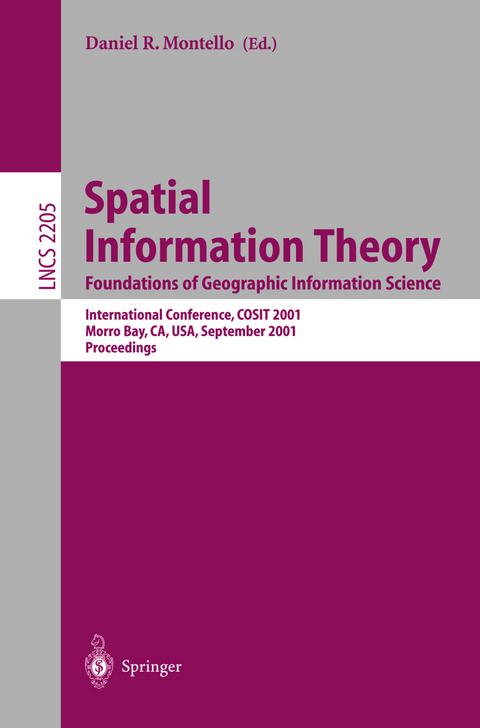
Spatial Information Theory: Foundations of Geographic Information Science
Springer Berlin (Verlag)
978-3-540-42613-4 (ISBN)
Keynote Lecture.- A Geographer Looks at Spatial Information Theory.- Geospatial Ontology and Ontologies I.- True Grid.- A Taxonomy of Granular Partitions.- A Geometric Theory of Vague Boundaries Based on Supervaluation.- Qualitative Spatio-Temporal Reasoning I.- When Tables Tell It All: Qualitative Spatial and Temporal Reasoning Based on Linear Orderings.- Computational structure in three-valued nearness relations.- Qualitative Spatio-Temporal Continuity.- Formalizations of Human Spatial Cognition.- Application of Supervaluation Semantics to Vaguely Defined Spatial Concepts.- Spatial and Cognitive Simulation with Multi-agent Systems.- A Virtual Test Bed in Support of Cognitively-Aware Geomatics Technologies.- Space, Cognition, and Information Systems I.- Evaluating the Usability of the Scale Metaphor for Querying Semantic Spaces.- A Semantic Map as Basis for the Decision Process in the www Navigation.- Pragmatism and Spatial Layout Design.- Navigation: Human and Machine Approaches.- Spatial Frames of Reference Used in Identifying Direction of Movement: An Unexpected Turn.- The Role of a Self-Reference System in Spatial Navigation.- The Utility of Global Representations in a Cognitive Map.- Keynote Lecture.- How Spoken Language and Signed Language Structure Space Differently.- Language and Space.- Two Path Preposition: Along and Past.- Ambiguity in Acquiring Spatial Representation from Descriptions Compared to Depictions: The Role of Spatial Orientation.- When and Why Are Visual Landmarks Used in Giving Directions?.- Space, Cognition, and Information Systems II.- Recognition of Abstract Regions in Cartographic Maps.- Geographical Information Retrieval with Ontologies of Place.- Qualitative Spatial Representation for Information Retrieval by Gazetteers.- Keynote Lecture.-Spatial representation and updating: Evidence from neuropsychological investigations.- Cognitive Mapping.- Mental Processing of Geographic Knowledge.- Spatial Cognition and the Processing of Verticality in Underground Environments.- Grid Patterns and Cultural Expectations in Urban Wayfinding.- Qualitative Spatio-Temporal Reasoning II.- The House Is North of the River: Relative Localization of Extended Objects.- Double-Crossing: Decidability and Computational Complexity of a Qualitative Calculus for Navigation.- Spatial Reasoning: No Need for Visual Information.- Geospatial Ontology and Ontologies II.- A Formal Theory of Objects and Fields.- What's in an Image?.- Features, Objects, and other Things: Ontological Distinctions in the Geographic Domain.
| Erscheint lt. Verlag | 5.9.2001 |
|---|---|
| Reihe/Serie | Lecture Notes in Computer Science |
| Zusatzinfo | XIV, 506 p. |
| Verlagsort | Berlin |
| Sprache | englisch |
| Maße | 155 x 233 mm |
| Gewicht | 726 g |
| Themenwelt | Informatik ► Theorie / Studium ► Künstliche Intelligenz / Robotik |
| Schlagworte | Cognition • data structures • Geographic Information Systems (GIS) • Hardcover, Softcover / Informatik, EDV/Informatik • HC/Geowissenschaften/Geografie • HC/Informatik, EDV/Informatik • information system • Information Theory • Navigation • Ontology • Spatial Cognition • spatial data representation • Spatial Information Processing • spatial information systems • Spatial information theory • spation temporal information |
| ISBN-10 | 3-540-42613-2 / 3540426132 |
| ISBN-13 | 978-3-540-42613-4 / 9783540426134 |
| Zustand | Neuware |
| Informationen gemäß Produktsicherheitsverordnung (GPSR) | |
| Haben Sie eine Frage zum Produkt? |
aus dem Bereich