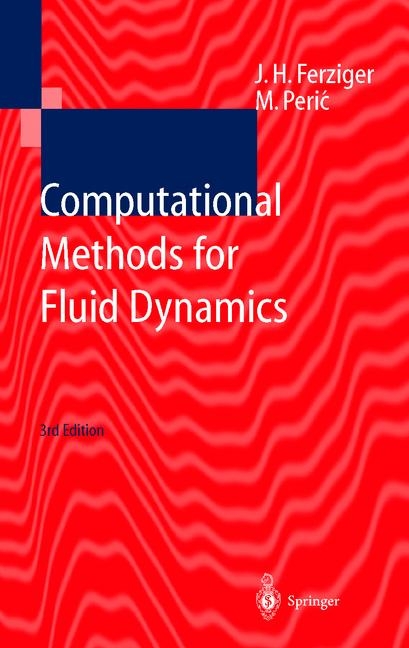
Computational Methods for Fluid Dynamics
Springer Berlin (Verlag)
978-3-540-42074-3 (ISBN)
- Titel erscheint in neuer Auflage
- Artikel merken
1. Basic Concepts of Fluid Flow.- 1.1 Introduction.- 1.2 Conservation Principles.- 1.3 Mass Conservation.- 1.4 Momentum Conservation.- 1.5 Conservation of Scalar Quantities.- 1.6 Dimensionless Form of Equations.- 1.7 Simplified Mathematical Models.- 1.7.1 Incompressible Flow.- 1.7.2 Inviscid (Euler) Flow.- 1.7.3 Potential Flow.- 1.7.4 Creeping (Stokes) Flow.- 1.7.5 Boussinesq Approximation.- 1.7.6 Boundary Layer Approximation.- 1.7.7 Modeling of Complex Flow Phenomena.- 1.8 Mathematical Classification of Flows.- 1.8.1 Hyperbolic Flows.- 1.8.2 Parabolic Flows.- 1.8.3 Elliptic Flows.- 1.8.4 Mixed Flow Types.- 1.9 Plan of This Book.- 2. Introduction to Numerical Methods.- 2.1 Approaches to Fluid Dynamical Problems.- 2.2 What is CFD?.- 2.3 Possibilities and Limitations of Numerical Methods.- 2.4 Components of a Numerical Solution Method.- 2.4.1 Mathematical Model.- 2.4.2 Discretization Method.- 2.4.3 Coordinate and Basis Vector Systems.- 2.4.4 Numerical Grid.- 2.4.5 Finite Approximations.- 2.4.6 Solution Method.- 2.4.7 Convergence Criteria.- 2.5 Properties of Numerical Solution Methods.- 2.5.1 Consistency.- 2.5.2 Stability.- 2.5.3 Convergence.- 2.5.4 Conservation.- 2.5.5 Boundedness.- 2.5.6 Realizability.- 2.5.7 Accuracy.- 2.6 Discretization Approaches.- 2.6.1 Finite Difference Method.- 2.6.2 Finite Volume Method.- 2.6.3 Finite Element Method.- 3. Finite Difference Methods.- 3.1 Introduction.- 3.2 Basic Concept.- 3.3 Approximation of the First Derivative.- 3.3.1 Taylor Series Expansion.- 3.3.2 Polynomial Fitting.- 3.3.3 Compact Schemes.- 3.3.4 Non-Uniform Grids.- 3.4 Approximation of the Second Derivative.- 3.5 Approximation of Mixed Derivatives.- 3.6 Approximation of Other Terms.- 3.7 Implementation of Boundary Conditions.- 3.8 The Algebraic Equation System.- 3.9 Discretization Errors.- 3.10 An Introduction to Spectral Methods.- 3.10.1 Basic Concept.- 3.10.2 Another View of Discretization Error.- 3.11 Example.- 4. Finite Volume Methods.- 4.1 Introduction.- 4.2 Approximation of Surface Integrals.- 4.3 Approximation of Volume Integrals.- 4.4 Interpolation and Differentiation Practices.- 4.4.1 Upwind Interpolation (UDS).- 4.4.2 Linear Interpolation (CDS).- 4.4.3 Quadratic Upwind Interpolation (QUICK).- 4.4.4 Higher-Order Schemes.- 4.4.5 Other Schemes.- 4.5 Implementation of Boundary Conditions.- 4.6 The Algebraic Equation System.- 4.7 Examples.- 5. Solution of Linear Equation Systems.- 5.1 Introduction.- 5.2 Direct Methods.- 5.2.1 Gauss Elimination.- 5.2.2 LU Decomposition.- 5.2.3 Tridiagonal Systems.- 5.2.4 Cyclic Reduction.- 5.3 Iterative Methods.- 5.3.1 Basic Concept.- 5.3.2 Convergence.- 5.3.3 Some Basic Methods.- 5.3.4 Incomplete LU Decomposition: Stone's Method.- 5.3.5 ADI and Other Splitting Methods.- 5.3.6 Conjugate Gradient Methods.- 5.3.7 Biconjugate Gradients and CGSTAB.- 5.3.8 Multigrid Methods.- 5.3.9 Other Iterative Solvers.- 5.4 Coupled Equations and Their Solution.- 5.4.1 Simultaneous Solution.- 5.4.2 Sequential Solution.- 5.4.3 Under-Relaxation.- 5.5 Non-Linear Equations and their Solution.- 5.5.1 Newton-like Techniques.- 5.5.2 Other Techniques.- 5.6 Deferred-Correction Approaches.- 5.7 Convergence Criteria and Iteration Errors.- 5.8 Examples.- 6. Methods for Unsteady Problems.- 6.1 Introduction.- 6.2 Methods for Initial Value Problems in ODEs.- 6.2.1 Two-Level Methods.- 6.2.2 Predictor-Corrector and Multipoint Methods.- 6.2.3 Runge-Kutta Methods.- 6.2.4 Other Methods.- 6.3 Application to the Generic Transport Equation.- 6.3.1 Explicit Methods.- 6.3.2 Implicit Methods.- 6.3.3 Other Methods.- 6.4 Examples.- 7. Solution of the Navier-Stokes Equations.- 7.1 Special Features of the Navier-Stokes Equations.- 7.1.1 Discretization of Convective and Viscous Terms.- 7.1.2 Discretization of Pressure Terms and Body Forces.- 7.1.3 Conservation Properties.- 7.2 Choice of Variable Arrangement on the Grid.- 7.2.1 Colocated Arrangement.- 7.2.2 Staggered Arrangements.- 7.3 Calculation of the Pressure.- 7.3.1 The Pressure Equatio
From the reviews of the third edition:
"This book, primarily oriented towards industrial applications, intends to provide engineers with the necessary background to use and understand commercial fluid dynamics modeling codes or, alternatively, to develop their own. ... In summary, this text, which is commendable for its excellent plain English and pedagogic qualities, constitutes an excellent introduction to the world of computational fluid dynamics and will proudly find its place on the shelf besides more classical reference textbooks." (Michael Crucifix, Physicalia, Vol. 25 (2), 2003)
"In reviewer's opinion, the book is a mixture of surveys and detailed discussions, the latter reflecting the experience of the authors. Thus the book is valuable for the beginners and also for the specialists." (Willi Schönauer, Zentralblatt MATH, Vol. 998, 2002)
"In its 3rd revised and extended edition the book offers an overview of the techniques used to solve problems in fluid mechanics on computers and describes in detail those most often used in practice. ... The book also contains a great deal of practical advice for code developers and users, it is designed to be equally useful to beginners and experts. ... A full-feature user-friendly demo-version of a commercial CFD software has been added ... ." (ETDE Energy Database, January, 2002)
| Erscheint lt. Verlag | 6.11.2001 |
|---|---|
| Zusatzinfo | XIV, 426 p. 50 illus. |
| Verlagsort | Berlin |
| Sprache | englisch |
| Maße | 155 x 235 mm |
| Gewicht | 642 g |
| Themenwelt | Mathematik / Informatik ► Mathematik ► Angewandte Mathematik |
| Technik ► Maschinenbau | |
| Schlagworte | Combustion • computational fluid dynamics • Computational Fluid Dynamics (CFD) • Design • Finite Volume Method • Fluid Dynamics • Fluiddynamik • fluid mechanics • Large Eddy Simulation • Navier-Stokes Equation • Numerical Methods • Simulation • Turbulens |
| ISBN-10 | 3-540-42074-6 / 3540420746 |
| ISBN-13 | 978-3-540-42074-3 / 9783540420743 |
| Zustand | Neuware |
| Informationen gemäß Produktsicherheitsverordnung (GPSR) | |
| Haben Sie eine Frage zum Produkt? |
aus dem Bereich