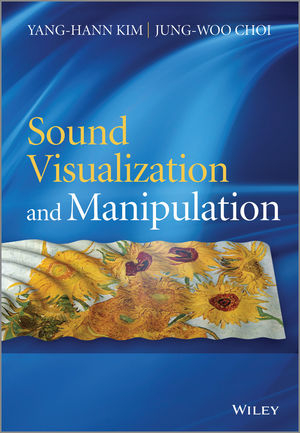
Sound Visualization and Manipulation (eBook)
440 Seiten
John Wiley & Sons (Verlag)
978-1-118-36850-3 (ISBN)
visualization and manipulation - in a unified way
Advances in signal processing technology are enabling ever more
accurate visualization of existing sound fields and precisely
defined sound field production. The idea of explaining both the
problem of sound visualization and the problem of the manipulation
of sound within one book supports this inter-related area of
study. With rapid development of array technologies, it is
possible to do much in terms of visualization and manipulation,
among other technologies involved with the spatial distribution of
sound. This book aims to explore various basic functions for the
visualization and manipulation and demonstrate to the reader how
these properties determine the quality of visualization and
manipulation. The first half of the book introduces some basic and
general concepts and theories and the second part of the book
explains a number of techniques in sound visualization and
manipulation. It offers a unified presentation to two very
different topics - sound field visualization techniques based on
microphone arrays, and techniques for generation of controlled
sound fields using loudspeaker arrays. The authors emphasize the
similarities between these two physical problems and between the
mathematical methods used for solving them.
With extensive examples throughout the book, chapters include:
Acoustic Wave Equation and its Basic Physical Measures, Acoustic
Wave Equation and its Basic Physical Measures, Basic Theory of
Sound Visualization, Acoustic Holography, Beamforming, Basic Theory
of Sound Manipulation, Sound Focusing, and Sound Field
Reproduction.
* The first book to combine both the visualization and
manipulation of sound technologies in one comprehensive volume
* Presents the basic concepts using simple one dimensional cases
and then extends the concept to three dimensional cases, enabling
easier understanding of the fundamental concepts through the use of
minimum mathematics
* Provides a solid understanding of associated physics as well as
mathematical concepts for understanding the technologies,
addressing diffraction problems in an integrated format by using
Kirchhoff-Helmholtz integral equation
* Uses extensive examples demonstrating the benefits and
drawbacks of various applications, including beamforming and
acoustic holography
A valuable resource forpost/graduate students, acoustic
engineers, audio and noise control system developers
Professor Yang-Hann Kim and Jung-Woo Choi; both of the Center for Noise and Vibration Control (NOVIC), Department of Mechanical Engineering, KAIST (Korea Advanced Institute of Science and Engineering, Korea. Professor Kim gained his B.S. in Naval Architecture and Marine Engineering from Seoul National University, Korea, in 1977, and his Ph.D in Acoustics and Vibration in M.E. (O.E. Program), M.I.T., USA, in 1985. He has been working in the field of sound visualization and manipulation for more than 20 years, and has taught acoustics to undergraduate and graduate students. His research interests include Sound Visualization, Active Noise/Vibration Control, Sound Focusing, Structural Acoustics, and Duct Acoustics. He has written two books and contributed to numerous journals and conference papers. Professor Kim was awarded the Excellence Award in Teaching from Mechanical Engineering, KAIST (Dynamics, 2010). Professor Choi gained his Ph.D in Acoustics and Vibration in Mechanical Engineering from KAIST in 2005. He was Visiting Post-Doctoral Researcher Institute of Sound and Vibration Research (ISVR) at the University of Southampton, UK, in 2006, and worked as a Senior Engineer in the Acoustic and Sound Technology Lab., Samsung Electronics in 2011 before taking up his current post. Professor Choi's research interests include Sound Focusing, Sound Field Reproduction, Sound Visualization, and Active Noise/Vibration Control. He has written extensively on the topic in numerous journals and conference proceedings.
| Erscheint lt. Verlag | 30.8.2013 |
|---|---|
| Sprache | englisch |
| Themenwelt | Mathematik / Informatik ► Informatik |
| Technik ► Elektrotechnik / Energietechnik | |
| Schlagworte | Audio & Speech Processing & Broadcasting • Audiobearbeitung • Audio-, Sprachverarbeitung u. Ãbertragung • Audio-, Sprachverarbeitung u. Übertragung • Audiotechnik • Electrical & Electronics Engineering • Elektrotechnik u. Elektronik • Maschinenbau • mechanical engineering • Physics • Physics of Acoustics • Physik • Physik des Schalls |
| ISBN-10 | 1-118-36850-9 / 1118368509 |
| ISBN-13 | 978-1-118-36850-3 / 9781118368503 |
| Informationen gemäß Produktsicherheitsverordnung (GPSR) | |
| Haben Sie eine Frage zum Produkt? |
 PDF (Adobe DRM)
Größe: 12,6 MB
Kopierschutz: Adobe-DRM
Adobe-DRM ist ein Kopierschutz, der das eBook vor Mißbrauch schützen soll. Dabei wird das eBook bereits beim Download auf Ihre persönliche Adobe-ID autorisiert. Lesen können Sie das eBook dann nur auf den Geräten, welche ebenfalls auf Ihre Adobe-ID registriert sind.
Details zum Adobe-DRM
Dateiformat: PDF (Portable Document Format)
Mit einem festen Seitenlayout eignet sich die PDF besonders für Fachbücher mit Spalten, Tabellen und Abbildungen. Eine PDF kann auf fast allen Geräten angezeigt werden, ist aber für kleine Displays (Smartphone, eReader) nur eingeschränkt geeignet.
Systemvoraussetzungen:
PC/Mac: Mit einem PC oder Mac können Sie dieses eBook lesen. Sie benötigen eine
eReader: Dieses eBook kann mit (fast) allen eBook-Readern gelesen werden. Mit dem amazon-Kindle ist es aber nicht kompatibel.
Smartphone/Tablet: Egal ob Apple oder Android, dieses eBook können Sie lesen. Sie benötigen eine
Geräteliste und zusätzliche Hinweise
Zusätzliches Feature: Online Lesen
Dieses eBook können Sie zusätzlich zum Download auch online im Webbrowser lesen.
Buying eBooks from abroad
For tax law reasons we can sell eBooks just within Germany and Switzerland. Regrettably we cannot fulfill eBook-orders from other countries.
 EPUB (Adobe DRM)
Kopierschutz: Adobe-DRM
Adobe-DRM ist ein Kopierschutz, der das eBook vor Mißbrauch schützen soll. Dabei wird das eBook bereits beim Download auf Ihre persönliche Adobe-ID autorisiert. Lesen können Sie das eBook dann nur auf den Geräten, welche ebenfalls auf Ihre Adobe-ID registriert sind.
Details zum Adobe-DRM
Dateiformat: EPUB (Electronic Publication)
EPUB ist ein offener Standard für eBooks und eignet sich besonders zur Darstellung von Belletristik und Sachbüchern. Der Fließtext wird dynamisch an die Display- und Schriftgröße angepasst. Auch für mobile Lesegeräte ist EPUB daher gut geeignet.
Systemvoraussetzungen:
PC/Mac: Mit einem PC oder Mac können Sie dieses eBook lesen. Sie benötigen eine
eReader: Dieses eBook kann mit (fast) allen eBook-Readern gelesen werden. Mit dem amazon-Kindle ist es aber nicht kompatibel.
Smartphone/Tablet: Egal ob Apple oder Android, dieses eBook können Sie lesen. Sie benötigen eine
Geräteliste und zusätzliche Hinweise
Buying eBooks from abroad
For tax law reasons we can sell eBooks just within Germany and Switzerland. Regrettably we cannot fulfill eBook-orders from other countries.
aus dem Bereich