MyLab Math for Developmental Mathematics
Pearson (Hersteller)
978-0-321-95307-0 (ISBN)
- Keine Verlagsinformationen verfügbar
- Artikel merken
Packages
Access codes for Pearson's MyLab & Mastering products may not be included when purchasing or renting from companies other than Pearson; check with the seller before completing your purchase.
Used or rental books
If you rent or purchase a used book with an access code, the access code may have been redeemed previously and you may have to purchase a new access code.
Access codes
Access codes that are purchased from sellers other than Pearson carry a higher risk of being either the wrong ISBN or a previously redeemed code. Check with the seller prior to purchase.
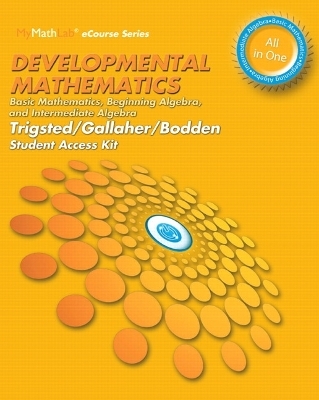
-- Developmental Mathematics by Trigsted, Gallaher, and Bodden is the first online, completely “clickable” combined Basic Mathematics, Beginning Algebra, and Intermediate Algebra text to take full advantage of MyMathLab’s® features and benefits. Kirk Trigsted saw marked improvements in student learning when he started teaching with MyMathLab, but he noticed that most students started their assignments by going directly to the MyMathLab homework exercises without consulting their textbook. This inspired Kirk to write a true eText, built within MyMathLab, to create a dynamic, seamless learning experience that would better meet the needs and expectations of his students. Completely clickable and fully integrated–the Trigsted eText is designed for today’s learners.
Developmental Mathematics is also available to be packaged with two printed resources to provide additional support for you:
The eText Reference is a spiral-bound, printed version of the eText that provides a place for you to do practice work and summarize key concepts from the online videos and animations. In addition to the benefits it provides you, the eText Reference is also a nice resource for those instructors that prefer a printed text for class preparation.
The Guided Notebook is an interactive workbook that guides you through the course by asking you to write down key definitions and work through important examples for each section of the eText. This resource is available in a three-hole-punched, unbound format to provide the foundation for a personalized course notebook. You can integrate your class notes and homework notes within the appropriate section of the Guided Notebook. Instructors can customize the Guided Notebook files found within MyMathLab.
This is the MyMathLab Student Access Kit only, and does not include the supplementary materials listed above.
Kirk Trigsted teaches mathematics at the University of Idaho and has been director of the Polya Mathematics Center since its inception in 2001. Kirk has taught with MyMathLab for many years, and has contributed to the videos for several Pearson books. Kirk is also actively involved with the National Center for Academic Transformation (NCAT). Randy Gallaher is a professor of mathematics at Lewis & Clark Community College, where he has taught since 1997. Prior to this position, Randy taught high school and middle school mathematics for five years in Missouri. He holds a master’s degree in mathematics from Southeast Missouri State University and has completed additional graduate coursework at both Missouri State University and the University of Illinois at Urbana-Champaign. He has coauthored ancillary materials for numerous math and statistics textbooks and has worked as a math author on several grant projects for the Illinois Community College Board. Randy is married with three children and spends most evenings actively involved in their activities. In his limited free time, he loves to fish the small rivers and streams of southern Missouri. Kevin Bodden is a professor of mathematics at Lewis & Clark Community College where he has taught since 1999. He holds a master’s degree in mathematics from Southern Illinois University at Edwardsville and a master’s degree in engineering from Purdue University. He has authored or co-authored ancillary material for numerous textbooks ranging from basic college math to calculus and statistics. He has contributed videos for several of these textbooks and has authored math content on grant projects for the Illinois Community College Board. Kevin is married with three children and is actively involved in their school and extracurricular activities. In his spare time, he enjoys soccer, camping, and geocaching.
Module 1. Whole Numbers
1.1 Study Tips for This Course
1.2 Introduction to Whole Numbers
1.3 Adding and Subtracting Whole Numbers; Perimeter
1.4 Multiplying Whole Numbers; Area
1.5 Dividing Whole Numbers
1.6 Exponents and Order of Operations
Module 2. Fractions and Mixed Numbers
2.1 Introduction to Fractions and Mixed Numbers
2.2 Factors and Simplest Form
2.3 Multiplying and Dividing Fractions
2.4 Adding and Subtracting Fractions
2.5 Complex Fractions and Review Order of Operations
2.6 Operations on Mixed Numbers
Module 3. Decimals
3.1 Introduction to Decimals
3.2 Adding and Subtracting Decimals
3.3 Multiplying Decimals
3.4 Dividing Decimals
3.5 Fractions, Decimals, and Oder of Operations
Module 4. Negative Numbers
4.1 Introduction to Integers
4.2 Adding Integers
4.3 Subtracting Integers
4.4 Multiplying and Dividing Integers
4.5 Order of Operations
4.6 Negative Fractions and Decimals
4.7 Solving Equations Containing Fractions
Module 5. Ratios and Proportions
5.1 Ratios, Rates, and Unit Prices
5.2 Proportions
5.3 Proportions and Problem Solving
5.4 Congruent and Similar Triangles
Module 6. Percent
6.1 Percents, Decimals, and Fractions
6.2 Solving Percent Problems with Equations
6.3 Solving Percent Problems with Proportions
6.4 Application of Percent
7.5 Percent and Problem Solving: Sales Tax, Commission, and Discount
6.6 Percent and Problem Solving: Interest
Module 7. Geometry
7.1 Lines and Angles
7.2 Square Root and the Pythagorean Theorem
7.3 Perimeter, Circumference, and Area
7.4 Volume and Surface Area
Module 8. Measurement
8.1Linear Measurement
8.2 Weight and Mass
8.3 Capacity
8.4 Time and Temperature
Module 9. Introduction to Statistics
9.1 Mean, Median, and Mode
9.2 Pictographs, Circle Graphs, and Line Graphs
9.3 Histograms
9.4 Counting
9.5 Probability
Module 10. Real Numbers and Algebraic Expressions
10.1 The Real Number System
10.2 Adding and Subtracting Real Numbers
10.3 Multiplying and Dividing Real Numbers
10.4 Exponents and Order of Operations
10.5 Variables and Properties of Real Numbers
10.6 Simplifying Algebraic Expressions
Module 11. Linear Equations and Inequalities in One Variable
11.1 The Addition and Multiplication Properties of Equality
11.2 Solving Linear Equations in One Variable
11.3 Introduction to Problem Solving
11.4 Formulas
11.5 Geometry, Motion, and Mixture Problem Solving
11.6 Linear Inequalities in One Variable
Module 12. Graphs of Linear Equations and Inequalities in Two Variables
12.1 The Rectangular Coordinate System
12.2 Graphing Linear Equations in Two Variables
12.3 Slope
12.4 Equations of Lines
12.5 Linear Inequalities in Two Variables
Module 13. Systems of Linear Equations
13.1 Solving Systems of Linear Equations by Graphing
13.2 Solving Systems of Linear Equations by Substitution
13.3 Solving Systems of Linear Equations by Elimination
13.4 Applications of Linear Systems
Module 14. Exponents and Polynomials
14.1 Exponents
14.2 Introduction to Polynomials
14.3 Adding and Subtracting Polynomials
14.4 Multiplying Polynomials
14.5 Special Products
14.6 Negative Exponents and Scientific Notation
14.7 Dividing Polynomials
14.8 Polynomials in Several Variables
Module 15. Factoring Polynomials
15.1 Greatest Common Factor and Factoring by Grouping
15.2 Factoring Trinomials of the Form x²+bx+c
15.3 Factoring Trinomials of the Form ax²+bx+c Using Trial and Error
15.4 Factoring Trinomials of the Form ax²+bx+c Using the ac Method
15.5 Factoring Special Forms
15.6 A General Factoring Strategy
15.7 Solving Polynomial Equations by Factoring
15.8 Applications of Quadratic Equations
Module 16. Rational Expressions and Equations
16.1 Simplifying Rational Expressions
16.2 Multiplying and Dividing Rational Expressions
16.3 Least Common Denominators
16.4 Adding and Subtracting Rational Expressions
16.5 Complex Rational Expressions
16.6 Solving Rational Equations
16.7 Applications of Rational Equations
16.8 Variation
Module 17. Radicals and Rational Exponents
17.1 Finding Roots
17.2 Simplifying Radicals
17.3 Adding and Subtracting Radical Expressions
17.4 Multiplying and Dividing Radicals; Rationalizing Denominators
17.5 Rational Exponents
17.6 Complex Numbers
Module 18. Quadratic Equations
18.1 Solving Quadratic Equations Using the Square Root Property
18.2 Solving Quadratic Functions by Completing the Square
18.3 Solving Quadratics Equations Using the Quadratic Formula
18.4 Graphs of Quadratic Equations
Module 19. Introduction to Functions
19.1 Relations and Functions
19.2 Function Notation and the Algebra of Functions
19.3 Graphs of Functions and Their Applications
Module 20. More with Systems of Linear Equations and Inequalities
20.1 Systems of Linear Equations in Three Variables
20.2 Solving Systems of Linear Equations Using Matrices
20.3 Determinants and Cramer’s Rule
20.4 Systems of Linear Inequalities
Appendix A. Tables
Appendix B. Geometric Formulas
Appendix C. Synthetic Division
Appendix D. Compound Inequalities: Absolute Value Equations and Inequalities
| Erscheint lt. Verlag | 18.2.2014 |
|---|---|
| Sprache | englisch |
| Maße | 10 x 10 mm |
| Gewicht | 68 g |
| Themenwelt | Mathematik / Informatik ► Mathematik ► Algebra |
| ISBN-10 | 0-321-95307-X / 032195307X |
| ISBN-13 | 978-0-321-95307-0 / 9780321953070 |
| Zustand | Neuware |
| Informationen gemäß Produktsicherheitsverordnung (GPSR) | |
| Haben Sie eine Frage zum Produkt? |
aus dem Bereich