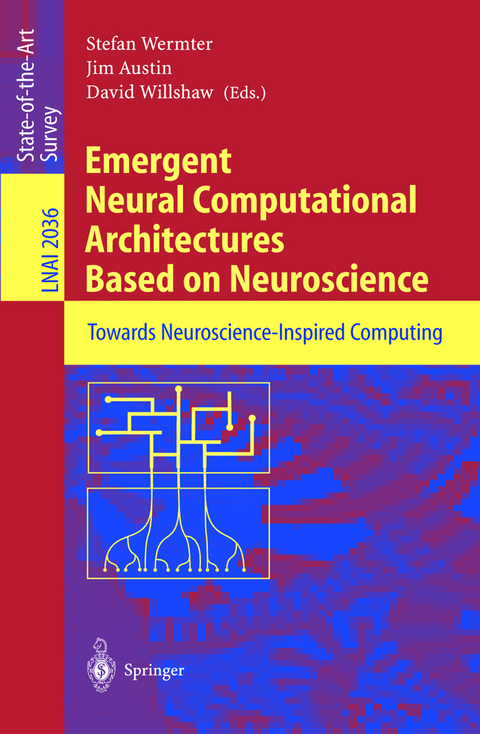
Emergent Neural Computational Architectures Based on Neuroscience
Springer Berlin (Verlag)
9783540423638 (ISBN)
Towards Novel Neuroscience-Inspired Computing.- Towards Novel Neuroscience-Inspired Computing.- Modular Organisation and Robustness.- Images of the Mind: Brain Images and Neural Networks.- Stimulus-Independent Data Analysis for fMRI.- Emergence of Modularity within One Sheet of Neurons: A Model Comparison.- Computational Investigation of Hemispheric Specialization and Interactions.- Explorations of the Interaction between Split Processing and Stimulus Types.- Modularity and Specialized Learning: Mapping between Agent Architectures and Brain Organization.- Biased Competition Mechanisms for Visual Attention in a Multimodular Neurodynamical System.- Recurrent Long-Range Interactions in Early Vision.- Neural Mechanisms for Representing Surface and Contour Features.- Representations of Neuronal Models Using Minimal and Bilinear Realisations.- Collaborative Cell Assemblies: Building Blocks of Cortical Computation.- On the Influence of Threshold Variability in a Mean-Field Model of the Visual Cortex.- Towards Computational Neural Systems through Developmental Evolution.- The Complexity of the Brain: Structural, Functional, and Dynamic Modules.- Timing and Synchronisation.- Synchronisation, Binding, and the Role of Correlated Firing in Fast Information Transmission.- Segmenting State into Entities and Its Implication for Learning.- Temporal Structure of Neural Activity and Modelling of Information Processing in the Brain.- Role of the Cerebellum in Time-Critical Goal-Oriented Behaviour: Anatomical Basis and Control Principle.- Locust Olfaction.- Temporal Coding in Neuronal Populations in the Presence of Axonal and Dendritic Conduction Time Delays.- The Role of Brain Chaos.- Neural Network Classification of Word Evoked Neuromagnetic Brain Activity.- Simulation Studies of the Speed of Recurrent Processing.- Learning and Memory Storage.- The Dynamics of Learning and Memory: Lessons from Neuroscience.- Biological Grounding of Recruitment Learning and Vicinal Algorithms in Long-Term Potentiation.- Plasticity and Nativism: Towards a Resolution of an Apparent Paradox.- Cell Assemblies as an Intermediate Level Model of Cognition.- Modelling Higher Cognitive Functions with Hebbian Cell Assemblies.- Spiking Associative Memory and Scene Segmentation by Synchronization of Cortical Activity.- A Familiarity Discrimination Algorithm Inspired by Computations of the Perirhinal Cortex.- Linguistic Computation with State Space Trajectories.- Robust Stimulus Encoding in Olfactory Processing: Hyperacuity and Efficient Signal Transmission.- Finite-State Computation in Analog Neural Networks: Steps towards Biologically Plausible Models?.- An Investigation into the Role of Cortical Synaptic Depression in Auditory Processing.- The Role of Memory, Anxiety, and Hebbian Learning in Hippocampal Function: Novel Explorations in Computational Neuroscience and Robotics.- Using a Time-Delay Actor-Critic Neural Architecture with Dopamine-Like Reinforcement Signal for Learning in Autonomous Robots.- Connectionist Propositional Logic A Simple Correlation Matrix Memory Based Reasoning System.- Analysis and Synthesis of Agents That Learn from Distributed Dynamic Data Sources.- Connectionist Neuroimaging.
| Erscheint lt. Verlag | 25.7.2001 |
|---|---|
| Reihe/Serie | Lecture Notes in Artificial Intelligence | Lecture Notes in Computer Science |
| Zusatzinfo | X, 582 p. |
| Verlagsort | Berlin |
| Sprache | englisch |
| Maße | 155 x 235 mm |
| Gewicht | 834 g |
| Themenwelt | Informatik ► Theorie / Studium ► Künstliche Intelligenz / Robotik |
| Schlagworte | Algorithm analysis and problem complexity • algorithms • autonomous robot • biocomputation • Bioinformatik • bio-inspired computing • Biologically Inspired • brain-like computing • brain research • classification • Cognition • Complexity • Hardcover, Softcover / Informatik, EDV/Informatik • HC/Informatik, EDV/Informatik • Information Processing • Knowledge • Künstliche Intelligenz • learning • Memory • memory storage • nervous system • Neural Computation • neural computational architectures • neural learning • Neural networks • Neuroscience • neuroscience-inspired computing • Performance • robot • Robotics |
| ISBN-13 | 9783540423638 / 9783540423638 |
| Zustand | Neuware |
| Informationen gemäß Produktsicherheitsverordnung (GPSR) | |
| Haben Sie eine Frage zum Produkt? |
aus dem Bereich