


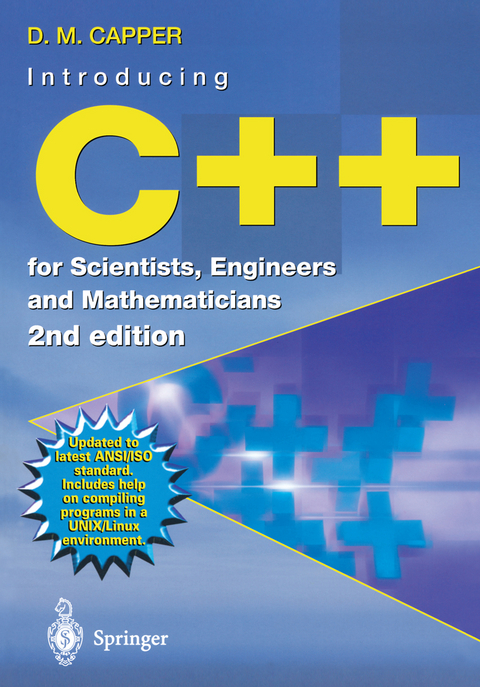
Introducing C++ for Scientists, Engineers and Mathematicians
Seiten
2001
|
Second Edition 2001
Springer London Ltd (Verlag)
978-1-85233-488-8 (ISBN)
Springer London Ltd (Verlag)
978-1-85233-488-8 (ISBN)
Since the first edition of C++ for Scientists, Engineers and Mathematicians, many things have changed. The facilities offered by the C++ language have also grown enormously since the first edition. It is not just the language itself that has grown, but the ANSI Standard also defines an extensive range of library facilities.
Since the first edition of C++ for Scientists, Engineers and Mathematicians, many things have changed. Perhaps the most important is that the ANSI C++ Standard was approved in 1998. The first edition of this book was incompatible with some parts of the Standard and every effort has been made to rectify this. The facilities offered by the C++ language have also grown enormously since the first edition. It is not just the language itself that has grown, but the ANSI Standard also defines an extensive range of library facilities. I have also made two changes in emphasis since the first edition. Firstly, since there is so much important material to cover, some less important features of the language have been removed. The second change is to try to illustrate the language by means of complete programs, rather than code fragments. Hopefully, this will give you more confidence in applying new techniques. Finally, although C++ is a bigger language than it was, it is even more fun to use.
Since the first edition of C++ for Scientists, Engineers and Mathematicians, many things have changed. Perhaps the most important is that the ANSI C++ Standard was approved in 1998. The first edition of this book was incompatible with some parts of the Standard and every effort has been made to rectify this. The facilities offered by the C++ language have also grown enormously since the first edition. It is not just the language itself that has grown, but the ANSI Standard also defines an extensive range of library facilities. I have also made two changes in emphasis since the first edition. Firstly, since there is so much important material to cover, some less important features of the language have been removed. The second change is to try to illustrate the language by means of complete programs, rather than code fragments. Hopefully, this will give you more confidence in applying new techniques. Finally, although C++ is a bigger language than it was, it is even more fun to use.
Introduction.- The Lexical Basis of C++.- Fundamental Types and Basic Operators.- Control Structure.- Functions.- Pointers and Arrays.- Further Pointer Techniques.- Classes.- Operator Overloading.- Constructors and Destructors.- Bitwise Operations.- Single Inheritance.- Multiple Inheritance.- Namespaces.- Exception Handling.- Templates.- Standard Library.- Input and Output.- Appendix A: The ASCII Character Codes.- Appendix B: Operator Precedence and Associativity.- Appendix C: Differences between C and C++.
| Erscheint lt. Verlag | 6.9.2001 |
|---|---|
| Zusatzinfo | 2 Illustrations, black and white |
| Verlagsort | England |
| Sprache | englisch |
| Maße | 170 x 244 mm |
| Themenwelt | Informatik ► Programmiersprachen / -werkzeuge ► C / C++ |
| Informatik ► Theorie / Studium ► Compilerbau | |
| Schlagworte | C++ • Programming language |
| ISBN-10 | 1-85233-488-6 / 1852334886 |
| ISBN-13 | 978-1-85233-488-8 / 9781852334888 |
| Zustand | Neuware |
| Informationen gemäß Produktsicherheitsverordnung (GPSR) | |
| Haben Sie eine Frage zum Produkt? |
Mehr entdecken
aus dem Bereich
aus dem Bereich
von der Analyse bis zur Dokumentation
Buch | Hardcover (2024)
Carl Hanser (Verlag)
CHF 55,95


