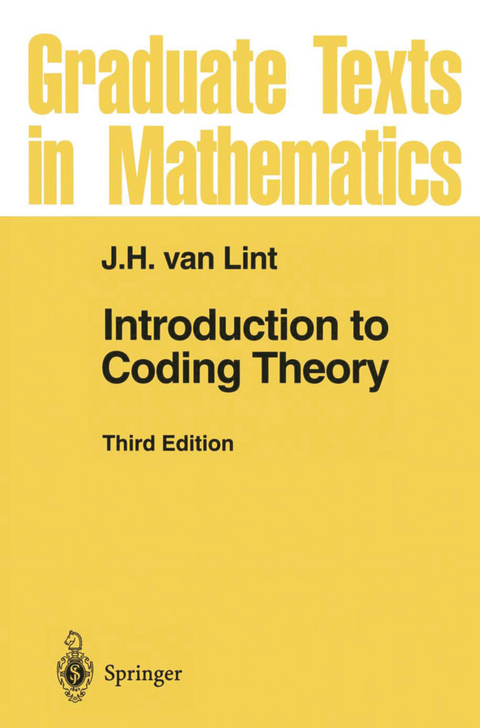
Introduction to Coding Theory
Springer Berlin (Verlag)
9783642636530 (ISBN)
1 Mathematical Background.- 1.1. Algebra.- 1.2. Krawtchouk Polynomials.- 1.3. Combinatorial Theory.- 1.4. Probability Theory.- 2 Shannon's Theorem.- 2.1. Introduction.- 2.2. Shannon's Theorem.- 2.3. On Coding Gain.- 2.4. Comments.- 2.5. Problems.- 3 Linear Codes.- 3.1. Block Codes.- 3.2. Linear Codes.- 3.3. Hamming Codes.- 3.4. Majority Logic Decoding.- 3.5. Weight Enumerators.- 3.6. The Lee Metric.- 3.7. Comments.- 3.8. Problems.- 4 Some Good Codes.- 4.1. Hadamard Codes and Generalizations.- 4.2. The Binary Golay Code.- 4.3. The Ternary Golay Code.- 4.4. Constructing Codes from Other Codes.- 4.5. Reed-Muller Codes.- 4.6. Kerdock Codes.- 4.7. Comments.- 4.8. Problems.- 5 Bounds on Codes.- 5.1. Introduction: The Gilbert Bound.- 5.2. Upper Bounds.- 5.3. The Linear Programming Bound.- 5.4. Comments.- 5.5. Problems.- 6 Cyclic Codes.- 6.1. Definitions.- 6.2. Generator Matrix and Check Polynomial.- 6.3. Zeros of a Cyclic Code.- 6.4. The Idempotent of a Cyclic Code.- 6.5. Other Representations of Cyclic Codes.- 6.6. BCH Codes.- 6.7. Decoding BCH Codes.- 6.8. Reed-Solomon Codes.- 6.9. Quadratic Residue Codes.- 6.10. Binary Cyclic Codes of Length 2n(n odd).- 6.11. Generalized Reed-Muller Codes.- 6.12. Comments.- 6.13. Problems.- 7 Perfect Codes and Uniformly Packed Codes.- 7.1. Lloyd's Theorem.- 7.2. The Characteristic Polynomial of a Code.- 7.3. Uniformly Packed Codes.- 7.4. Examples of Uniformly Packed Codes.- 7.5. Nonexistence Theorems.- 7.6. Comments.- 7.7. Problems.- 8 Codes over ?4.- 8.1. Quaternary Codes.- 8.2. Binary Codes Derived from Codes over ?4.- 8.3. Galois Rings over ?4.- 8.4. Cyclic Codes over ?4.- 8.5. Problems.- 9 Goppa Codes.- 9.1. Motivation.- 9.2. Goppa Codes.- 9.3. The Minimum Distance of Goppa Codes.- 9.4. Asymptotic Behaviour of Goppa Codes.- 9.5. Decoding Goppa Codes.- 9.6. Generalized BCH Codes.- 9.7. Comments.- 9.8. Problems.- 10 Algebraic Geometry Codes.- 10.1. Introduction.- 10.2. Algebraic Curves.- 10.3. Divisors.- 10.4. Differentials on a Curve.- 10.5. The Riemann-Roch Theorem.- 10.6. Codes from Algebraic Curves.- 10.7. Some Geometric Codes.- 10.8. Improvement of the Gilbert-Varshamov Bound.- 10.9. Comments.- 10.10.Problems.- 11 Asymptotically Good Algebraic Codes.- 11.1. A Simple Nonconstructive Example.- 11.2. Justesen Codes.- 11.3. Comments.- 11.4. Problems.- 12 Arithmetic Codes.- 12.1. AN Codes.- 12.2. The Arithmetic and Modular Weight.- 12.3. Mandelbaum-Barrows Codes.- 12.4. Comments.- 12.5. Problems.- 13 Convolutional Codes.- 13.1. Introduction.- 13.2. Decoding of Convolutional Codes.- 13.3. An Analog of the Gilbert Bound for Some Convolutional Codes.- 13.4. Construction of Convolutional Codes from Cyclic Block Codes.- 13.5. Automorphisms of Convolutional Codes.- 13.6. Comments.- 13.7. Problems.- Hints and Solutions to Problems.- References.
| Erscheint lt. Verlag | 14.10.2012 |
|---|---|
| Reihe/Serie | Graduate Texts in Mathematics |
| Zusatzinfo | XIV, 234 p. |
| Verlagsort | Berlin |
| Sprache | englisch |
| Maße | 155 x 235 mm |
| Gewicht | 391 g |
| Themenwelt | Mathematik / Informatik ► Mathematik ► Arithmetik / Zahlentheorie |
| Mathematik / Informatik ► Mathematik ► Geometrie / Topologie | |
| Mathematik / Informatik ► Mathematik ► Graphentheorie | |
| Schlagworte | Code • coding theory • combinatorics • error-correcting code • linear optimization • Shannon |
| ISBN-13 | 9783642636530 / 9783642636530 |
| Zustand | Neuware |
| Informationen gemäß Produktsicherheitsverordnung (GPSR) | |
| Haben Sie eine Frage zum Produkt? |
aus dem Bereich