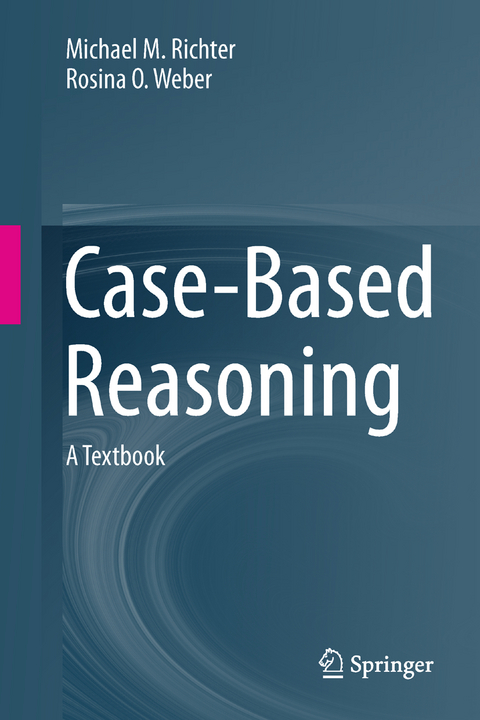
Case-Based Reasoning
Springer Berlin (Verlag)
978-3-642-40166-4 (ISBN)
While it is relatively easy to record billions of experiences in a database, the wisdom of a system is not measured by the number of its experiences but rather by its ability to make use of them. Case-based reasoning (CBR) can be viewed as experience mining, with analogical reasoning applied to problem-solution pairs. As cases are typically not identical, simple storage and recall of experiences is not sufficient, we must define and analyze similarity and adaptation. The fundamentals of the approach are now well-established, and there are many successful commercial applications in diverse fields, attracting interest from researchers across various disciplines.
This textbook presents case-based reasoning in a systematic approach with two goals: to present rigorous and formally valid structures for precise reasoning, and to demonstrate the range of techniques, methods, and tools available for many applications. In the chapters in Part I the authors present the basic elements of CBR without assuming prior reader knowledge; Part II explains the core methods, in particular case representations, similarity topics, retrieval, adaptation, evaluation, revisions, learning, development, and maintenance; Part III offers advanced views of these topics, additionally covering uncertainty and probabilities; and Part IV shows the range of knowledge sources, with chapters on textual CBR, images, sensor data and speech, conversational CBR, and knowledge management. The book concludes with appendices that offer short descriptions of the basic formal definitions and methods, and comparisons between CBR and other techniques.
The authors draw on years of teaching and training experience in academic and business environments, and they employ chapter summaries, background notes, and exercises throughout the book. It's suitable for advanced undergraduate and graduate students of computer science, management, and related disciplines, and it's also a practical introduction and guide for industrial researchers and practitioners engaged with knowledge engineering systems.
Prof. Michael M. Richter completed his PhD on mathematical logic at the University of Freiburg, and his Habilitation in mathematics at the University of Tübingen. He taught at the University of Texas at Austin and at RWTH Aachen, in addition to numerous visiting professorships. He was president of the German Society for Mathematical Logic and the Foundations of Exact Sciences for four years. Most recently, from 1986 he held a chair in computer science at the University of Kaiserslautern, where he was also a founding scientific director of the DFKI (German Research Center for Artificial Intelligence). In 2005 he became an adjunct professor at the University of Calgary. He has taught, researched, and published extensively in the areas of mathematical logic and artificial intelligence. Prof. Richter is one of the pioneers of case-based reasoning: he founded the leading European event on the subject, he led many of the key academic research projects, and he demonstrated the real-world viability of the approach with successful commercial products.
Part I - Basics and Preliminaries.- Chap. 1 - Introduction.- Chap. 2 - Basic CBR Elements.- Chap. 3 - Extended View.- Chap. 4 - Application Examples.- Part II - Core Methods.- Chap. 5 - Case Representations.- Chap. 6 - Basic Similarity Topics.- Chap. 7 - Complex Similarity Topics.- Chap. 8 - Retrieval.- Chap. 9 - Adaptation.- Chap. 10 - Evaluation, Revisions, and Learning.- Chap. 11 - Development and Maintenance.- Part III - Advanced Elements.- Chap. 12 - Advanced CBR Elements.- Chap. 13 - Advanced Similarity Topics.- Chap. 14 - Advanced Retrieval.- Chap. 15 - Uncertainty.- Chap. 16 - Probabilities.- Part IV - Complex Knowledge Sources.- Chap. 17 - Textual CBR.- Chap. 18 - Images.- Chap. 19 - Sensor Data and Speech.- Chap. 20 - Conversational CBR.- Chap. 21 - Knowledge Management.- Part V - Appendices.- Chap. 22 - Basic Formal Definitions and Methods.- Chap. 23 - Relations and Comparisons with Other Techniques.
| Erscheint lt. Verlag | 15.11.2013 |
|---|---|
| Zusatzinfo | XVIII, 546 p. 180 illus., 7 illus. in color. |
| Verlagsort | Berlin |
| Sprache | englisch |
| Maße | 155 x 235 mm |
| Gewicht | 968 g |
| Themenwelt | Informatik ► Theorie / Studium ► Künstliche Intelligenz / Robotik |
| Schlagworte | Artificial Intelligence • case-based Reasoning (CBR) • Complex knowledge • Information Retrieval • Knowledge-based systems • Knowledge Representation • machine learning • Reasoning • Similarity |
| ISBN-10 | 3-642-40166-X / 364240166X |
| ISBN-13 | 978-3-642-40166-4 / 9783642401664 |
| Zustand | Neuware |
| Informationen gemäß Produktsicherheitsverordnung (GPSR) | |
| Haben Sie eine Frage zum Produkt? |
aus dem Bereich