


Logic Program Synthesis from Incomplete Information
Seiten
2012
|
Softcover reprint of the original 1st ed. 1995
Springer-Verlag New York Inc.
9781461359258 (ISBN)
Springer-Verlag New York Inc.
9781461359258 (ISBN)
Program synthesis is a solution to the software crisis. If we had a program that develops correct programs from specifications, then program validation and maintenance would disappear from the software life-cycle, and one could focus on the more creative tasks of specification elaboration, validation, and maintenance, because replay of program development would be less costly.
This monograph describes a novel approach to Inductive Logic Programming (ILP), which cross-fertilizes logic programming and machine learning. Aiming at the synthesis of recursive logic programs only, and this from incomplete information, we take a software engineering approach that is more appropriate than a pure artificial intelligence approach.
This book is suitable as a secondary text for graduate level courses in software engineering and artificial intelligence, and as a reference for practitioners of program synthesis.
This monograph describes a novel approach to Inductive Logic Programming (ILP), which cross-fertilizes logic programming and machine learning. Aiming at the synthesis of recursive logic programs only, and this from incomplete information, we take a software engineering approach that is more appropriate than a pure artificial intelligence approach.
This book is suitable as a secondary text for graduate level courses in software engineering and artificial intelligence, and as a reference for practitioners of program synthesis.
I State of the Art.- 1 Automatic Programming.- 2 Deductive Inference in Automatic Programming.- 3 Inductive Inference in Automatic Programming.- 4 A Logic Program Development Methodology.- 5 Objectives.- II Building Blocks.- 6 A Specification Approach.- 7 A Framework for Stepwise Logic Algorithm Synthesis.- 8 Algorithm Analysis and Algorithm Schemata.- 9 The Proofs-as-Programs Method.- 10 The Most-Specific-Generalization Method.- III A Logic Algorithm Synthesis Mechanism.- 11 Overview of the Synthesis Mechanism.- 12 The Expansion Phase.- 13 The Reduction Phase.- 14 Conclusion.- Appendix: Conventions, Abbreviations, and Symbols.- References.
| Erscheint lt. Verlag | 26.9.2012 |
|---|---|
| Reihe/Serie | The Springer International Series in Engineering and Computer Science ; 295 |
| Zusatzinfo | XVIII, 242 p. |
| Verlagsort | New York, NY |
| Sprache | englisch |
| Maße | 155 x 235 mm |
| Themenwelt | Mathematik / Informatik ► Informatik ► Programmiersprachen / -werkzeuge |
| Informatik ► Software Entwicklung ► Objektorientierung | |
| Informatik ► Theorie / Studium ► Compilerbau | |
| Informatik ► Theorie / Studium ► Künstliche Intelligenz / Robotik | |
| ISBN-13 | 9781461359258 / 9781461359258 |
| Zustand | Neuware |
| Informationen gemäß Produktsicherheitsverordnung (GPSR) | |
| Haben Sie eine Frage zum Produkt? |
Mehr entdecken
aus dem Bereich

aus dem Bereich
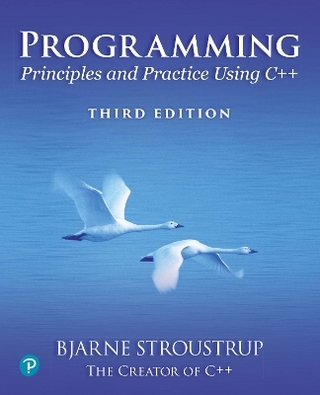
Principles and Practice Using C++
Buch | Softcover (2024)
Addison Wesley (Verlag)
CHF 119,95
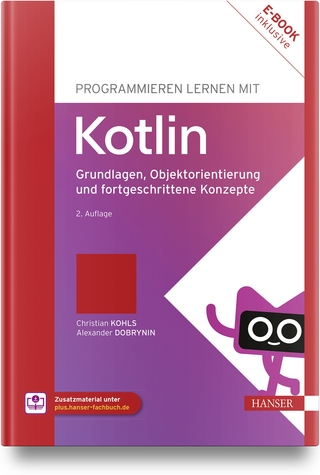
Grundlagen, Objektorientierung und fortgeschrittene Konzepte
Buch (2023)
Carl Hanser (Verlag)
CHF 55,95


