


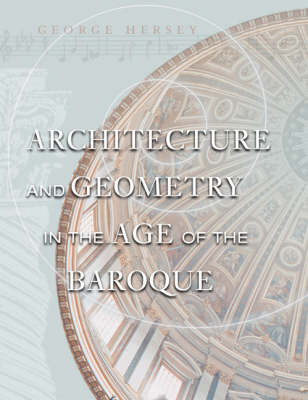
Architecture and Geometry in the Age of the Baroque
Seiten
2001
University of Chicago Press (Verlag)
978-0-226-32783-9 (ISBN)
University of Chicago Press (Verlag)
978-0-226-32783-9 (ISBN)
- Titel ist leider vergriffen;
keine Neuauflage - Artikel merken
The age of Baroque witnessed the construction of some magnificent buildings, but what did the work of architects such as Bernini and Wren have to do with Descartes and Newton? George L. Hersey explores the ways in which Baroque architecture reflects the scientific thinking of the time.
The age of Baroque witnessed the construction of some magnificent buildings, but what did the work of architects such as Bernini, Guarini and Wren have to do with Descartes, Galileo and Newton? In this book, George L. Hersey explores the ways in which Baroque architecture, with its shapes and experimentation with classical forms, reflects the scientific thinking of the time. He introduces us to a concept of geometry that encompassed more than the modern science of today, one that included geometrics (number and shape games), as well as introducing us to the art of geomancy, or magic and phrophecy using shapes and numbers. At first the text concentrates on specific problems in geometry and architectural design, and then it explores the affinities between music and several types of architectural form. Hersey shows how architects incorporated light into their architecture and how abstract ideas were transformed into visual, tactile form. He also looks at how Baroque form resonates in the modern form, in the work of architects such as Frank lloyd Wright and Le Corbusier. A disccusion of modern links to the past rounds off this re-examination of Baroque beliefs and practices.
The age of Baroque witnessed the construction of some magnificent buildings, but what did the work of architects such as Bernini, Guarini and Wren have to do with Descartes, Galileo and Newton? In this book, George L. Hersey explores the ways in which Baroque architecture, with its shapes and experimentation with classical forms, reflects the scientific thinking of the time. He introduces us to a concept of geometry that encompassed more than the modern science of today, one that included geometrics (number and shape games), as well as introducing us to the art of geomancy, or magic and phrophecy using shapes and numbers. At first the text concentrates on specific problems in geometry and architectural design, and then it explores the affinities between music and several types of architectural form. Hersey shows how architects incorporated light into their architecture and how abstract ideas were transformed into visual, tactile form. He also looks at how Baroque form resonates in the modern form, in the work of architects such as Frank lloyd Wright and Le Corbusier. A disccusion of modern links to the past rounds off this re-examination of Baroque beliefs and practices.
George L. Hersey is professor emeritus of the history of art at Yale University. His many books include The Monumental Impulse: Architecture's Biological Roots, The Evolution of Allure: Sexual Selection from the Medici Venus to the Incredible Hulk, and High Renaissance Art in St. Peter's and the Vatican.
| Erscheint lt. Verlag | 8.10.2001 |
|---|---|
| Zusatzinfo | 52 colour plates, 106 halftones, 52 line drawings, 2 tables |
| Sprache | englisch |
| Maße | 185 x 239 mm |
| Gewicht | 844 g |
| Themenwelt | Kunst / Musik / Theater ► Kunstgeschichte / Kunststile |
| Mathematik / Informatik ► Mathematik ► Allgemeines / Lexika | |
| Mathematik / Informatik ► Mathematik ► Geometrie / Topologie | |
| Technik ► Architektur | |
| ISBN-10 | 0-226-32783-3 / 0226327833 |
| ISBN-13 | 978-0-226-32783-9 / 9780226327839 |
| Zustand | Neuware |
| Informationen gemäß Produktsicherheitsverordnung (GPSR) | |
| Haben Sie eine Frage zum Produkt? |
Mehr entdecken
aus dem Bereich


aus dem Bereich
ein Übungsbuch für Fachhochschulen
Buch | Hardcover (2023)
Carl Hanser (Verlag)
CHF 23,75


