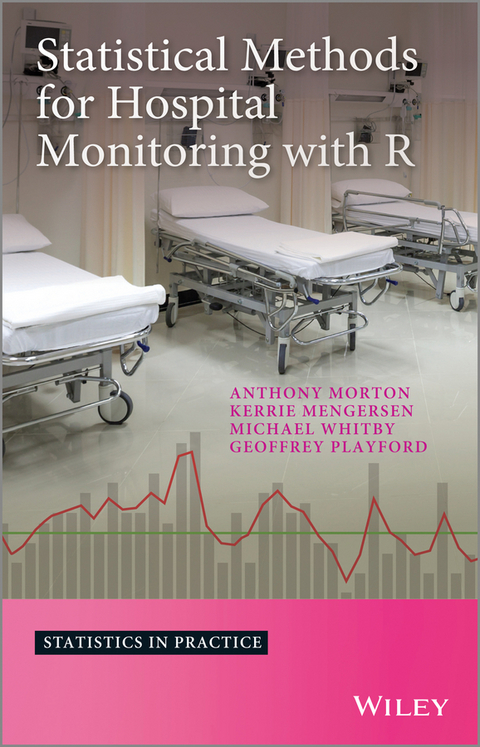
Statistical Methods for Hospital Monitoring with R (eBook)
John Wiley & Sons (Verlag)
978-1-118-63916-0 (ISBN)
Hospitals monitoring is becoming more complex and is increasing both because staff want their data analysed and because of increasing mandated surveillance. This book provides a suite of functions in R, enabling scientists and data analysts working in infection management and quality improvement departments in hospitals, to analyse their often non-independent data which is frequently in the form of trended, over-dispersed and sometimes auto-correlated time series; this is often difficult to analyse using standard office software.
This book provides much-needed guidance on data analysis using R for the growing number of scientists in hospital departments who are responsible for producing reports, and who may have limited statistical expertise.
This book explores data analysis using R and is aimed at scientists in hospital departments who are responsible for producing reports, and who are involved in improving safety. Professionals working in the healthcare quality and safety community will also find this book of interest
Statistical Methods for Hospital Monitoring with R:
- Provides functions to perform quality improvement and infection management data analysis.
- Explores the characteristics of complex systems, such as self-organisation and emergent behaviour, along with their implications for such activities as root-cause analysis and the Pareto principle that seek few key causes of adverse events.
- Provides a summary of key non-statistical aspects of hospital safety and easy to use functions.
- Provides R scripts in an accompanying web site enabling analyses to be performed by the reader http://www.wiley.com/go/hospital_monitoring
- Covers issues that will be of increasing importance in the future, such as, generalised additive models, and complex systems, networks and power laws.
Anthony Morton and Geoffrey Playford, Princess Alexandra Hospital, Brisbane, Australia
Kerrie Mengersen, Science and Engineering Faculty, Queensland University of Technology, Australia
Michael Whitby, Greenslopes Specialist Centre, Queensland, Australia
Hospitals monitoring is becoming more complex and is increasing both because staff want their data analysed and because of increasing mandated surveillance. This book provides a suite of functions in R, enabling scientists and data analysts working in infection management and quality improvement departments in hospitals, to analyse their often non-independent data which is frequently in the form of trended, over-dispersed and sometimes auto-correlated time series; this is often difficult to analyse using standard office software. This book provides much-needed guidance on data analysis using R for the growing number of scientists in hospital departments who are responsible for producing reports, and who may have limited statistical expertise. This book explores data analysis using R and is aimed at scientists in hospital departments who are responsible for producing reports, and who are involved in improving safety. Professionals working in the healthcare quality and safety community will also find this book of interest Statistical Methods for Hospital Monitoring with R: Provides functions to perform quality improvement and infection management data analysis. Explores the characteristics of complex systems, such as self-organisation and emergent behaviour, along with their implications for such activities as root-cause analysis and the Pareto principle that seek few key causes of adverse events. Provides a summary of key non-statistical aspects of hospital safety and easy to use functions. Provides R scripts in an accompanying web site enabling analyses to be performed by the reader http://www.wiley.com/go/hospital_monitoring Covers issues that will be of increasing importance in the future, such as, generalised additive models, and complex systems, networks and power laws.
Anthony Morton and Geoffrey Playford, Princess Alexandra Hospital, Brisbane, Australia Kerrie Mengersen, Science and Engineering Faculty, Queensland University of Technology, Australia Michael Whitby, Greenslopes Specialist Centre, Queensland, Australia
Statistical Methods for Hospital Monitoring with R 3
Contents 7
R Libraries 12
R Functions 13
Preface 18
Introduction 25
0.1 Overview and rationale for this book 25
0.1.1 Motivation for the book 25
0.1.2 Why R? 26
0.1.3 Other reading for R 26
0.2 What methods are covered in the book? 27
0.3 Structure of the book 28
0.4 Using R 29
0.4.1 Entering data 30
0.4.2 Dates 32
0.4.3 Exporting data 34
0.5 Further notes 35
0.6 A brief introduction to rprogs charts and figures 35
0.6.1 What if there is no date column? 42
0.7 Appendix menus 44
0.7.1 IMenu() 44
0.7.2 CCMenu() 45
1 Introduction to analysis of binary and proportion data 48
1.1 Single proportion, samples and population 48
1.1.1 Calculating the confidence interval 50
1.1.2 Comparison with an expected rate 51
1.2 Likelihood ratio (Bayes factor) & supported range
1.3 Confidence intervals for a series of proportions 54
1.4 Difference between two proportions 57
1.4.1 Confidence intervals 57
1.4.2 Hypothesis test 59
1.4.3 The twoproportions function 61
1.5 Introducing a Bayesian approach 63
1.6 When the data are not just one or two independent samples 63
1.6.1 More than two independent proportions 64
1.6.2 Example 1, yearly data 64
1.6.3 Example 2, hospital data 67
1.6.4 Prop test and small samples 71
1.7 Summarising stratified proportion data 72
1.8 Stratified proportion data, differences between rates 74
1.8.1 Yearly data 76
1.8.2 Hospital data 78
1.9 Mantel-Haenszel, homogeneity and trend tests 78
1.9.1 Yearly data 80
1.9.2 Data stratified by hospital 83
1.10 Stratified rates and overdispersion 87
2 The analysis of aggregated binary data 91
2.1 Risk-adjustment 92
2.1.1 Using stratification 92
2.1.2 Using logistic regression 94
2.2 Discrimination and calibration 95
2.3 Using 2005-06 data 100
2.3.1 Displaying and analysing data from multiple institutions 101
2.3.2 Tabulations 102
2.3.3 Funnel plot and plot of multiple confidence intervals 107
2.4 When the Es are not fixed 123
2.5 Complex Surgical Site Infections 126
2.5.1 Funnel plot analysis 126
2.5.2 Shrinkage analysis 128
2.6 Complex SSI risk-adjustment discrimination 130
2.7 Appendix 1 - Further tabulation methods 130
2.8 Appendix 2 - SMR CIs and tests, further scripts. Hospital expected values from other hospitals in group 133
3 Sequential binary data 140
3.1 CUSUM and related charts for binary data 141
3.2 Cumulative Observed-Expected (O-E) chart and combined CUSUM and O-E chart 144
3.3 Cumulative funnel plot and combined CUSUM and funnel plot 144
3.4 Example 145
3.5 Including risk adjustment 148
3.6 CUSUM chart 149
3.7 Cumulative observed minus expected (O-E) chart 149
3.8 Funnel plot 151
3.9 Discrimination and calibration of risk adjustment 152
3.10 Shewhart P chart and EWMA chart 156
3.11 Note on the Run-sum chart 159
3.12 The EWMA chart 159
3.13 Plotting the expected values 162
3.14 Using a spline or generalised additive model (GAM) chart 163
3.15 When there are few time periods 165
3.16 Charts for quarterly data and data without a first date column 167
3.17 Charts for composite measures 170
3.18 Additional tabulations 170
3.19 The issue of under-reporting 175
3.20 New CUSUM and EWMA charts, low-rate data 175
3.20.1 The risk-adjusted Bernoulli CUSUM 177
3.20.2 The EWMA 180
3.20.3 Quarterly rates 181
3.21 Intervals between uncommon binary adverse events 183
3.22 Appendix, proposed EWMA for low rate data 188
4 Introduction to analysis of count and rate data 192
4.1 Introduction 192
4.2 Rate and count data 193
4.3 Single count or rate 193
4.3.1 Confidence interval 194
4.3.2 Significance test 195
4.4 Confidence limits for columns of counts and rates 197
4.5 Two independent rates 199
4.5.1 Confidence interval 199
4.5.2 Hypothesis test 200
4.5.3 Bayesian approach 201
4.6 Chi-squared and trend tests for count and rate data 201
4.7 Stratified count and rate data 204
4.7.1 Obtaining a summary rate 204
4.7.2 Stratified count and rate data, two sets of rates 205
4.7.3 Indirect standardisation 206
4.7.4 Direct standardisation 208
4.8 Mantel-Haenszel, homogeneity and trend tests 211
4.8.1 Fixed effects analysis, stratification by years 211
4.8.2 Random effects analysis, stratification by hospitals 214
4.9 Illustration of dealing with overdispersed rates 217
4.10 The importance of count data variation 220
4.11 Complex systems, networks and variation 225
5 Tables and charts for aggregated count data 227
5.1 Introduction, data, limitations of aggregated count data analysis 227
5.2 Confidence intervals for Staphylococcus aureus bacteraemia SMR data 230
5.3 Funnel plots for Staphylococcus aureus bacteraemia SMR data 236
5.4 Tabulations and Z-scores 243
5.5 More on overdispersion, false discovery, very small expected counts 245
5.5.1 Proposal for Benjamini-Hochberg modified funnel plot 247
5.6 Bayesian shrinkage plot 251
5.6.1 Using OpenBUGS 252
5.6.2 Using empirical Bayes methods 253
5.7 Performing further tabulations in R 255
5.8 Adjusting hospital levels for MRSA bacteraemia 258
5.9 Bacteraemia risk adjustment 261
6 Sequential count and rate data 266
6.1 Grouping data 267
6.2 Means and variances, predictability 267
6.3 Tabulations 268
6.4 Denominators 270
6.5 Shewhart, EWMA and GAM control charts without denominators 271
6.5.1 Shewhart/EWMA charts 281
6.6 Shewhart, EWMA and GAM control charts with denominators 288
6.6.1 Overdispersed data 297
6.7 Charts for quarterly data and data without a first date column 304
6.8 When there are few time periods 306
6.9 Cross-tabulation in wide format 310
6.10 Uncommon count data AEs 315
6.11 Additional scripts for tabulations and charts 321
6.12 Intervals between uncommon count data events 324
6.13 Note on calculation of negative binomial parameters for control charts when denominators vary 327
6.13.1 Simple weighted variance 327
6.13.2 Linear approximation (Bissell) 327
6.13.3 Comparison of simple weighted variance and Bissell's linear approximation 328
7 Miscellaneous AEs 331
7.1 MRO prevalence 332
7.2 Antibiotic usage 339
7.3 Spurious proportions, some blood culture data 340
7.4 RIDIT charts, ECG data 345
7.5 Numerical data - theatre utilisation 350
7.6 Length of stay (LOS) data 353
7.7 Changepoint 363
7.8 Assessing agreement 370
7.8.1 Numerical data agreement 372
7.9 Making decisions (decision analysis) 374
7.10 Investigating outbreaks, further analysis of stratified data 376
7.10.1 Reviewing stratified data analysis 379
7.10.2 Outbreak investigation example 385
8 Hospital safety and adverse event prevention 398
8.1 Introduction 398
8.2 An overview of hospital quality improvement, five pillars 399
8.2.1 The Customer, the first pillar 399
8.2.2 The Practitioner, the second pillar 399
8.2.3 The System, the third and main pillar 399
8.3 Medical error 400
8.3.1 Background of medical error (Vincent, Taylor-Adams & Vincent)
8.4 Improving the system 401
8.4.1 Evidence-based systems 401
8.4.2 The role of bundles and checklists 401
8.5 Error-proofing systems 403
8.6 Discipline and accountability 403
8.7 Limitations of imposing quality 404
8.8 Performance and predictable variation 404
8.9 The keys to a good system 405
8.10 Analysing and implementing evidence-based systems 405
8.11 The role of patient-care staff 406
8.12 The role of central authority 406
8.13 Change management, the fourth pillar 407
8.14 Feedback loops, the fifth pillar 407
8.15 Implementation of the Quality Improvement Process 408
8.15.1 Implementation 408
8.15.2 Obtaining data 410
8.15.3 Special issues with QI studies 410
8.16 The hospital as a network 413
References 415
Index 423
Statistics in Practice 429
| Erscheint lt. Verlag | 27.6.2013 |
|---|---|
| Reihe/Serie | Statistics in Practice | Statistics in Practice |
| Sprache | englisch |
| Themenwelt | Mathematik / Informatik ► Mathematik ► Statistik |
| Mathematik / Informatik ► Mathematik ► Wahrscheinlichkeit / Kombinatorik | |
| Studium ► Querschnittsbereiche ► Epidemiologie / Med. Biometrie | |
| Schlagworte | Epidemiologie u. Biostatistik • Epidemiology & Biostatistics • Gesundheits- u. Sozialwesen • Health & Social Care • Medical Science • Medical Statistics & Epidemiology • Medizin • Medizinische Statistik • Medizinische Statistik u. Epidemiologie • Statistical Methods for Hospital Monitoring with R, R Software, Data Analysis, Stratified Data Analysis, Statistical Computing, Statistics In Medicine, Hospital Quality Improvement • Statistics • Statistik |
| ISBN-10 | 1-118-63916-2 / 1118639162 |
| ISBN-13 | 978-1-118-63916-0 / 9781118639160 |
| Informationen gemäß Produktsicherheitsverordnung (GPSR) | |
| Haben Sie eine Frage zum Produkt? |
 PDF (Adobe DRM)
Kopierschutz: Adobe-DRM
Adobe-DRM ist ein Kopierschutz, der das eBook vor Mißbrauch schützen soll. Dabei wird das eBook bereits beim Download auf Ihre persönliche Adobe-ID autorisiert. Lesen können Sie das eBook dann nur auf den Geräten, welche ebenfalls auf Ihre Adobe-ID registriert sind.
Details zum Adobe-DRM
Dateiformat: PDF (Portable Document Format)
Mit einem festen Seitenlayout eignet sich die PDF besonders für Fachbücher mit Spalten, Tabellen und Abbildungen. Eine PDF kann auf fast allen Geräten angezeigt werden, ist aber für kleine Displays (Smartphone, eReader) nur eingeschränkt geeignet.
Systemvoraussetzungen:
PC/Mac: Mit einem PC oder Mac können Sie dieses eBook lesen. Sie benötigen eine
eReader: Dieses eBook kann mit (fast) allen eBook-Readern gelesen werden. Mit dem amazon-Kindle ist es aber nicht kompatibel.
Smartphone/Tablet: Egal ob Apple oder Android, dieses eBook können Sie lesen. Sie benötigen eine
Geräteliste und zusätzliche Hinweise
Buying eBooks from abroad
For tax law reasons we can sell eBooks just within Germany and Switzerland. Regrettably we cannot fulfill eBook-orders from other countries.
aus dem Bereich