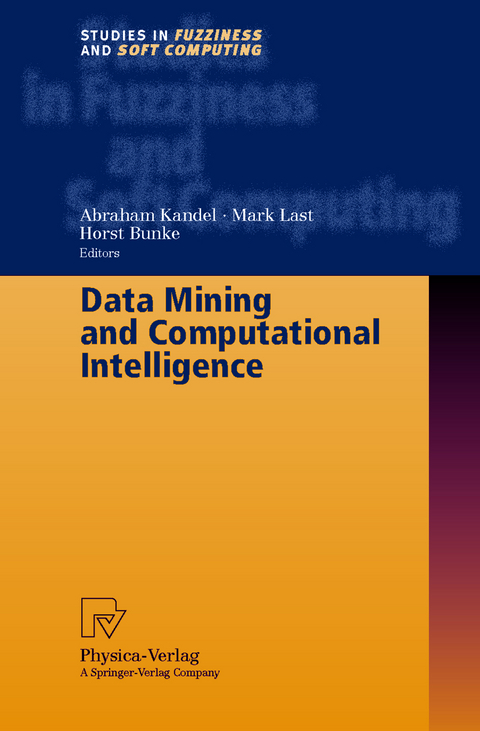
Data Mining and Computational Intelligence
Physica (Verlag)
9783790813715 (ISBN)
Data Mining with Neuro-Fuzzy Models.- Granular Computing in Data Mining.- Fuzzification and Reduction of Information - Theoretic Rule Sets.- Mining Fuzzy Association Rules in a Database Containing Relational and Transactional Data.- Fuzzy Linguistics Summaries via Association Rules.- The Fuzzy-ROSA Method: A Statistically Motivated Fuzzy Approach for Data-Based Generation of Small Interpretable Rule Bases in High-Dimensional Search Spaces.- Discovering Knowledge from Fuzzy Concept Lattice.- Mining of Labeled Incomplete Data Using Fast Dimension Partitioning.- Mining a Growing Feature Map by Data Skeleton Modelling.- Soft Regression - A Data Mining Tool.- Some Practical Applications of Soft Computing and Data Mining.- Intelligent Mining in Image Databases, with Applications to Satellite Imaging and to Web Search.- Fuzzy Genetic Modeling and Forecasting for Nonlinear Time Series.
| Erscheint lt. Verlag | 13.3.2001 |
|---|---|
| Reihe/Serie | Studies in Fuzziness and Soft Computing |
| Zusatzinfo | XII, 356 p. |
| Verlagsort | Heidelberg |
| Sprache | englisch |
| Maße | 155 x 235 mm |
| Gewicht | 732 g |
| Themenwelt | Mathematik / Informatik ► Informatik ► Datenbanken |
| Schlagworte | Computational Intelligence • Database • Database Management • Data Mining • fuzzy • Fuzzy Logic • Fuzzy-Logik • Fuzzy-Logik / Unscharfe Logik • Intelligence • Knowledge • Knowledge Discovery • Knowledge Discovery in Databases • Künstliche Intelligenz • learning • Linguistics • machine learning • Modeling • service-oriented computing |
| ISBN-13 | 9783790813715 / 9783790813715 |
| Zustand | Neuware |
| Informationen gemäß Produktsicherheitsverordnung (GPSR) | |
| Haben Sie eine Frage zum Produkt? |
aus dem Bereich