


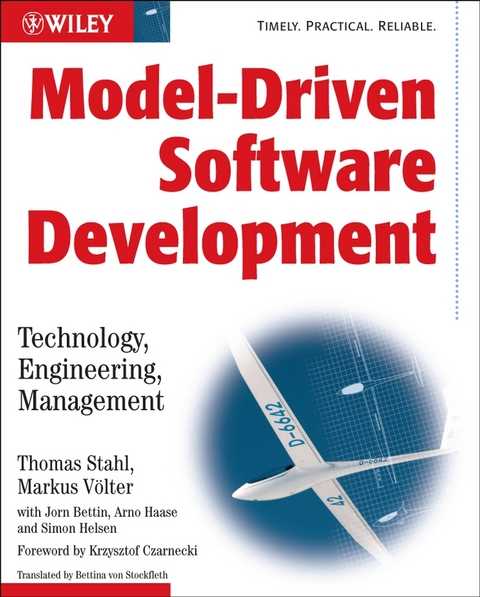
MDSD is about using domain-specific languages to create models that express application structure or behaviour in an efficient and domain-specific way. These models are subsequently transformed into executable code by a sequence of model transformations.
This practical guide for software architects and developers is peppered with practical examples and extensive case studies. International experts deliver:
* A comprehensive overview of MDSD and how it relates to industry standards such as MDA and Software Factories.
* Technical details on meta modeling, DSL construction, model-to-model and model-to-code transformations, and software architecture.
* Invaluable insight into the software development process, plus engineering issues such as versioning, testing and product line engineering.
* Essential management knowledge covering economic and organizational topics, from a global perspective.
Get started and benefit from some practical support along the way!
Thomas Stahl is Chief Architect at b+m Informatik AG. Thomas’ focus and expertise is in Model-Driven Software Development, of which he has extensive practical experience. Thomas is a journal-published writer, IT conference speaker and originator of the open-source MDSD-platform openArchitectureWare.
Markus Völter is an independent consultant for software technology and engineering. Markus focuses on software architecture and Model-Driven Software Development, in which he is a well-regarded authority. A Wiley Software Design Patterns Series published author, Markus also writes for journals and speaks at conferences on his area of expertise.
Model-Driven Software Development (MDSD) is currently a highly regarded development paradigm among developers and researchers. With the advent of OMG's MDA and Microsoft's Software Factories, the MDSD approach has moved to the centre of the programmer's attention, becoming the focus of conferences such as OOPSLA, JAOO and OOP. MDSD is about using domain-specific languages to create models that express application structure or behaviour in an efficient and domain-specific way. These models are subsequently transformed into executable code by a sequence of model transformations. This practical guide for software architects and developers is peppered with practical examples and extensive case studies. International experts deliver: * A comprehensive overview of MDSD and how it relates to industry standards such as MDA and Software Factories. * Technical details on meta modeling, DSL construction, model-to-model and model-to-code transformations, and software architecture. * Invaluable insight into the software development process, plus engineering issues such as versioning, testing and product line engineering. * Essential management knowledge covering economic and organizational topics, from a global perspective. Get started and benefit from some practical support along the way!
Thomas Stahl is Chief Architect at b+m Informatik AG. Thomas' focus and expertise is in Model-Driven Software Development, of which he has extensive practical experience. Thomas is a journal-published writer, IT conference speaker and originator of the open-source MDSD-platform openArchitectureWare. Markus Völter is an independent consultant for software technology and engineering. Markus focuses on software architecture and Model-Driven Software Development, in which he is a well-regarded authority. A Wiley Software Design Patterns Series published author, Markus also writes for journals and speaks at conferences on his area of expertise.
Part I: Introduction.
1. Introduction.
2. MDSD - Basic Ideas and Terminology.
3. Case Study: A Typical Web Application.
4. Concept Formation.
5. Classification.
Part II: Domain Architectures.
6. Metamodeling.
7. MDSD-Capable Target Architectures.
8. Building Domain Architectures.
9. Code Generation Techniques.
10. Model Transformation Techniques.
11. MDSD Tools: Roles, Architecture, Selection
Criteria,
and Pointers.
12. The MDA Standard.
Part III: Processes and Engineering.
13. MDSD Process Building Blocks and Best Practices.
14. Testing.
15. Versioning.
16. Case Study: Embedded Component Infrastructures.
17. Case Study: An Enterprise System.
Part IV: Management.
18. Decision Support.
1.9 Organizational Aspects.
20. Adoption Strategies for MDSD.
References.
Index.
| Erscheint lt. Verlag | 26.6.2013 |
|---|---|
| Reihe/Serie | Wiley Series in Software Design Patterns | Wiley Series in Software Design Patterns |
| Übersetzer | Bettina von Stockfleth |
| Vorwort | Krzysztof Czarnecki |
| Sprache | englisch |
| Themenwelt | Mathematik / Informatik ► Informatik ► Programmiersprachen / -werkzeuge |
| Mathematik / Informatik ► Informatik ► Software Entwicklung | |
| Schlagworte | Advent • application • Approach • attention • Behaviour • centre • Computer Science • conferences • Development • domainspecific • Express • focus • highly • Informatik • Languages • MDSD • modeldriven • Models • omgs • OOPSLA • paradigm • programmers • Programmierung u. Software-Entwicklung • Programming & Software Development • Sequence • Software • Softwareentwicklung • transformations |
| ISBN-13 | 9781118725764 / 9781118725764 |
| Informationen gemäß Produktsicherheitsverordnung (GPSR) | |
| Haben Sie eine Frage zum Produkt? |
 EPUB (Adobe DRM)
Kopierschutz: Adobe-DRM
Adobe-DRM ist ein Kopierschutz, der das eBook vor Mißbrauch schützen soll. Dabei wird das eBook bereits beim Download auf Ihre persönliche Adobe-ID autorisiert. Lesen können Sie das eBook dann nur auf den Geräten, welche ebenfalls auf Ihre Adobe-ID registriert sind.
Details zum Adobe-DRM
Dateiformat: EPUB (Electronic Publication)
EPUB ist ein offener Standard für eBooks und eignet sich besonders zur Darstellung von Belletristik und Sachbüchern. Der Fließtext wird dynamisch an die Display- und Schriftgröße angepasst. Auch für mobile Lesegeräte ist EPUB daher gut geeignet.
Systemvoraussetzungen:
PC/Mac: Mit einem PC oder Mac können Sie dieses eBook lesen. Sie benötigen eine
eReader: Dieses eBook kann mit (fast) allen eBook-Readern gelesen werden. Mit dem amazon-Kindle ist es aber nicht kompatibel.
Smartphone/Tablet: Egal ob Apple oder Android, dieses eBook können Sie lesen. Sie benötigen eine
Geräteliste und zusätzliche Hinweise
Buying eBooks from abroad
For tax law reasons we can sell eBooks just within Germany and Switzerland. Regrettably we cannot fulfill eBook-orders from other countries.
aus dem Bereich


