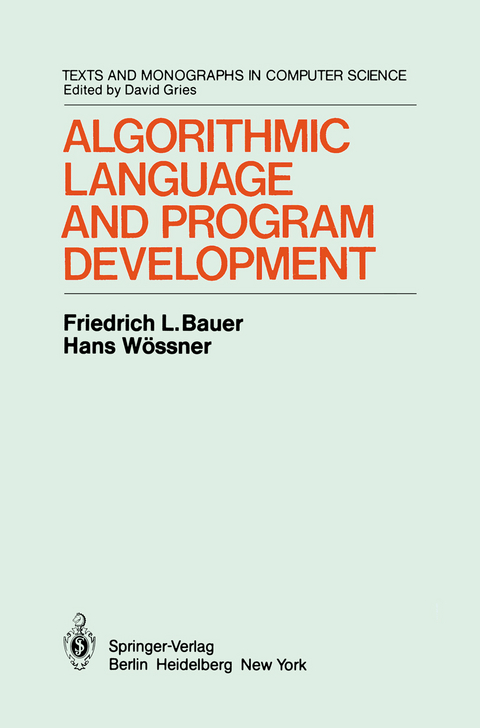
Algorithmic Language and Program Development
Springer Berlin (Verlag)
978-3-540-11148-1 (ISBN)

0.1 On the Etymology of the Word Algorithm.- 0.2 How Algorithms are Characterized.- 0.3 Programming as an Evolutionary Process.- 0.4 How to Solve it.- 1. Routines.- 1.1 The Parameter Concept.- 1.2 Declaration of a Routine.- 1.3 Hierarchical Construction of Routines.- 1.4 Recursive Routines and Systems.- 1.5 Mathematical Semantics: Fixpoint Theory.- 1.6 Proofs by Induction of Properties of Routines.- 1.7 Operational Semantics: Machines.- 1.8 Restriction of the Parameter Domain.- 1.9 Dijkstra's Guards.- 1.10 Pre-Algorithmic Formulations by Means of Choice and Determination.- 1.11 Semantics of Non-Deterministic Constructions.- 1.12 Routines with a Multiple Result.- 1.13 Structuring of Routines.- 1.14 Routines as Parameters and Results.- Addendum: Notations.- 2. Objects and Object Structures.- 2.1 Denotations.- 2.2 Scope of a Freely Chosen Designation.- 2.3 Kinds of Objects.- 2.4 Sets of Objects, Modes.- 2.5 Composite Modes and Objects.- 2.6 Selectors, Structures with Direct (Selector) Access.- 2.7 Mode Variants.- 2.8 Introduction of New Modes: Summary.- 2.9 Recursive Object Structures.- 2.10 Algorithms with Linear Object Structures.- 2.11 The Recursive Object Structure "File".- 2.12 Algorithms with Cascade-Type Object Structures.- 2.13 Traversal and Scanning of Recursive Object Structures.- 2.14 Infinite Objects.- 2.15 Some Peculiarities of Arrays.- 2.16 Routines with Multiple Results Revisited.- Addendum: Notations.- 3. Computational Structures.- 3.1 Concrete Computational Structures.- 3.2 Abstract Computational Structures and Abstract Types.- 3.3 Abstract Arrays.- 3.4 Sequence-Type Computational Structures.- 3.5 Number-Type Computational Structures.- 3.6 Changing Abstract Types and Object Structures.- Addendum: Notations.- 4. Transformation into Repetitive Form.-4.1 Schemes and Transformations.- 4.2 Treatment of Linear Recursion.- 4.3 Treatment of Non-Linear Recursions.- 4.4 Disentanglement of the Control.- 5. Program Variables.- 5.1 The Origin of Program Variables.- 5.2 Formal Introduction of Program Variables.- 5.3 Procedures.- 5.4 Axiomatic Description of Programming Languages.- 5.5 Variables for Structured Objects.- Addendum: Notations.- 6. Control Elements.- 6.1 Deparameterization and Formal Treatment of Repetition.- 6.2 Jumps.- 6.3 The General do-od Construction.- 6.4 Loops.- 6.5 Loops and Repetitive Systems.- 6.6 Sequential Circuits.- 6.7 Flow Diagrams.- 6.8 Petri Nets.- 6.9 bool Petri Nets, Signals.- 6.10 nat Petri Nets, Semaphores.- Addendum: Notations.- 7. Organized Storages and Linked Lists.- 7.1 Organized Storages.- 7.2 Identity of Variables and Alias Ban Revisited.- 7.3 Implementing Object Structures by Organized Storages.- 7.4 Linked-List Implementation of Organized Storages.- 7.5 Improvement of Algorithms Working on Linked Lists by Selective Updating.- 7.6 Addressing.- Addendum: Notations.- Conclusion. Programming as an Evolutionary Process.- Program Specification and Development in a Uniform Language.- Conceptual Organization of the Algorithmic Language.- Tools to Be Used.- Methodology of Programming.
| Erscheint lt. Verlag | 1.10.1982 |
|---|---|
| Reihe/Serie | Monographs in Computer Science |
| Mitarbeit |
Assistent: H. Partsch, P. Pepper |
| Zusatzinfo | XVI, 500 p. |
| Verlagsort | Berlin |
| Sprache | englisch |
| Maße | 155 x 235 mm |
| Gewicht | 888 g |
| Themenwelt | Mathematik / Informatik ► Informatik ► Theorie / Studium |
| Schlagworte | algorithm • Algorithmen • algorithms • Algorithmus • Development • Fundamental Concepts of Progr. • Languages • Programmiersprache • Programmierung (EDV) • Software engineering • Software Engineering / Softwareentwicklung • Softwareentwicklung |
| ISBN-10 | 3-540-11148-4 / 3540111484 |
| ISBN-13 | 978-3-540-11148-1 / 9783540111481 |
| Zustand | Neuware |
| Informationen gemäß Produktsicherheitsverordnung (GPSR) | |
| Haben Sie eine Frage zum Produkt? |
aus dem Bereich