


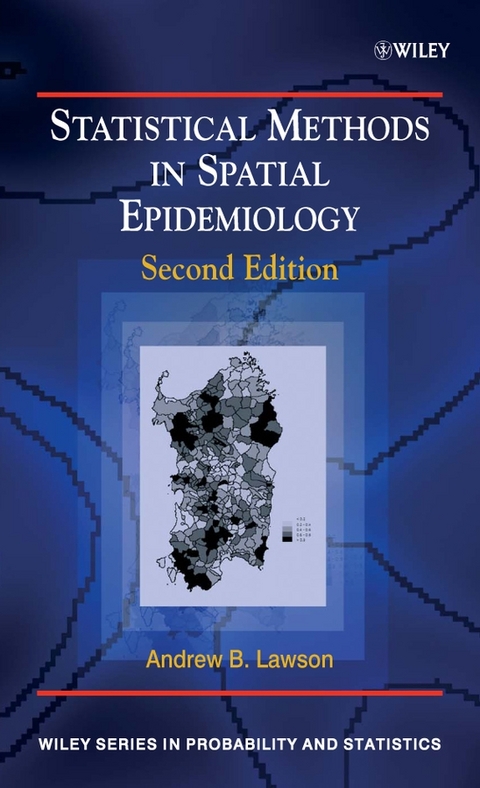
Statistical Methods in Spatial Epidemiology (eBook)
John Wiley & Sons (Verlag)
978-0-470-03578-8 (ISBN)
- Provides a comprehensive overview of the main statistical methods used in spatial epidemiology.
- Updated to include a new emphasis on bio-terrorism and disease surveillance.
- Emphasizes the importance of space-time modelling and outlines the practical application of the method.
- Discusses the wide range of software available for analyzing spatial data, including WinBUGS, SaTScan and R, and features an accompanying website hosting related software.
- Contains numerous data sets, each representing a different approach to the analysis, and provides an insight into various modelling techniques.
This text is primarily aimed at medical statisticians, researchers and practitioners from public health and epidemiology. It is also suitable for postgraduate students of statistics and epidemiology, as well professionals working in government agencies.
Professor Andrew B. Lawson is a respected and well-known academic. He has published many papers in leading journals, and a number of books on spatial statistics, including five for Wiley.
Spatial epidemiology is the description and analysis of the geographical distribution of disease. It is more important now than ever, with modern threats such as bio-terrorism making such analysis even more complex. This second edition of Statistical Methods in Spatial Epidemiology is updated and expanded to offer a complete coverage of the analysis and application of spatial statistical methods. The book is divided into two main sections: Part 1 introduces basic definitions and terminology, along with map construction and some basic models. This is expanded upon in Part II by applying this knowledge to the fundamental problems within spatial epidemiology, such as disease mapping, ecological analysis, disease clustering, bio-terrorism, space-time analysis, surveillance and infectious disease modelling. Provides a comprehensive overview of the main statistical methods used in spatial epidemiology. Updated to include a new emphasis on bio-terrorism and disease surveillance. Emphasizes the importance of space-time modelling and outlines the practical application of the method. Discusses the wide range of software available for analyzing spatial data, including WinBUGS, SaTScan and R, and features an accompanying website hosting related software. Contains numerous data sets, each representing a different approach to the analysis, and provides an insight into various modelling techniques. This text is primarily aimed at medical statisticians, researchers and practitioners from public health and epidemiology. It is also suitable for postgraduate students of statistics and epidemiology, as well professionals working in government agencies.
Professor Andrew B. Lawson is a respected and well-known academic. He has published many papers in leading journals, and a number of books on spatial statistics, including five for Wiley.
Title Page 5
Contents 11
Preface and Acknowledgements to Second Edition 17
Preface and Acknowledgements 19
I The Nature of Spatial Epidemiology 21
1 Definitions, Terminology and Data Sets 23
1.1 Map Hypotheses and Modelling Approaches 25
1.2 Definitions and Data Examples 27
1.2.1 Case event data 27
1.2.2 Count data 28
1.3 Further Definitions 30
1.3.1 Control events and processes 30
1.3.2 Census tract information 30
1.3.3 Clustering definitions 30
1.4 Some Data Examples 31
1.4.1 Case event examples 31
1.4.2 Count data examples 39
2 Scales of Measurement and Data Availability 45
2.1 Small Scale 46
2.2 Large Scale 46
2.3 Rate Dependence 47
2.4 Data Quality and the Ecological Fallacy 47
2.5 Edge Effects 48
3 Geographical Representation and Mapping 51
3.1 Introduction and Definitions 51
3.2 Maps and Mapping 52
3.2.1 Statistical maps and mapping 54
3.2.2 Object process mapping 54
3.2.3 Geostatistical mapping 56
3.3 Statistical Accuracy 57
3.4 Aggregation 57
3.5 Mapping Issues Related to Aggregated Data 57
3.6 Conclusions 59
4 Basic Models 61
4.1 Sampling Considerations 61
4.2 Likelihood-Based and Bayesian Approaches 62
4.3 Point Event Models 62
4.3.1 Point process models and applications 63
4.3.2 The basic Poisson process model 64
4.3.3 Hybrid models and regionalisation 69
4.3.4 Bayesian models and random effects 70
4.3.5 MAP estimation, empirical Bayes and full Bayesian analysis 72
4.3.6 Bivariate/multivariate models 73
4.3.7 Hidden structure and mixture models 76
4.3.8 Space-time extensions 76
4.4 Count Models 78
4.4.1 Standard models 80
4.4.2 Approximations 83
4.4.3 Random-effect extensions 83
4.4.4 Hidden structure and mixture models 84
4.4.5 Space-time extensions 85
5 Exploratory Approaches, Parametric Estimation and Inference 87
5.1 Exploratory Methods 88
5.1.1 Cartographic issues 89
5.1.2 Case event mapping 91
5.1.3 Count mapping 95
5.2 Parameter Estimation 100
5.2.1 Case event likelihood models 100
5.2.2 Count event likelihood models 105
5.2.3 Approximations 107
5.2.4 Bayesian models 108
5.3 Residual Diagnostics 116
5.4 Hypothesis Testing 118
5.5 Edge Effects 119
5.5.1 Edge effects in case events 121
5.5.2 Edge effects in counts 121
5.5.3 Edge weighting schemes and MCMC methods 122
5.5.4 Discussion 124
5.5.5 The Tuscany example 125
II Important Problems in Spatial Epidemiology 129
6 Small Scale: Disease Clustering 131
6.1 Definition of Clusters and Clustering 132
6.2 Modelling Issues 135
6.3 Hypothesis Tests for Clustering 138
6.3.1 General non-specific clustering 138
6.3.2 Specific clustering 141
6.4 Space-Time Clustering 143
6.4.1 Modelling issues 143
6.4.2 Hypothesis testing 146
6.5 Clustering Examples 147
6.5.1 Humberside example 147
6.5.2 Larynx cancer example 151
6.5.3 Count data clustering example 153
6.5.4 Space-time clustering examples 156
6.6 Other Methods Related to Clustering 158
6.6.1 Wombling 160
7 Small Scale: Putative Sources of Hazard 163
7.1 Introduction 163
7.2 Study Design 164
7.2.1 Retrospective and prospective studies 164
7.2.2 Study region design 165
7.2.3 Replication and controls 166
7.3 Problems of Inference 167
7.3.1 Exploratory techniques 168
7.4 Modelling the Hazard Exposure Risk 173
7.5 Models for Case Event Data 182
7.5.1 Estimation 184
7.5.2 Hypothesis tests 184
7.5.3 Diagnostic techniques 186
7.6 A Case Event Example 187
7.7 Models for Count Data 189
7.7.1 Estimation 191
7.7.2 Hypothesis tests 191
7.8 A Count Data Example 192
7.9 Other Directions 194
7.9.1 Multiple disease analysis 194
7.9.2 Space-time modelling 204
7.9.3 Space-time exploratory analysis 204
7.9.4 Space-time Bayesian analysis 205
8 Large Scale: Disease Mapping 209
8.1 Introduction 209
8.2 Simple Statistical Representation 209
8.2.1 Crude rates 210
8.2.2 Standardised mortality/morbidity ratios, standardisation and relative risk surfaces 211
8.2.3 Interpolation 213
8.2.4 Exploratory mapping methods 213
8.3 Basic Models 214
8.3.1 Likelihood models 214
8.3.2 Random effects and Bayesian models 217
8.4 Advanced Methods 221
8.4.1 Non-parametric methods 222
8.4.2 Incorporating spatially correlated heterogeneity 223
8.4.3 Case event modelling 226
8.5 Model Variants and Extensions 229
8.5.1 Semiparametric modelling 229
8.5.2 Geographically weighted regression 230
8.5.3 Mixture models 231
8.6 Approximate Methods 232
8.7 Multivariate Methods 233
8.8 Evaluation of Model Performance 236
8.9 Hypothesis Testing in Disease Mapping 239
8.9.1 First-order effects 239
8.9.2 Second-order and variance effects 241
8.10 Space-Time Disease Mapping 242
8.11 Spatial Survival and Longitudinal Data 249
8.11.1 Spatial survival analysis 249
8.11.2 Spatial longitudinal analysis 251
8.11.3 Spatial multiple event modelling 252
8.12 Disease Mapping: Case Studies 252
8.12.1 Eastern Germany 252
8.12.2 Ohio respiratory cancer 259
9 Ecological Analysis and Scale Change 267
9.1 Ecological Analysis: Introduction 267
9.2 Small-Scale Modelling Issues 272
9.2.1 Hypothesis tests 273
9.2.2 Ecological aggregation effects 273
9.3 Changes of Scale and MAUP 275
9.3.1 MAUP: the 275
9.3.2 Large-scale issues 280
9.4 A Simple Example: Sudden Infant Death in North Carolina 281
9.5 A Case Study: Malaria and IDDM 283
10 Infectious Disease Modelling 289
10.1 Introduction 289
10.2 General Model Development 290
10.3 Spatial Model Development 293
10.3.1 Count data 293
10.3.2 Individual-level data 298
10.4 Modelling Special Cases for Individual-Level Data 300
10.4.1 Proportional hazards interpretation 300
10.4.2 Subgroup modifications 301
10.4.3 Cluster function specification 302
10.5 Survival Analysis with Spatial Dependence 303
10.6 Individual-Level Data Example 304
10.6.1 Distribution of susceptibles S(x, t) 304
10.6.2 The spatial distance function h 305
10.6.3 The function g 305
10.6.4 Fitting the model 306
10.6.5 Revised model 307
10.7 Underascertainment and Censoring 308
10.8 Conclusions 309
11 Large Scale: Surveillance 313
11.1 Process Control Methodology 314
11.2 Spatio-Temporal Modelling 315
11.3 S-T Monitoring 317
11.3.1 Fixed spatial and temporal frame 317
11.3.2 Fixed spatial frame and dynamic temporal frame 321
11.4 Syndromic Surveillance 324
11.5 Multivariate–Multifocus Surveillance 325
11.6 Bayesian Approaches 328
11.6.1 Bayesian alarm functions, Bayes factors and syndromic analyses 328
11.7 Computational Considerations 330
11.8 Infectious Diseases 331
11.9 Conclusions 332
Appendic A Monte Carlo Testing, Parametric Bootstrap and Simulation Envelopes 333
A.1 Nuisance Parameters and Test Statistics 333
A.2 Monte Carlo Tests 334
A.3 Null Hypothesis Simulation 335
A.3.1 Spatial case 336
A.3.2 Spatio-temporal case 338
A.4 Parametric Bootstrap 339
A.4.1 Bayesian spatial models 342
A.4.2 Spatio-temporal case 343
A.5 Simulation Envelopes 344
Appendix B Markov Chain Monte Carlo Methods 345
B.1 Definitions 345
B.2 Metropolis and Metropolis–Hastings Algorithms 346
B.2.1 Metropolis algorithm 346
B.2.2 Metropolis–Hastings extension 347
B.2.3 The Gibbs sampler 347
B.2.4 M–H versus Gibbs algorithms 348
B.2.5 Examples 348
Appendix C Algorithms and Code 351
C.1 Data Exploration 351
C.2 Likelihood and Bayesian Models 355
C.3 Likelihood Models 356
C.3.1 Case event data 356
C.3.2 Count data 360
C.4 Bayesian Hierarchical Models 361
C.4.1 Case event data 361
C.4.2 Count data 364
C.5 Space-Time Analysis 366
C.5.1 Data exploration 366
C.5.2 Likelihood models 369
C.5.3 Bayesian models 371
C.5.4 Infectious disease models 377
Appendix D Glossary of Estimators 379
D.1 Case Event Estimators 379
D.2 Tract Count Estimators 381
Appendix E Software 383
E.1 Software 383
E.1.1 Spatial statistical tools 383
E.1.2 Geographical information systems 385
Bibliography 387
Index 409
"...the second edition is a substantial improvement on what was already a valuable, well structured and comprehensive reference..." (Biometrics, September 2007)
| Erscheint lt. Verlag | 23.5.2013 |
|---|---|
| Reihe/Serie | Wiley Series in Probability and Statistics | Wiley Series in Probability and Statistics |
| Sprache | englisch |
| Themenwelt | Mathematik / Informatik ► Mathematik ► Statistik |
| Mathematik / Informatik ► Mathematik ► Wahrscheinlichkeit / Kombinatorik | |
| Medizin / Pharmazie ► Allgemeines / Lexika | |
| Studium ► Querschnittsbereiche ► Epidemiologie / Med. Biometrie | |
| Schlagworte | Allg. Public Health • Analysis • Arbeitssicherheit u. Umweltschutz i. d. Chemie • BASIC • biometrics • Biometrie • Biostatistics • Biostatistik • bioterrorism • Book • Chemical and Environmental Health and Safety • Chemie • Chemistry • complete • Complex • Construction • Coverage • Description • Disease • Distribution • Edition • Epidemiologie • epidemiology • Geographical • Gesundheits- u. Sozialwesen • Health & Social Care • important • main sections • map • Modern • Part • Public Health General • Spatial • Statistical Methods • Statistics • Statistik • threats • two |
| ISBN-10 | 0-470-03578-1 / 0470035781 |
| ISBN-13 | 978-0-470-03578-8 / 9780470035788 |
| Informationen gemäß Produktsicherheitsverordnung (GPSR) | |
| Haben Sie eine Frage zum Produkt? |
 PDF (Adobe DRM)
Kopierschutz: Adobe-DRM
Adobe-DRM ist ein Kopierschutz, der das eBook vor Mißbrauch schützen soll. Dabei wird das eBook bereits beim Download auf Ihre persönliche Adobe-ID autorisiert. Lesen können Sie das eBook dann nur auf den Geräten, welche ebenfalls auf Ihre Adobe-ID registriert sind.
Details zum Adobe-DRM
Dateiformat: PDF (Portable Document Format)
Mit einem festen Seitenlayout eignet sich die PDF besonders für Fachbücher mit Spalten, Tabellen und Abbildungen. Eine PDF kann auf fast allen Geräten angezeigt werden, ist aber für kleine Displays (Smartphone, eReader) nur eingeschränkt geeignet.
Systemvoraussetzungen:
PC/Mac: Mit einem PC oder Mac können Sie dieses eBook lesen. Sie benötigen eine
eReader: Dieses eBook kann mit (fast) allen eBook-Readern gelesen werden. Mit dem amazon-Kindle ist es aber nicht kompatibel.
Smartphone/Tablet: Egal ob Apple oder Android, dieses eBook können Sie lesen. Sie benötigen eine
Geräteliste und zusätzliche Hinweise
Buying eBooks from abroad
For tax law reasons we can sell eBooks just within Germany and Switzerland. Regrettably we cannot fulfill eBook-orders from other countries.


