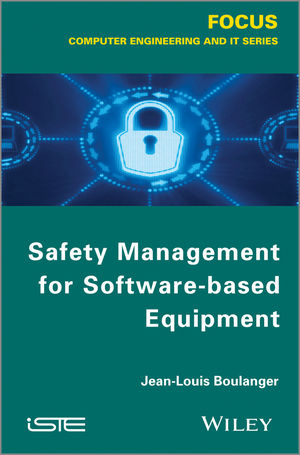
Jean-Louis Boulanger is currently an Independent Safety Assessor (ISA) in the railway sector focusing on software elements. He is a specialist in the field of software engineering (requirement engineering, semi-formal and formal method, proof and model-checking). He also works as an expert for the French notified body CERTIFER in the field of certification of safety critical railway applications based on software (ERTMS, SCADA, automatic subway etc.). His research interests include requirements, software verification and validation, traceability and RAMS with a special focus on SAFETY.
INTRODUCTION ix
CHAPTER 1. SAFETY MANAGEMENT 1
1.1. Introduction 1
1.2. Dependability 1
1.3. Conclusion 8
1.4. Bibliography 8
CHAPTER 2. FROM SYSTEM TO SOFTWARE 9
2.1. Introduction 9
2.2. Systems of command and control 10
2.3 System 13
2.4 Software implementation 14
2.5. Conclusion 16
2.6. Bibliography 17
2.7. Glossary 17
CHAPTER 3. CERTIFIABLE SYSTEMS 19
3.1. Introduction 19
3.2. Normative context 20
3.3. Conclusion 37
3.4. Bibliography 38
3.5. Glossary 41
CHAPTER 4. RISK AND SAFETY LEVELS 43
4.1. Introduction 43
4.2. Basic definitions 43
4.3. Safety implementation 48
4.4. In standards IEC 61508 and IEC 61511 70
4.5. Conclusions 74
4.6. Bibliography 74
4.7. Acronyms 77
CHAPTER 5. PRINCIPLES OF HARDWARE SAFETY 79
5.1. Introduction 79
5.2. Safe and/or available hardware 79
5.3. Reset of a processing unit 80
5.4. Presentation of safety control techniques 81
5.5. Conclusion 117
5.6. Bibliography 118
5.7. Glossary 119
CHAPTER 6. PRINCIPLES OF SOFTWARE SAFETY 121
6.1. Introduction 121
6.2. Techniques to make software application safe 121
6.3. Other forms of diversification 149
6.4. Overall summary 150
6.5. Quality management 150
6.6. Conclusion 155
6.7. Bibliography 156
6.8. Glossary 157
CHAPTER 7. CERTIFICATION 159
7.1. Introduction 159
7.2. Independent assessment 159
7.3. Certification 160
7.4. Certification in the rail sector 161
7.5. Automatic systems 171
7.6. Aircraft 171
7.7. Nuclear 171
7.8. Automotive 172
7.9. Spacecraft 172
7.10 Safety case 172
7.11 Conclusion 173
7.12 Bibliography 174
7.13 Glossary 176
CONCLUSION 177
INDEX 179
| Erscheint lt. Verlag | 6.5.2013 |
|---|---|
| Sprache | englisch |
| Themenwelt | Informatik ► Netzwerke ► Sicherheit / Firewall |
| Technik ► Elektrotechnik / Energietechnik | |
| Technik ► Nachrichtentechnik | |
| Schlagworte | Communication System Security • Computersicherheit • Electrical & Electronics Engineering • Elektrotechnik u. Elektronik • Securization Techniques of Software-based Equipment, Certifiable systems, Securization Principles Of Hardware Architecture, Security Architecture, Software Securization, System Certification • Sicherheit in Kommunikationssystemen |
| ISBN-13 | 9781118578650 / 9781118578650 |
| Informationen gemäß Produktsicherheitsverordnung (GPSR) | |
| Haben Sie eine Frage zum Produkt? |
 PDF (Adobe DRM)
Kopierschutz: Adobe-DRM
Adobe-DRM ist ein Kopierschutz, der das eBook vor Mißbrauch schützen soll. Dabei wird das eBook bereits beim Download auf Ihre persönliche Adobe-ID autorisiert. Lesen können Sie das eBook dann nur auf den Geräten, welche ebenfalls auf Ihre Adobe-ID registriert sind.
Details zum Adobe-DRM
Dateiformat: PDF (Portable Document Format)
Mit einem festen Seitenlayout eignet sich die PDF besonders für Fachbücher mit Spalten, Tabellen und Abbildungen. Eine PDF kann auf fast allen Geräten angezeigt werden, ist aber für kleine Displays (Smartphone, eReader) nur eingeschränkt geeignet.
Systemvoraussetzungen:
PC/Mac: Mit einem PC oder Mac können Sie dieses eBook lesen. Sie benötigen eine
eReader: Dieses eBook kann mit (fast) allen eBook-Readern gelesen werden. Mit dem amazon-Kindle ist es aber nicht kompatibel.
Smartphone/Tablet: Egal ob Apple oder Android, dieses eBook können Sie lesen. Sie benötigen eine
Geräteliste und zusätzliche Hinweise
Buying eBooks from abroad
For tax law reasons we can sell eBooks just within Germany and Switzerland. Regrettably we cannot fulfill eBook-orders from other countries.
aus dem Bereich