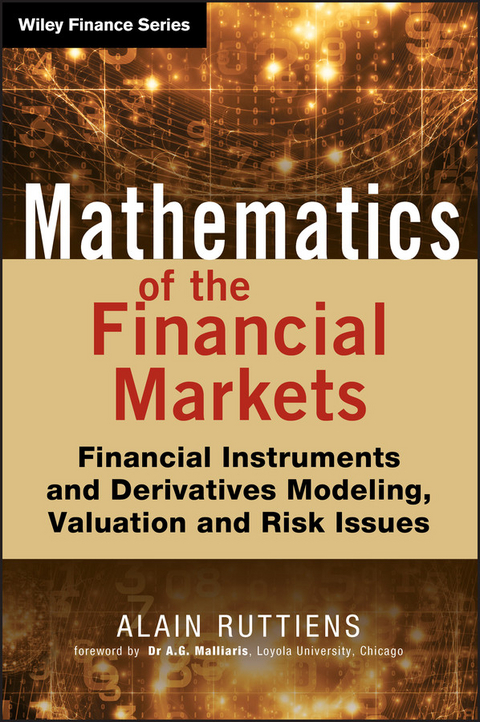
Mathematics of the Financial Markets (eBook)
The book aims to prioritise what needs mastering and presents the content in the most understandable, concise and pedagogical way illustrated by real market examples. Given the variety and the complexity of the materials the book covers, the author sorts through a vast array of topics in a subjective way, relying upon more than twenty years of experience as a market practitioner. The book only requires the reader to be knowledgeable in the basics of algebra and statistics.
The Mathematical formulae are only fully proven when the proof brings some useful insight. These formulae are translated from algebra into plain English to aid understanding as the vast majority of practitioners involved in the financial markets are not required to compute or calculate prices or sensitivities themselves as they have access to data providers. Thus, the intention of this book is for the practitioner to gain a deeper understanding of these calculations, both for a safety reason – it is better to understand what is behind the data we manipulate – and secondly being able to appreciate the magnitude of the prices we are confronted with and being able to draft a rough calculation, aside of the market data.
The author has avoided excessive formalism where possible. Formalism is securing the outputs of research, but may, in other circumstances, burden the understanding by non-mathematicians; an example of this case is in the chapter dedicated to the basis of stochastic calculus.
The book is divided into two parts:
- First, the deterministic world, starting from the yield curve building and related calculations (spot rates, forward rates, discrete versus continuous compounding, etc.), and continuing with spot instruments valuation (short term rates, bonds, currencies and stocks) and forward instruments valuation (forward forex, FRAs and variants, swaps & futures);
- Second, the probabilistic world, starting with the basis of stochastic calculus and the alternative approach of ARMA to GARCH, and continuing with derivative pricing: options, second generation options, volatility, credit derivatives;
- This second part is completed by a chapter dedicated to market performance & risk measures, and a chapter widening the scope of quantitative models beyond the Gaussian hypothesis and evidencing the potential troubles linked to derivative pricing models.
Mathematics of the Financial Markets Financial Instruments and Derivatives Modeling, Valuation and Risk Issues "e;Alain Ruttiens has the ability to turn extremely complex concepts and theories into very easy to understand notions. I wish I had read his book when I started my career!"e; Marco Dion, Global Head of Equity Quant Strategy, J.P. Morgan "e;The financial industry is built on a vast collection of financial securities that can be valued and risk profiled using a set of miscellaneous mathematical models. The comprehension of these models is fundamental to the modern portfolio and risk manager in order to achieve a deep understanding of the capabilities and limitations of these methods in the approximation of the market. In his book, Alain Ruttiens exposes these models for a wide range of financial instruments by using a detailed and user friendly approach backed up with real-life data examples. The result is an excellent entry-level and reference book that will help any student and current practitioner up their mathematical modeling skills in the increasingly demanding domain of asset and risk management."e; Virgile Rostand, Consultant, Toronto ON "e;Alain Ruttiens not only presents the reader with a synthesis between mathematics and practical market dealing, but, more importantly a synthesis of his thinking and of his life."e; Ren Chopard, CEO, Centro di Studi Bancari Lugano, Vezia / Professor, Universit dell'Insubria, Varese "e;Alain Ruttiens has written a book on quantitative finance that covers a wide range of financial instruments, examples and models. Starting from first principles, the book should be accessible to anyone who is comfortable with trading strategies, numbers and formulas."e; Dr Yuh-Dauh Lyuu, Professor of Finance & Professor of Computer Science & Information Engineering, National Taiwan University
About the author ALAIN RUTTIENS has an MA degree in Chemical Engineering (Faculté Polytechnique de Mons, Belgium). He joined the former Banque Indosuez in Belgium in 1981, and ended his bank career as Director of Financial Engineering Department in CBC Banque, Brussels (affiliate of KBC Bank). In 2004, he started his own business as Partner of NEURON sàrl, consulting on financial markets and funds management (Luxembourg). He is also Affiliate Professor at the Ecole Supérieure de Commerce de Paris, and teaches in several universities and institutions, a.o. HEC Paris, the Sorbonne University of Paris I, the Institut d'Etudes Politiques (Paris), and the Ecole Supérieure des Affaires, Beirut (Lebanon). Alain is the author of several books and research papers.
Foreword by A.G. MALLIARIS, Loyola University, Chicago xi
Main Notations xiii
Introduction xv
PART I THE DETERMINISTIC ENVIRONMENT
1 Prior to the Yield Curve: Spot and Forward Rates 3
2 The Term Structure or Yield Curve 13
3 Spot Instruments 23
4 Equities and Stock Indexes 47
5 Forward Instruments 75
6 Swaps 91
7 Futures 119
PART II THE PROBABILISTIC ENVIRONMENT
8 The Basis of Stochastic Calculus 147
9 Other Financial Models: From ARMA to the GARCH Family 165
10 Option Pricing in General 175
11 Options on Specific Underlyings and Exotic Options 209
12 Volatility and Volatility Derivatives 237
13 Credit Derivatives 257
14 Market Performance and Risk Measures 275
15 Beyond the Gaussian Hypothesis: Potential Troubles with Derivatives Valuation 303
Bibliography 319
Index 323
| Erscheint lt. Verlag | 25.4.2013 |
|---|---|
| Reihe/Serie | The Wiley Finance Series |
| Wiley Finance Series | Wiley Finance Series |
| Sprache | englisch |
| Themenwelt | Mathematik / Informatik ► Mathematik ► Angewandte Mathematik |
| Recht / Steuern ► Wirtschaftsrecht | |
| Wirtschaft ► Betriebswirtschaft / Management ► Finanzierung | |
| Schlagworte | Array • author • Book • Chicago • deterministic • Environment • Finance & Investments • Financial Engineering • Finanztechnik • Finanz- u. Anlagewesen • Forward • Introduction • Market • Materials • notations • Part • Practitioner • Prior • real market examples • sorts • SPOT • subjective way • Topics • Twenty • variety • vast • Way • xi main • years • yield |
| ISBN-13 | 9781118513484 / 9781118513484 |
| Informationen gemäß Produktsicherheitsverordnung (GPSR) | |
| Haben Sie eine Frage zum Produkt? |
 EPUB (Adobe DRM)
Kopierschutz: Adobe-DRM
Adobe-DRM ist ein Kopierschutz, der das eBook vor Mißbrauch schützen soll. Dabei wird das eBook bereits beim Download auf Ihre persönliche Adobe-ID autorisiert. Lesen können Sie das eBook dann nur auf den Geräten, welche ebenfalls auf Ihre Adobe-ID registriert sind.
Details zum Adobe-DRM
Dateiformat: EPUB (Electronic Publication)
EPUB ist ein offener Standard für eBooks und eignet sich besonders zur Darstellung von Belletristik und Sachbüchern. Der Fließtext wird dynamisch an die Display- und Schriftgröße angepasst. Auch für mobile Lesegeräte ist EPUB daher gut geeignet.
Systemvoraussetzungen:
PC/Mac: Mit einem PC oder Mac können Sie dieses eBook lesen. Sie benötigen eine
eReader: Dieses eBook kann mit (fast) allen eBook-Readern gelesen werden. Mit dem amazon-Kindle ist es aber nicht kompatibel.
Smartphone/Tablet: Egal ob Apple oder Android, dieses eBook können Sie lesen. Sie benötigen eine
Geräteliste und zusätzliche Hinweise
Buying eBooks from abroad
For tax law reasons we can sell eBooks just within Germany and Switzerland. Regrettably we cannot fulfill eBook-orders from other countries.
aus dem Bereich