


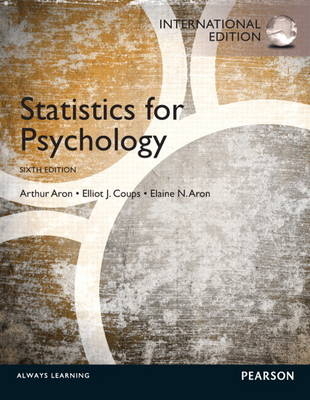
Statistics for Psychology, plus MyStatLab with Pearson eText
Pearson Education Limited
978-1-4479-5890-1 (ISBN)
- Titel ist leider vergriffen;
keine Neuauflage - Artikel merken
Emphasizing meaning and concepts, not just symbols and numbers
Statistics for Psychology, 6th edition places definitional formulas center stage to emphasize the logic behind statistics and discourage rote memorization. Each procedure is explained in a direct, concise language and both verbally and numerically.
MyStatLab is an integral part of the Statistics course. MyStatLab gives students practice with hundreds of homework problems. Every problem includes tools to help students understand and solve each problem - and grades all of the problems for instructors. MyStatLab also includes tests, quizzes, eText, a Gradebook, a customizable study plan, and much more.
Learning Goals
Upon completing this book, readers should be able to:
Know both definitional and numerical formulas and how to apply them
Understand the logic behind each formula
Expose students to the latest thinking in statistical theory and application
Prepare students to read research articles
Learn how to use SPSS
MyLab and Mastering from Pearson improve results for students and educators. Used by over ten million students, they effectively engage learners at every stage.
MyStatLab is being used in universities all over the world to improve student performance. MyStatLab has immersive content and engaging tools, along with time-saving automatic grading. "What students especially like about the system is that they get immediate feedback from MyStatLab on whether the exercise was right or wrong. I would recommend MyStatLab to another lecturer because I think I became a better lecturer in statistics, [as now] I'm able to provide individual students with better feedback." - Dr Patrick Stroobandt, Plantijn Hogeschool, Belgium
With MyStatLab, students gain knowledge that they will use throughout their lives, and universities gain a partner deeply committed to helping students and educators achieve their goals.
For students
Pearson eText gives you access to an eBook that can be used on the go, and allows you to highlight, search and take notes as you read online. Access to the eBook depends on the package you have bought.
Help Me Solve This breaks the problem down into manageable chunks so you can work through the methodology a stage at a time, applying what you've learnt as you go along.
MyStatLab questions often require you to draw or interpret graphs or statistical data. The integrated StatCrunch software allows your students to analyse the data set in the question and draw conclusions with a simple click.
For educators
Online assignments, tests, quizzes can be easily created and assigned to students.
Gradebook: Assignments are automatically graded and visible at a glance.
Register now to benefit from these resources.
A student access code card is included with your textbook at a reduced cost. To register with your code, visit www.mystatlab.co.uk.
For educator access, contact your Pearson account manager. To find out who your account manager is, visit www.pearsoned.co.uk/replocator
For more instructor resources available with this title, visit www.pearsoned.co.uk
In this Section:
1. Brief Table of Contents
2. Full Table of Contents
1. BRIEF TABLE OF CONTENTS
Chapter 1 Displaying the order in a group of numbers
Chapter 2 Central tendency and variability
Chapter 3 Some key ingredients for inferential statistics: Z scores, the normal curve, sample versus
population, and probability
Chapter 4 Introduction to hypothesis testing
Chapter 5 Hypothesis testing with means of samples
Chapter 6 Making sense of statistical significance: Effect size and statistical power
Chapter 7 Introduction to the t test: Single sample and dependent means
Chapter 8 The t test for independent means
Chapter 9 Introduction to the analysis of variance
Chapter 10 Factorial analysis of variance
Chapter 11 Correlation
Chapter 12 Prediction
Chapter 13 Chi-square tests
Chapter 14 Strategies when population distributions are not normal: Data transformations and rank-order
tests
Chapter 15 Integration and the general linear model and Making sense of advanced statistical procedures in
research articles
2. FULL TABLE OF CONTENTS
Chapter 1: Displaying the order in a group of numbers
The Two Branches of Statistical Methods
Some Basic Concepts
Frequency Tables
Histograms
Shapes of Frequency Distributions
Controversy: Misleading Graphs
Frequency Tables and Histograms in Research Articles
Summary
Key Terms
Example Worked-Out Problems
Practice Problems
Using SPSS
Chapter Note
Chapter 2: Central tendency and variability
Central Tendency
Variability
Controversy: The Tyranny of the Mean
Central Tendency and Variability in Research Articles
Summary
Key Terms
Example Worked-Out Problems
Practice Problems
Using SPSS
Chapter Note
Chapter 3: Some key ingredients for inferential statistics: Z scores, the normal curve, sample versus
population, and probability
Z Scores
The Normal Curve
Sample and Population
Probability
Controversies: Is the Normal Curve Really So Normal? And Using Nonrandom Samples
Z Scores, Normal Curves, Samples and Populations, and Probabilities in Research Articles
Advanced Topics: Probability Rules and Conditional Probabilities
Summary
Key Terms
Example Worked-Out Problems
Practice Problems
Using SPSS
Chapter Note
Chapter 4: Introduction to hypothesis testing
A Hypothesis-Testing Example
The Core Logic of Hypothesis Testing
The Hypothesis-Testing Process
One-Tailed and Two-Tailed Hypothesis Tests
Controversy: Should Significance Tests Be Banned?
Hypothesis Tests in Research Articles
Summary
Key Terms
Example Worked-Out Problems
Practice Problems
Using SPSS
Chapter Note
Chapter 5: Hypothesis testing with means of samples
The Distribution of Means
Hypothesis Testing with a Distribution of Means: The Z Test
Controversy: Marginal Significance
Hypothesis Tests About Means of Samples (Z Tests) and Standards Errors in Research Articles
Advanced Topic: Estimation, Standard Errors, and Confidence Intervals
Advanced Topic Controversy: Confidence Intervals versus Significance Tests
Advance Topic: Confidence Intervals in Research Articles
Summary
Key Terms
Example Worked-Out Problems
Practice Problems
Using SPSS
Chapter Note
Chapter 6: Making sense of statistical significance: Effect size and statistical power
Decision Errors
Effect Size
Statistical Power
What Determines the Power of Study
The Role of Power Interpreting the Results of a Study
Controversy: Statistical Significance versus Effect Size
Decision Errors, Effect Size, and Power in Research Articles
Advanced Topics; Figuring Statistical Power
Summary
Key Terms
Example Worked-Out Problems
Practice Problems
Using SPSS
Chapter Note
Chapter 7: Introduction to the t test: Single sample and dependent means
The t Test for a Single Sample
The t Test for Dependent Means
Assumptions of the t Test for a Single Sample and the t Test for Dependent Means
Controversy: Advantages and Disadvantages of Repeated-Measures Designs
Single Sample t Tests and Dependent Means t Tests in Research Articles
Summary
Key Terms
Example Worked-Out Problems
Practice Problems
Using SPSS
Chapter Note
Chapter 8: The t test for independent means
The Distribution of Differences Between Means
Hypothesis Testing with a t Test for Independent Means
Assumptions of the t Test for Independent Means
Effect Size and Power for the t Test for Independent Means
Review and Comparison of the Three Kinds of t Tests
The t Test for Independent Means in Research Articles
Advanced Topic: Power for the t Test for Independent Means When Sample Sizes Are Not Equal
Summary
Key Terms
Example Worked-Out Problems
Practice Problems
Using SPSS
Chapter Note
Chapter 9: Introduction to the analysis of variance
Basic Logic of the Analysis of Variance
Carrying Out an Analysis of Variance
Hypothesis Testing with the Analysis of Variance
Assumptions in the Analysis of Variance
Planned Contrasts
Post Hoc Comparisons
Effect Size and Power for the Analysis of Variance
Controversy: Omnibus Tests versus Planned Contrasts
Analyses of Variance in Research Articles
Advanced Topic: The Structural Model in the Analysis of Variance
Principles of the Structural Model
Summary
Key Terms
Example Worked-Out Problems
Practice Problems
Using SPSS
Chapter Note
Chapter 10: Factorial analysis of variance
Basic Logic of Factorial Designs and Interaction Effects
Recognizing and Interpreting Interaction Effect
Basic Logic of the Two-Way Analysis of Variance
Assumptions in the Factorial Analysis of Variance
Extensions and Special Cases of the Analysis of Variance
Controversy: Dichotomizing Numeric Variables
Factorial Analysis of Variance in Research Articles
Advanced Topic: Figuring a Two-Way Analysis of Variance
Advanced Topic: Power and Effect Size in the Factorial Analysis of Variance
Summary
Key Terms
Example Worked-Out Problems
Practice Problems
Using SPSS
Chapter Note
Chapter 11: Correlation
Graphing Correlations: The Scatter Diagram
Patterns in Correlation
The Correlation Coefficient
Significance of a Correlation Coefficient
Correlation and Causality
Issues in Interpreting the Correlation Coefficient
Effect Size and Power for the Correlation Coefficient
Controversy: What is a Large Correlation?
Correlation in Research Articles
Summary
Key Terms
Example Worked-Out Problems
Practice Problems
Using SPSS
Chapter Note
Chapter 12: Prediction
Predictor (X) and Criterion (Y) Variables
The Linear Prediction Rule
The Regression Line
Finding the Best Linear Prediction Rule
The Least Squared Error Principle
Issues in Prediction
Multiple Regression
Limitations of Prediction
Controversy: Unstandardized and Standardized Regression Coefficients; Comparing Predictors
Prediction in Research Articles
Advanced Topic: Error and Proportionate Reduction in Error
Summary
Key Terms
Example Worked-Out Problems
Practice Problems
Using SPSS
Chapter Note
Chapter 13: Chi-square tests
The Chi-Square Statistic and the Chi-Square Test for Goodness of Fit
The Chi-Square Test for Independence
Assumptions for Chi-Square Tests
Effect Size and Power for Chi-Tests for Independence
Controversy: The Minimum Expected Frequency
Chi-Square Tests in Research Articles
Summary
Key Terms
Example Worked-Out Problems
Practice Problems
Using SPSS
Chapter Note
Chapter 14: Strategies when population distributions are not normal: Data transformations and
rank-order tests
Assumptions in the Standard Hypothesis-Testing Procedures
Data Transformations
Rank-Order Tests
Comparison of Methods
Controversy: Computer-Intensive Methods
Data Transformations and Rank-Order Tests in Research Articles
Summary
Key Terms
Example Worked-Out Problems
Practice Problems
Using SPSS
Chapter Note
Chapter 15: Integration and the general linear model and Making sense of advanced statistical
procedures in research articles
The General Linear
Partial Correlation
Reliability
Multilevel Modeling
Factor Analysis
Casual Modeling
Procedures That Compare Groups
Analysis of Covariance (ANCOVA)
Multivariate Analysis of Variance (MANOVA) and Multivariate Analysis of Covariance (MANCOVA)
Overview of Statistical Techniques
Controversy: Should Statistics Be Controversial?
How to Read Results Using Unfamiliar Statistical Techniques
Summary
Key Terms
Example Worked-Out Problems
Practice Problems
Using SPSS
Chapter Note
| Verlagsort | Harlow |
|---|---|
| Sprache | englisch |
| Maße | 203 x 256 mm |
| Gewicht | 1236 g |
| Themenwelt | Geisteswissenschaften ► Psychologie |
| Mathematik / Informatik ► Mathematik ► Statistik | |
| Sozialwissenschaften ► Soziologie ► Empirische Sozialforschung | |
| ISBN-10 | 1-4479-5890-X / 144795890X |
| ISBN-13 | 978-1-4479-5890-1 / 9781447958901 |
| Zustand | Neuware |
| Informationen gemäß Produktsicherheitsverordnung (GPSR) | |
| Haben Sie eine Frage zum Produkt? |
aus dem Bereich


