


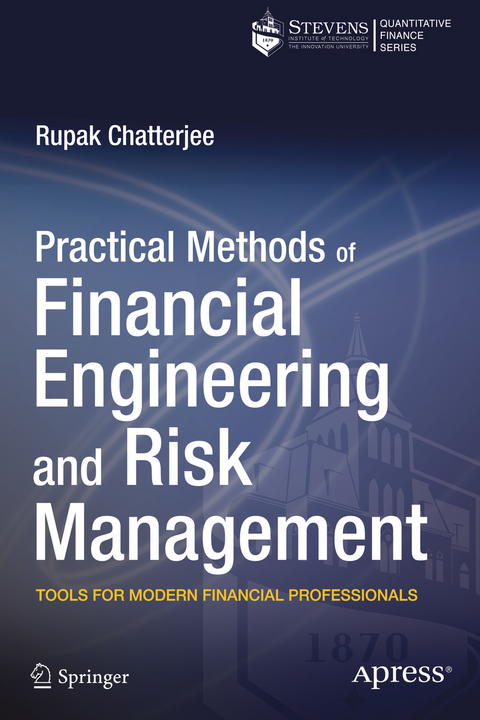
Practical Methods of Financial Engineering and Risk Management
Apress (Verlag)
9781430261339 (ISBN)
In Practical Methods of Financial Engineering and Risk Management, Dr. Rupak Chatterjee— former director of the multi-asset quantitative research group at Citi—introduces finance professionals and advanced students to the latest concepts, tools, valuation techniques, and analytic measures being deployed by the more discerning and responsive Wall Street practitioners, on all operational scales from day trading to institutional strategy, to model and analyze more faithfully the real behavior and risk exposure of financial markets in the cold light of the post-2008 realities. Until one masters this modern skill set, one cannot allocate risk capital properly, price and hedge derivative securities realistically, or risk-manage positions from the multiple perspectives of market risk, credit risk, counterparty risk, and systemic risk.
The book assumes a working knowledge of calculus, statistics, and Excel, but it teaches techniques from statistical analysis, probability, and stochastic processes sufficient to enable the reader to calibrate probability distributions and create the simulations that are used on Wall Street to valuate various financial instruments correctly, model the risk dimensions of trading strategies, and perform the numerically intensive analysis of risk measures required by various regulatory agencies.
RupakChatterjee,Ph.D., is an Industry Professor and the Deputy Director of the FinancialEngineering Division at the Stevens Institute of Technology. He is also theProgram Manager for the Accenture-Stevens Financial Services Analytics graduateprogram. Dr. Chatterjee has over fifteen years of experience as a quantitativeanalyst working for various Wall Street firms. His last role before returningto academia was as the Director of the Multi-Asset Hybrid DerivativesQuantitative Research group at Citi in New York. He was also the global BaselIII coordinator for all the modeling efforts needed to satisfy the newregulatory risk requirements. Previously, he was a quantitative analyst atBarclays Capital, a vice president at Credit Suisse, and a senior vice presidentat HSBC. His educational background is in theoretical physics, which he studiedat the University of Waterloo, Stony Brook University, and the University ofChicago. His research interests have included discrete time hedging problemsusing the Optimal Hedging Monte Carlo (OHMC) method and the design andexecution of systematic trading strategies that embody the hallmarks of capitalpreservation and measured risk-taking.
Chapter 1. Financial InstrumentsChapter 2. Building a Yield CurveChapter 3. Statistical Analysis of Financial DataChapter 4. Stochastic ProcessesChapter 5. Optimal Hedging Monte Carlo (OHMC) MethodsChapter 6. Introduction to Credit DerivativesChapter 7. Basel II, Basel III, and Credit Valuation Adjustment (CVA)Chapter 8. Modeling Extreme Moves with Power LawsChapter 9. Asset Replication
| Erscheint lt. Verlag | 11.8.2014 |
|---|---|
| Zusatzinfo | 186 Illustrations, black and white; XXIV, 388 p. 186 illus. |
| Verlagsort | Berkley |
| Sprache | englisch |
| Maße | 178 x 254 mm |
| Themenwelt | Mathematik / Informatik ► Informatik |
| Wirtschaft ► Betriebswirtschaft / Management ► Finanzierung | |
| Wirtschaft ► Betriebswirtschaft / Management ► Unternehmensführung / Management | |
| Schlagworte | Finanzmanagement • Risikomanagement |
| ISBN-13 | 9781430261339 / 9781430261339 |
| Zustand | Neuware |
| Informationen gemäß Produktsicherheitsverordnung (GPSR) | |
| Haben Sie eine Frage zum Produkt? |
aus dem Bereich


