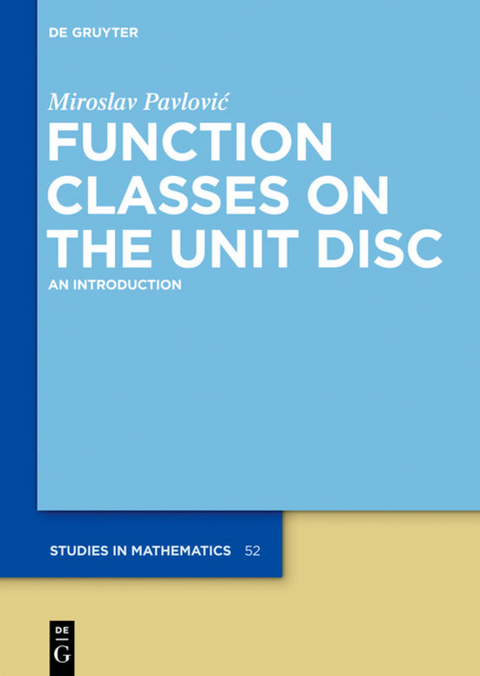
Function Classes on the Unit Disc
De Gruyter (Verlag)
978-3-11-028123-1 (ISBN)
This monograph contains a study on various function classes, a number of new results and new or easy proofs of old results (Fefferman-Stein theorem on subharmonic behavior, theorems on conjugate functions and fractional integration on Bergman spaces, Fefferman's duality theorem), which are interesting for specialists; applications of the Hardy-Littlewood inequalities on Taylor coefficients to (C, α)-maximal theorems and (C, α)-convergence; a study of BMOA, due to Knese, based only on Green's formula; the problem of membership of singular inner functions in Besov and Hardy-Sobolev spaces; a full discussion of g-function (all p > 0) and Calderón's area theorem; a new proof, due to Astala and Koskela, of the Littlewood-Paley inequality for univalent functions; and new results and proofs on Lipschitz spaces, coefficient multipliers and duality, including compact multipliers and multipliers on spaces with non-normal weights. It also contains a discussion of analytic functions and lacunary series with values in quasi-Banach spaces with applications to function spaces and composition operators. Sixteen open questions are posed. The reader is assumed to have a good foundation in Lebesgue integration, complex analysis, functional analysis, and Fourier series. Further information can be found at the author's website at http://poincare.matf.bg.ac.rs/~pavlovic.
Miroslav Pavlović, University of Belgrade, Serbia.
Preface
1 Quasi-Banach spaces
1.1 Quasinorm and p-norm
1.2 Linear operators
1.3 The closed graph theorem
The open mapping theorem
The uniform boundedness principle
The closed graph theorem
1.4 F-spaces
1.5 The spaces lp
1.6 Spaces of analytic functions
1.7 The Abel dual of a space of analytic functions
1.7a Homogeneous spaces
2 Interpolation and maximal functions
2.1 The Riesz/Thorin theorem
2.2 Weak Lp-spaces and Marcinkiewicz's theorem
2.3 The maximal function and Lebesgue points
2.4 The Rademacher functions and Khintchine's inequality
2.5 Nikishin's theorem
2.6 Nikishin and Stein's theorem
2.7 Banach's principle, the theorem on a.e. convergence, and Sawier's theorems
2.8 Addendum: Vector-valued maximal theorem
3 Poisson integral
3.1 Harmonic functions
3.1a Green's formulas
3.1b The Poisson integral
3.2 Borel measures and the space h1
3.3 Positive harmonic functions
3.4 Radial and non-tangential limits of the Poisson integral
3.4a Convolution of harmonic functions
3.5 The spaces hp and Lp(T)
3.6 A theorem of Littlewood and Paley
3.7 Harmonic Schwarz lemma
4 Subharmonic functions
4.1 Basic properties
4.1a The maximum principle
4.1b Approximation by smooth functions
4.2 Properties of the mean values
4.3 Integral means of univalent functions
Prawitz' theorem
Distortion theorems
4.4 The subordination principle
4.5 The Riesz measure
Green's formula
The Riesz measure of | f |p (f H(D)) and | u |p (u hp)
5 Classical Hardy spaces
5.1 Basic properties
The decomposition lemma of Hardy and Littlewood
5.1a Radial limits
The Poisson integral of log | f* |
5.2 The space H1
5.3 Blaschke products
Riesz' factorization theorem
5.4 Some inequalities
5.5 Inner and outer functions
5.5a Beurling's approximation theorem
5.6 Composition with inner functions. Stephenson's theorems
5.6a Approximation by inner functions
6 Conjugate functions
6.1 Harmonic conjugates
6.1a The Privalov/Plessner theorem and the Hilbert operator
6.2 Riesz projection theorem
6.2a The Hardy/Stein identity
6.2b Proof of Riesz' theorems
6.3 Applications of the projection theorem
6.4 Aleksandrov's theorem: Lp(T) = Hp(T) + /overline{Hp}(T)
6.5 Strong convergence in H1
6.6 Quasiconformal harmonic homeomorphisms and the Hilbert transformation
7 Maximal functions, interpolation, and coefficients
7.1 Maximal theorems
7.1a Hardy/Littlewood/Sobolev theorem
7.2 Maximal characterization of Hp (Burkholder, Gundy and Silverstein)
7.3 "Smooth" Cesàro means
s -maximal theorem
The "W-maximal" theorem
7.4 Interpolation of operators on Hardy spaces
7.4a Application to Taylor coefficients and mean growth
7.4b On the Hardy/Littlewood inequality
7.4c The case of monotone coefficients
7.5 Lacunary series
7.6 A proof of the s -maximal theorem
8 Bergman spaces: Atomic decomposition
8.1 Bergman spaces
8.2 Reproducing kernels
8.3 The Coifman/Rochberg theorem
q-envelops of Hardy spaces
8.4 Coefficients of vector-valued functions. Kalton's theorems
8.4a Inequalities for a Hadamard product
8.4b Applications to spaces of scalar valued functions
9 Lipschitz spaces
9.1 Lipschitz spaces of first order
9.2 Conjugate functions
9.3 Lipschitz condition for the modulus. Dyakonov's theorems with simple proofs by Pavlovic
9.4 Lipschitz spaces of higher order
9.5 Lipschitz spaces as duals of Hp, p < 1
10 Generalized Bergman spaces and Besov spaces
10.1 Decomposition of mixed norm spaces: case 1 < p <
10.1a Besov spaces
10.2 Decomposition of mixed norm spaces: case 0 < p
10.2a Radial limits of Hardy/Bloch functions
10.2b Fractional integration and differentiation
10.3 Möbius invariant Besov spaces
10.4 Mean Lipschitz spaces
10.4a Lacunary series in mixed norm spaces
10.5 Duality in the case 0 < p
10.6 Appendix: Characterizations of Besov spaces
11 BMOA, Bloch space
11.1 The dual of H1 and the Carleson measures
Proof of Fefferman's theorem
11.2 Vanishing mean osillation
11.3 BMOA and mean Lipschitz spaces
11.4 Coefficients of BMOA-functions
11.4a Lacunary series
11.5 The Bloch space
11.5a On the predual of B
Functions with decreasing coefficients
12 Subharmonic behavior
12.1 Subharmonic behavior and Bergman spaces
Two simple proofs of Hardy/Littlewood/Fefferman/Stein theorem
12.2 The space hp, p < 1
Two open problems posed by Hardy and Littlewood
12.3 Subharmonic behavior of smooth functions
12.3a Quasi-nearly subharmonic functions
12.3b Regularly oscillating functions
12.4 A generalization of the Littlewood/Paley theorem
12.4a Invariant Besov spaces and the derivatives of the integral means
12.4b Addendum: The case of vector valued functions
12.5 Mixed norm spaces of harmonic functions
13 Littlewood/Paley theory
13.1 Some more vector maximal functions
13.2 The Littlewood/Paley g-function
Calderon's generalization of the area theorem (p > 0)
A proof of a the Littlewood/Paley g-theorem (p > 0)
13.3 Applications of Cesàro means
13.4 The Littlewood/Paley g-theorem in a generalized form
An improvement
13.5 Proof of Calderon's theorem
14 Tauberian theorems and lacunary series on the interval (0,1)
14.1 Karamata's theorem and Littlewood's theorem
14.1a Tauberian nature of p1/p
14.2 Lacunary series in C[0,1]
14.2a Lacunary series on weighted L -spaces
14.3 Lp-integrability of lacunary series on (0,1)
14.3a Some consequences
Bibliography
"In this ambitious book, the author treats a number of topics from the theory of functions and function spaces on the unit disc in the complex plane. The selection of topics is far ranging, and includes both classical and modern ideas. Many of his proofs are new or unusual, and many of his ideas and presentations appear here in book form for the first time." - Steven G. Krantz, Mathematical Reviews
"[...] this is a well-written and detailed text with concise proofs. Graduate students and researchers who are pursuing research in harmonic or holomorphic function theory of one or several variables will find this book to be an excellent addition to their personal library." - Manfred Stoll, Zentralblatt für Mathematik
| Erscheint lt. Verlag | 12.12.2013 |
|---|---|
| Reihe/Serie | De Gruyter Studies in Mathematics ; 52 |
| Verlagsort | Berlin/Boston |
| Sprache | englisch |
| Maße | 170 x 240 mm |
| Gewicht | 908 g |
| Themenwelt | Schulbuch / Wörterbuch ► Lexikon / Chroniken |
| Mathematik / Informatik ► Mathematik ► Analysis | |
| Schlagworte | Bergman space • Bergman spaces • Besov-Lipschitz Space • bounded mean oscillation • Funktion (Mathematik) • Hardy space • Hardy Space; Bergman Space; Bounded Mean Oscillation; Besov-Lipschitz Space; Littlewood-Paley g-Function • Hardy Spaces • Harmonic Functions • H^p spaces • Littlewood-Paley g-Function • L^p spaces • Quasinormed spaces |
| ISBN-10 | 3-11-028123-6 / 3110281236 |
| ISBN-13 | 978-3-11-028123-1 / 9783110281231 |
| Zustand | Neuware |
| Informationen gemäß Produktsicherheitsverordnung (GPSR) | |
| Haben Sie eine Frage zum Produkt? |
aus dem Bereich