


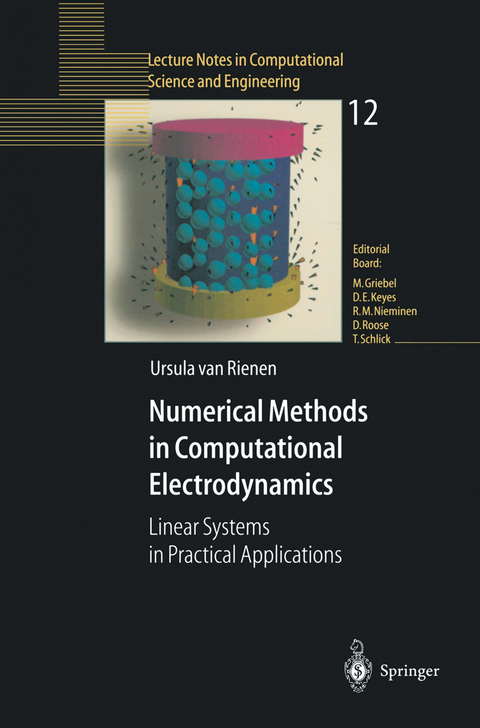
Numerical Methods in Computational Electrodynamics
Linear Systems in Practical Applications
Seiten
2000
Springer Berlin (Verlag)
9783540676294 (ISBN)
Springer Berlin (Verlag)
9783540676294 (ISBN)
treated in more detail. They are just specimen of larger classes of schemes. Es sentially, we have to distinguish between semi-analytical methods, discretiza tion methods, and lumped circuit models. The semi-analytical methods and the discretization methods start directly from Maxwell's equations. Semi-analytical methods are concentrated on the analytical level: They use a computer only to evaluate expressions and to solve resulting linear algebraic problems. The best known semi-analytical methods are the mode matching method, which is described in subsection 2. 1, the method of integral equations, and the method of moments. In the method of integral equations, the given boundary value problem is transformed into an integral equation with the aid of a suitable Greens' function. In the method of moments, which includes the mode matching method as a special case, the solution function is represented by a linear combination of appropriately weighted basis func tions. The treatment of complex geometrical structures is very difficult for these methods or only possible after geometric simplifications: In the method of integral equations, the Greens function has to satisfy the boundary condi tions. In the mode matching method, it must be possible to decompose the domain into subdomains in which the problem can be solved analytically, thus allowing to find the basis functions. Nevertheless, there are some ap plications for which the semi-analytic methods are the best suited solution methods. For example, an application from accelerator physics used the mode matching technique (see subsection 5. 4).
1.Classical Electrodynamics.- 2. Numerical Field Theory.- 3. Numerical Treatment of Linear Systems.- 4. Applications from Electrical Engineering.- 5. Applications from Accelerator Physics.- Summary.- References.- Symbols.
| Erscheint lt. Verlag | 12.12.2000 |
|---|---|
| Reihe/Serie | Lecture Notes in Computational Science and Engineering |
| Zusatzinfo | XIII, 375 p. 122 illus., 91 illus. in color. |
| Verlagsort | Berlin |
| Sprache | englisch |
| Maße | 155 x 235 mm |
| Gewicht | 616 g |
| Themenwelt | Mathematik / Informatik ► Informatik ► Theorie / Studium |
| Schlagworte | 65C20 • 65C20 65F10, 65F50, 65N06, 65N12, 65N22, • 65F05 • 65F10 • 65F50 • 65N06 • 65N12 • 65N22 • 65N25 • 65N50 • 65N55 • 78-02 • 78-04 • 78-08 • 78A25 • 78A30 • 78A35 • 78A40 • 78A45 • accelerator physic • algorithm • Beschleunigerphysik • comput • computational electrodynamics • computational science and engineering • electrical engineering and communications engineering • Elektrodynamik • Elektrotechnik und Informationstechnik • HTS • Lineares System • Mathematics • Numerical analysis • Numerical Methods • Numerische Analysis • numerische Berechnung elektromagnetischer Felder und Wellen • Numerische Mathematik • Scientific Computing • Scientific Computing / Wissenschaftliches Rechnen • Simulation • wissenschaftliches Rechnen |
| ISBN-13 | 9783540676294 / 9783540676294 |
| Zustand | Neuware |
| Informationen gemäß Produktsicherheitsverordnung (GPSR) | |
| Haben Sie eine Frage zum Produkt? |
Mehr entdecken
aus dem Bereich

aus dem Bereich
was jeder über Informatik wissen sollte
Buch | Softcover (2024)
Springer Vieweg (Verlag)
CHF 53,15
Grundlagen – Anwendungen – Perspektiven
Buch | Softcover (2022)
Springer Vieweg (Verlag)
CHF 53,15
Teil 2 der gestreckten Abschlussprüfung Fachinformatiker/-in …
Buch | Softcover (2025)
Europa-Lehrmittel (Verlag)
CHF 37,90


