Precalculus, plus MyMathLab with Pearson eText
Pearson Education Limited
978-1-4479-5335-7 (ISBN)
- Titel erscheint in neuer Auflage
- Artikel merken
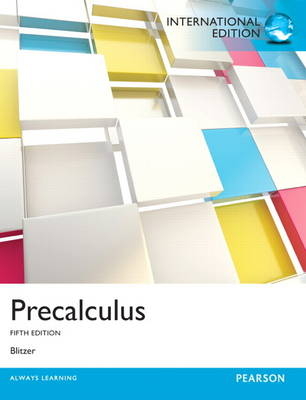
Bob Blitzer has inspired thousands of students with his engaging approach to mathematics, making this beloved series the #1 in the market. Blitzer draws on his unique background in mathematics and behavioral science to present the full scope of mathematics with vivid applications in real-life situations. Students stay engaged because Blitzer often uses pop-culture and up-to-date references to connect math to students' lives, showing that their world is profoundly mathematical.
With the Fifth Edition, Blitzer takes student engagement to a whole new level. In addition to the multitude of exciting updates to the text and MyMathLab (R) course, new application-based MathTalk videos allow students to think about and understand the mathematical world in a fun, yet practical way. Assessment exercises allow instructors to assign the videos and check for understanding of the mathematical concepts presented.
The MyMathLab (R) online course engages students and keeps them thinking. Access code is required.
Ready to Go Courses make it easier for instructors to get started with MyMathLab. Each course includes author-chosen, pre-assigned homework, integrated review questions, and quizzes, to make creating a course even simpler.
MathTalk Videos arefun, application-based videos featuring Andrew Vickers showing students how the math they are learning in Blitzer applies to the real world. Filmed on location in New York City and Boston, these instructional videos have a sense of humor while demonstrating how everyday life is full of math applications and give the students context on why they should care. They will also have an accompanying Instructor Guide and video assessment questions assignable in MyMathLab.
Interactive Figures are now available, enabling users to manipulate figures to bring hard-to-convey math concepts to life. These are also assignable in MyMathLab.
Section-Lecture Videos provide lectures for each section of the text to help students review important concepts and procedures 24/7.
Chapter Test Prep Videos allow students to work through step-by-step solutions to all of the Chapter Test exercises from the textbook. These are available in MyMathLab and on YouTube.
The downloadable Learning Guide begins each chapter with an engaging application and is organized by objective, providing additional examples and exercises for students to work through for greater conceptual understanding and mastery of mathematical topics. The Learning Guide is available for download as PDF and Word (R) files from MyMathLab. It can also be packaged with the textbook and MyMathLab access code.
MyLab and Mastering from Pearson improve results for students and educators. Used by over ten million students, they effectively engage learners at every stage.
Since 2001, MyMathLab--along with MyStatLab and MathXL, have helped over 9 million students succeed at more than 1,900 colleges and universities. MyMathLab engages students in active learning-it's modular, self-paced, accessible anywhere with Web access, and adaptable to each student's learning style-and instructors can easily customize MyMathLab to better meet their students' needs.
For students
MyMathLab's homework and practice exercises are correlated to the exercises in the textbook, and they regenerate algorithmically to give students unlimited opportunity for practice and mastery.
You will work one-on-one, in real-time with a tutor using an interactive whiteboard. Tutors will guide you through solving your problems.
The MathXL Exercise Builder (MEB) for MyMathLab lets you create static and algorithmic online exercises for your online assignments.
For educators
Create, import, and manage online homework assignments, quizzes, and tests that are automatically graded, allowing you to spend less time grading and more time teaching.
The MathXL Exercise Builder (MEB) for MyMathLab lets you create static and algorithmic online exercises for your online assignments.
For educator access, contact your Pearson Account Manager. To find out who your Account Manager is, visit www.pearsoned.co.uk/replocator
Bob Blitzer is a native of Manhattan and received a Bachelor of Arts degree with dual majors in mathematics and psychology (minor: English literature) from the City College of New York. His unusual combination of academic interests led him toward a Master of Arts in mathematics from the University of Miami and a doctorate in behavioral sciences from Nova University. Bob is most energized by teaching mathematics and has taught a variety of mathematics courses at Miami-Dade College for nearly 30 years. He has received numerous teaching awards, including Innovator of the Year from the League for Innovations in the Community College, and was among the first group of recipients at Miami-Dade College for an endowed chair based on excellence in the classroom. Bob has written Intermediate Algebra for College Students, Introductory Algebra for College Students, Essentials of Intermediate Algebra for College Students, Introductory and Intermediate Algebra for College Students, Essentials of Introductory and Intermediate Algebra for College Students, Algebra for College Students, Thinking Mathematically, College Algebra, Algebra and Trigonometry, Precalculus, and Trigonometry all published by Pearson.
P. Prerequisite
P Prerequisites: Fundamental Concepts of Algebra
P.1 Algebraic Expressions, Mathematical Models, and Real Numbers
P.2 Exponents and Scientific Notation
P.3 Radicals and Rational Exponents
P.4 Polynomials
P.5 Factoring Polynomials
P.6 Rational Expressions
1. Functions and Graphs
1.1 Graphs and Graphing Utilities
1.2 Basics of Functions and Their Graphs
1.3 More on Functions and Their Graphs
1.4 Linear Functions and Slope
1.5 More on Slope
1.6 Transformations of Functions
1.7 Combinations of Functions; Composite Functions
1.8 Inverse Functions
1.9 Distance and Midpoint Formulas; Circles
2. Polynomial and Rational Functions
2.1 Complex Numbers
2.2 Quadratic Functions
2.3 Polynomial Functions and Their Graphs
2.4 Dividing Polynomials; Remainder and Factor Theorems
2.5 Zeros of Polynomial Functions
2.6 Rational Functions and Their Graphs
2.7 Polynomial and Rational Inequalities
2.8 Modeling Using Variation
3. Exponential and Logarithmic Functions
3.1 Exponential Functions
3.2 Logarithmic Functions
3.3 Properties of Logarithms
3.4 Exponential and Logarithmic Equations
3.5 Exponential Growth and Decay; Modeling Data
4. Trigonometric Functions
4.1 Angles and Radian Measure
4.2 Trigonometric Functions: The Unit Circle
4.3 Right Triangle Trigonometry
4.4 Trigonometric Functions of Any Angle
4.5 Graphs of Sine and Cosine Functions
4.6 Graphs of Other Trigonometric Functions
4.7 Inverse Trigonometric Functions
4.8 Applications of Trigonometric Functions
5. Analytic Trigonometry
5.1 Verifying Trigonometric Identities
5.2 Sum and Difference Formulas
5.3 Double-Angle, Power-Reducing, and Half-Angle Formulas
5.4 Product-to-Sum and Sum-to-Product Formulas
5.5 Trigonometric Equations
6. Additional Topics in Trigonometry
6.1 The Law of Sines
6.2 The Law of Cosines
6.3 Polar Coordinates
6.4 Graphs of Polar Equations
6.5 Complex Numbers in Polar Form; DeMoivre's Theorem
6.6 Vectors
6.7 The Dot Product
7. Systems of Equations and Inequalities
7.1 Systems of Linear Equations in Two Variables
7.2 Systems of Linear Equations in Three Variables
7.3 Partial Fractions
7.4 Systems of Nonlinear Equations in Two Variables
7.5 Systems of Inequalities
7.6 Linear Programming
8. Matrices and Determinants
8.1 Matrix Solutions to Linear Systems
8.2 Inconsistent and Dependent Systems and Their Applications
8.3 Matrix Operations and Their Applications
8.4 Multiplicative Inverses of Matrices and Matrix Equations
8.5 Determinants and Cramer's Rule
9. Conic Sections and Analytic Geometry
9.1 The Ellipse
9.2 The Hyperbola
9.3 The Parabola
9.4 Rotation of Axes
9.5 Parametric Equations
9.6 Conic Sections in Polar Coordinates
10. Sequences, Induction, and Probability
10.1 Sequences and Summation Notation
10.2 Arithmetic Sequences
10.3 Geometric Sequences and Series
10.4 Mathematical Induction
10.5 The Binomial Theorem
10.6 Counting Principles, Permutations, and Combinations
10.7 Probability
11. Introduction to Calculus
11.1 Finding Limits Using Tables and Graphs
11.2 Finding Limits Using Properties of Limits
11.3 Limits and Continuity
11.4 Introduction to Derivatives
| Erscheint lt. Verlag | 3.6.2013 |
|---|---|
| Verlagsort | Harlow |
| Sprache | englisch |
| Themenwelt | Mathematik / Informatik ► Mathematik |
| ISBN-10 | 1-4479-5335-5 / 1447953355 |
| ISBN-13 | 978-1-4479-5335-7 / 9781447953357 |
| Zustand | Neuware |
| Informationen gemäß Produktsicherheitsverordnung (GPSR) | |
| Haben Sie eine Frage zum Produkt? |
aus dem Bereich