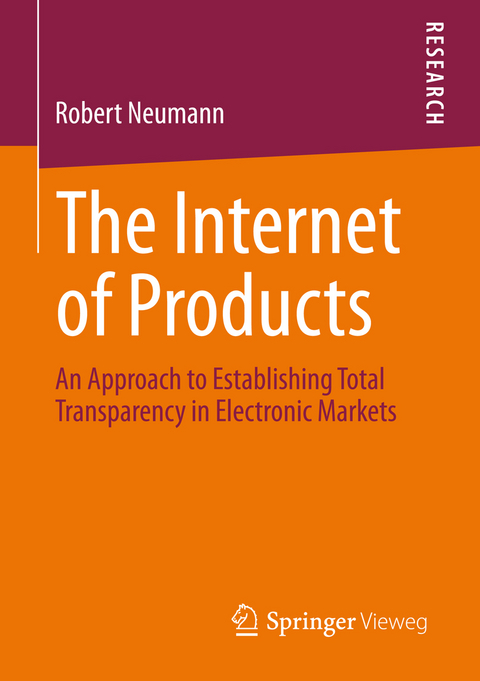
The Internet of Products (eBook)
XXI, 263 Seiten
Springer Fachmedien Wiesbaden GmbH (Verlag)
978-3-658-00905-2 (ISBN)
Robert Neumann is currently working as a researcher at the Department of Distributed Systems at the Otto-von-Guericke University in Magdeburg, Germany. His focus is upon the design and implementation of new Internet usage scenarios.
Robert Neumann is currently working as a researcher at the Department of Distributed Systems at the Otto-von-Guericke University in Magdeburg, Germany. His focus is upon the design and implementation of new Internet usage scenarios.
Abstract 5
Table of Contents 7
Acronyms 12
List of Figures 14
List of Tables 18
Listings 20
1 Introduction 21
1.1 Motivation 21
1.2 Research Objectives 22
1.3 Chapter Overview 25
1.4 A Word on Category Theory 27
Part I: Electronic Commerce and the Internet of Products 29
2 The Economics of E-Economies 30
2.1 Fundamentals 30
2.1.1 Gallery of Economics 30
2.1.2 From Economy to E-Economy 41
2.1.3 From Commerce to E-Commerce 44
2.1.4 Electronic Commerce Busines Models 46
2.1.5 Electronic Commerce Pricing Models 49
2.1.6 Markets vs. Electronic Markets 50
2.1.7 Macroeconomic Implications of Electronic Markets 53
2.1.8 Implications on Welfare 56
2.2 E-Commerce Process Modeling 58
2.2.1 BPMN-based E-Commerce Process Model 58
2.2.2 Calculus-based E-Commerce Process Model 60
2.2.3 System Theoretical Market Model 62
2.3 Chapter Summary 63
3 The Internet of Products and The Triple Bottom Line 65
3.1 Market-based Categories 65
3.1.1 Basics of Category Theory 66
3.1.2 Category of Supply 69
3.1.3 Category of Demand 71
3.1.4 Category of Markets 72
3.1.5 Functors between Demand, Supply, and Markets 74
3.1.6 Functor Category of Markets 75
3.2 The Internet of Products 77
3.2.1 Semantic Product Retrieval Benchmark 79
3.2.2 Toward Total Commerce 85
3.2.3 Reverse Commerce in the IoP 89
3.3 The Triple Bottom Line 90
3.3.1 The Category 3BL 90
3.3.2 The IoP Impact on the 3BL 92
3.3.3 3BL Impact Analysis Criticism 96
3.4 Chapter Summary 97
Part II: Technologies and Paradigms of the Internet of Products 100
4 Foundations of Semantic Product Query Systems 102
4.1 Semantic and Web 2.0 Principles 102
4.1.1 The Internet of Things 102
4.1.2 Ontologies 107
4.1.3 Taxonomies 111
4.1.4 Faceted Classification 113
4.1.5 Folksonomies 115
4.1.6 Section Summary 119
4.2 Semantic Product Models and Classification 120
4.2.1 Origins of Product Modeling 120
4.2.2 Semantic Product Models 121
4.2.3 Product Model Persistence 126
4.2.4 Product Configurators 129
4.2.5 Product Classification 130
4.2.6 Section Summary 134
4.3 Distributed SPQS Technologies and Paradigms 134
4.3.1 Component-based Software Engineering 134
4.3.2 Service-oriented Software Engineering 137
4.3.3 Agent-oriented Software Engineering 141
4.3.4 Cloud-based Software Engineering 145
4.3.5 Section Summary 152
4.4 Quality Assurance in SPQS 154
4.4.1 Software Measurement Definition 154
4.4.2 Measurement Objects in Business Software 154
4.4.3 Measurement Subjects of Business Software Evaluation 157
4.4.4 Measurement Results of Software Quality Assurance 159
4.4.5 Measurement Resources of Software Measurement 160
4.4.6 Measurement Repercussions of E-Business Software Improvement 161
4.4.7 Detailed Measurement Process BMP for Business Software QualityAssurance 162
4.4.8 Section Summary 163
4.5 Chapter Summary 163
Part III: S-PDL and SPS as Technological Backbone of the Internet of Products 165
5 Semantic Product Description Language 167
5.1 Hierarchy-based Product Descriptions 167
5.2 Semantic Product Description 169
5.2.1 Explicit vs. Implicit Semantics 172
5.2.2 Category-based Fundamentals of Semantic Product Descriptions 173
5.2.3 Product attributes 175
5.2.4 Internationalization of Product Descriptions 176
5.2.5 Matching Product Descriptions with Queries 176
5.2.6 Query Refinement through Semantic Operators 178
5.2.7 Localization of Product Descriptions 182
5.2.8 Attribute Handlers 185
5.3 BNF of the S-PDL 187
5.4 S-PDL Schema 189
5.5 Chapter Summary 191
6 Semantic Product Servers 193
6.1 SPS Implementation 193
6.2 SPS Client Interfaces 194
6.3 SPS Catalog 194
6.4 SPS Execution Environment and Reference Architecture 195
6.5 Dynamic Binding 197
6.5.1 Mapping Functors to Software 202
6.5.2 Memoized Functors 203
6.5.3 Memoization and Memory Utilization 206
6.6 Query Matching 209
6.7 SPS Deployment 211
6.8 Chapter Summary 213
7 Validation and Applications 216
7.1 SPS Prototypes and Applications 216
7.1.1 ArbiterOne 216
7.1.2 eVoces 219
7.1.3 EscapeMisery 220
7.1.4 SpotCrowd 220
7.2 System Performance and Caching 222
7.2.1 Optimal Query Caching 223
7.2.2 Hybrid Cloud Storage Framework 229
7.3 Chapter Summary 237
8 Conclusion 239
8.1 Summary 239
8.2 Future Work 240
9 Appendix 244
9.1 Appendix A: Transport Efficiency Analysis 244
9.1.1 Triangle Inequality-based Model 244
9.1.2 Ellipse-based Model 246
9.1.3 Segments-based Model 248
9.2 Appendix B: S-PDL Template Generation 251
9.3 Appendix C: The KULI Model of E-Commerce Maturity 255
10 Bibliography 258
| Erscheint lt. Verlag | 27.11.2012 |
|---|---|
| Zusatzinfo | XXI, 263 p. 78 illus. |
| Verlagsort | Wiesbaden |
| Sprache | englisch |
| Themenwelt | Mathematik / Informatik ► Informatik |
| Wirtschaft ► Allgemeines / Lexika | |
| Schlagworte | E-Commerce Process Modeling • Economics of E-Economies • Internet of Products and the Triple Bottom Line • Semantic Product Description Language • Semantic Product Query Systems • Semantic Product Servers |
| ISBN-10 | 3-658-00905-5 / 3658009055 |
| ISBN-13 | 978-3-658-00905-2 / 9783658009052 |
| Informationen gemäß Produktsicherheitsverordnung (GPSR) | |
| Haben Sie eine Frage zum Produkt? |
 PDF (Wasserzeichen)
DRM: Digitales Wasserzeichen
Dieses eBook enthält ein digitales Wasserzeichen und ist damit für Sie personalisiert. Bei einer missbräuchlichen Weitergabe des eBooks an Dritte ist eine Rückverfolgung an die Quelle möglich.
Dateiformat: PDF (Portable Document Format)
Mit einem festen Seitenlayout eignet sich die PDF besonders für Fachbücher mit Spalten, Tabellen und Abbildungen. Eine PDF kann auf fast allen Geräten angezeigt werden, ist aber für kleine Displays (Smartphone, eReader) nur eingeschränkt geeignet.
Systemvoraussetzungen:
PC/Mac: Mit einem PC oder Mac können Sie dieses eBook lesen. Sie benötigen dafür einen PDF-Viewer - z.B. den Adobe Reader oder Adobe Digital Editions.
eReader: Dieses eBook kann mit (fast) allen eBook-Readern gelesen werden. Mit dem amazon-Kindle ist es aber nicht kompatibel.
Smartphone/Tablet: Egal ob Apple oder Android, dieses eBook können Sie lesen. Sie benötigen dafür einen PDF-Viewer - z.B. die kostenlose Adobe Digital Editions-App.
Buying eBooks from abroad
For tax law reasons we can sell eBooks just within Germany and Switzerland. Regrettably we cannot fulfill eBook-orders from other countries.
aus dem Bereich