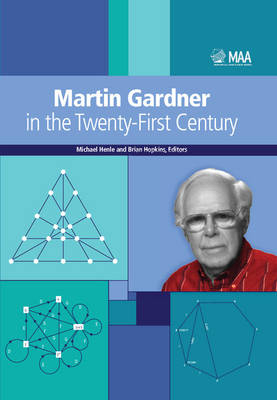
Martin Gardner in the Twenty-First Century
Mathematical Association of America (Verlag)
978-0-88385-913-1 (ISBN)
- Titel z.Zt. nicht lieferbar
- Versandkostenfrei
- Auch auf Rechnung
- Artikel merken
Mistakes in mathematical reasoning can range from outlandish blunders to deep and subtle oversights that evade even the most watchful eye. This book represents the second collection of such errors to be compiled by Edward Barbeau. Like Barbeau's previous book, Mathematical Fallacies, Flaws and Flimflam, material is drawn from a variety of sources including the work of students, textbooks, the media, and even professional mathematicians. The errors presented here serve both to entertain, and to emphasize the need to subject even the most "obvious" assertions to rigorous scrutiny, as intuition and facile reasoning can often be misleading. Each item is carefully analysed and the source of the error is exposed. All students and teachers of mathematics, from school to university level, will find this book both enlightening and entertaining.
Michael Henle is a professor of mathematics at Oberlin College. He is the author of several books including "Which Numbers are Real?" published by the MAA in 2012. Trained as a functional analysis, he also writes on combinatorial subjects and geometry. He is serving as editor of The College Mathematics Journal through to 2013. Brian Hopkins is a professor of mathematics at Saint Peter's University in Jersey City, New Jersey. He won, with Robin Wilson, the 2005 George Polya Award, edited the 2008 MAA Notes volume Resources for Teaching Discrete Mathematics, and was given the 2011 MAA New Jersey Section Award for Distinguished College or University Teaching of Mathematics. Much of his research stems from Bulgarian Solitaire, a topic popularized by Martin Gardner. Hopkins will be the editor of the College Mathematics Journal from 2014 to 2018.
Preface; Part I. Geometry: 1. The asymmetric propeller Martin Gardner; 2. The asymmetric propeller revisited Gillian Saenz, Christopher Jackson, and Ryan Crumley; 3. Bracing regular polygons as we race into the future Greg W. Frederickson; 4. A Platonic Sextet for Strings Karl Schaffer; 5. Prince Rupert's rectangles Richard P. Jerrard and John E. Wetzel; Part II. Number Theory and Graph Theory: 6. Transcendentals and early birds Martin Gardner; 7. Squaring, cubing, and cube rooting Arthur T. Benjamin; 8. Carryless arithmetic mod 10 David Applegate, Marc LeBrun and N. J. A. Sloane; 9. Mad tea party cyclic partitions Robert Bekes, Jean Pedersen and Bin Sha; 10. The continuing saga of snarks Sarah-Marie Belcastro; 11. The map-coloring game Tomasz Bartnicki, Jaroslaw Grytczuk, H. A. Kierstead and Xuding Zhu; Part III. Flexagons and Catalan Numbers: 12. It's okay to be square If you're a flexagon Ethan J. Berkove and Jeffrey P. Dumont; 13. The V-flex, triangle orientation, and Catalan numbers in hexaflexagons Ionut E. Iacob, T. Bruce McLean and Hua Wang; 14. From hexaflexagons to edge flexagons to point flexagons Les Pook; 15. Flexagons lead to a Catalan number identity David Callan; 16. Convergence of a Catalan series Thomas Koshy and Z. Gao; Part IV. Making Things Fit: 17. L-tromino tiling of mutilated chessboards Martin Gardner; 18. Polyomino dissections Tiina Hohn and Andy Liu; 19. Squaring the plane Frederick V. Henle and James M. Henle; 20. Magic knight's tours John Beasley; 21. Some new results on magic hexagrams Martin Gardner; 22. Finding all solutions to the magic hexagram Alexander Karabegov and Jason Holland; 23. Triangular numbers, Gaussian integers, and KenKen John J. Watkins; Part V. Further Puzzles and Games; 24. Cups and downs Ian Stewart; 25. 30 years of Bulgarian solitaire Brian Hopkins; 26. Congo bongo Hsin-Po Wang; 27. Sam Loyd's courier problem with Diophantus, Pythagoras, and Martin Gardner Owen O'Shea; 28. Retrolife and the pawns neighbors Yossi Elran; 29. RATWYT Aviezri Fraenkel; Part VI. Cards and Probability; 30. Modeling mathematics with playing cards Martin Gardner; 31. The probability an amazing card trick is dull Christopher N. Swanson; 32. The Monty Hall problem, reconsidered Stephen Lucas, Jason Rosenhouse and Andrew Schepler; 33. The secretary problem from the applicant's point of view Darren Glass; 34. Lake Wobegon dice Jorge Moraleda and David G. Stork; 35. Martin Gardner's mistake Tanya Khovanova; Part VII. Other Aspects of Martin Gardner: 36. Against the odds Martin Gardner; 37. A modular miracle John Stillwell; 38. The golden ratio—a contrary viewpoint Clement Falbo; 39. Review of The Mysterious Mr. Ammann by Marjorie Senechal Philip Straffin; 40. Review of PopCo by Scarlett Thomas Martin Gardner; 41. Superstrings and Thelma Martin Gardner; Index; About the editors.
| Erscheint lt. Verlag | 30.12.2012 |
|---|---|
| Reihe/Serie | Spectrum |
| Sprache | englisch |
| Maße | 178 x 253 mm |
| Gewicht | 585 g |
| Themenwelt | Mathematik / Informatik ► Mathematik ► Arithmetik / Zahlentheorie |
| Mathematik / Informatik ► Mathematik ► Geometrie / Topologie | |
| Mathematik / Informatik ► Mathematik ► Geschichte der Mathematik | |
| ISBN-10 | 0-88385-913-0 / 0883859130 |
| ISBN-13 | 978-0-88385-913-1 / 9780883859131 |
| Zustand | Neuware |
| Informationen gemäß Produktsicherheitsverordnung (GPSR) | |
| Haben Sie eine Frage zum Produkt? |
aus dem Bereich