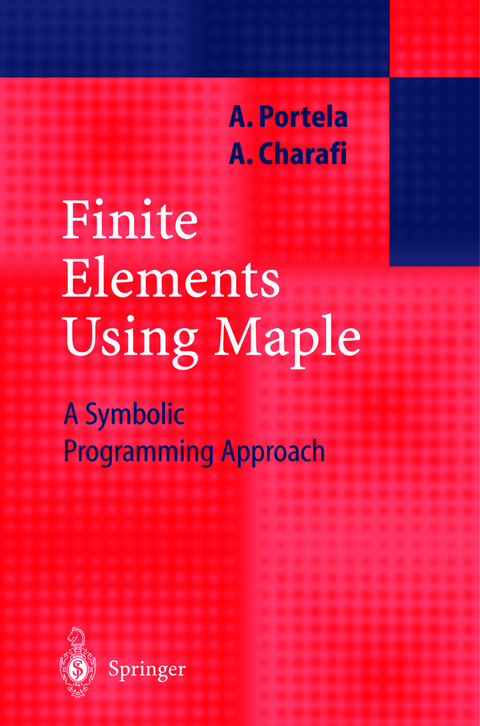
Finite Elements Using Maple
Springer Berlin (Verlag)
9783642627552 (ISBN)
1. Introduction to Maple.- 1.1 Basics.- 1.2 Entering Commands.- 1.3 Fundamental Data Types.- 1.4 Mathematical Functions.- 1.5 Names.- 1.6 Basic Types of Maple Objects.- 1.7 Evaluation Rules.- 1.8 Algebraic Equations.- 1.9 Differentiation and Integration.- 1.10 Solving Differential Equations.- 1.11 Expression Manipulation.- 1.12 Basic Programming Constructs.- 1.13 Functions, Procedures and Modules.- 1.14 Maple's Organization.- 1.15 Linear Algebra Computations.- 1.16 Graphics.- 1.17 Plotter: Package for Finite Element Graphics.- 2. Computational Mechanics.- 2.1 Introduction.- 2.2 Mathematical Modelling of Physical Systems.- 2.3 Continuous Models.- 2.4 Mathematical Analysis.- 2.5 Approximation Methods.- 2.6 Discrete Models.- 2.7 Structural Models.- 3. Approximation Methods.- 3.1 Introduction.- 3.2 Residuals.- 3.3 Weighted-Residual Equation.- 3.4 Approximation Functions.- 3.5 Admissibility Conditions.- 3.6 Global Indirect Discretization.- 3.7 Integration by Parts.- 3.8 Local Direct Discretization.- 4. Interpolation.- 4.1 Introduction.- 4.2 Globally Defined Functions.- 4.3 Piecewisely Defined Functions.- 4.4 Finite Element Generalized Coordinates.- 4.5 Finite Element Shape Functions.- 4.6 Parametric Finite Elements.- 4.7 Isoparametric Finite Elements.- 4.8 Linear Triangular Isoparametric Element.- 5. The Finite Element Method.- 5.1 Introduction.- 5.2 Steady-State Models with Scalar Variable.- 5.3 Finite Element Mesh.- 5.4 Local Finite Element Equations.- 5.5 Global Finite Element Equations.- 5.6 Exact Boundary Conditions.- 5.7 Solution of the System of Equations.- 5.8 Computation of Derivatives.- 5.9 Finite Element Pre- and Post- Processing.- 5.10 Cgt-fem: Package for Finite Element Analysis.- 5.11 Example.- 5.12 Example.- 5.13 Example.- 5.14 Example.- 6. Fluid MechanicsApplications.- 6.1 Introduction.- 6.2 Continuous Models of Fluid Flow.- 6.3 Confined Flows.- 6.4 Unconfined Flows.- 6.5 Groundwater Flows.- 6.6 Example.- 6.7 Example.- 7. Solid Mechanics Applications.- 7.1 Introduction.- 7.2 Continuous Models.- 7.3 Fundamental Continuous Model: Elasticity Theory.- 7.4 Finite Element Model.- 7.5 Mesh Topology.- 7.6 Constrained Displacements.- 7.7 Application of the Finite Element Model.- 7.8 Three-Dimensional Equilibrium States.- 7.9 Two-Dimensional Equilibrium States.- 7.10 One-Dimensional Equilibrium States.- 7.11 Further Study.
From the reviews:
"The purpose of this book is to illustrate how the computational environment of Maple can be used in a finite element ... . It gives to the reader a very unique insight into the finite element method together with symbolic programming approach ... . In summary, this book is an excellent introductory book for finite element method and I strongly recommend to all undergraduate and postgraduate students and also to engineers and scientists who wish to program easily the finite element method." (T.E. Simos, Journal of Computational Methods in Sciences and Engineering, Vol. 3 (2), 2003)
"This book is an essential tool written to be used as the primary text for an undergraduate or early postgraduate course as well as a reference book for engineers and scientists who want to develop quickly finite-element programs." (European Journal of Mechanical and Environmental Engineering, Vol. 47 (2), 2002)
From the reviews:"The purpose of this book is to illustrate how the computational environment of Maple can be used in a finite element … . It gives to the reader a very unique insight into the finite element method together with symbolic programming approach … . In summary, this book is an excellent introductory book for finite element method and I strongly recommend to all undergraduate and postgraduate students and also to engineers and scientists who wish to program easily the finite element method." (T.E. Simos, Journal of Computational Methods in Sciences and Engineering, Vol. 3 (2), 2003)"This book is an essential tool written to be used as the primary text for an undergraduate or early postgraduate course as well as a reference book for engineers and scientists who want to develop quickly finite-element programs." (European Journal of Mechanical and Environmental Engineering, Vol. 47 (2), 2002)
| Erscheint lt. Verlag | 27.10.2012 |
|---|---|
| Zusatzinfo | XV, 326 p. |
| Verlagsort | Berlin |
| Sprache | englisch |
| Maße | 155 x 235 mm |
| Gewicht | 521 g |
| Themenwelt | Mathematik / Informatik ► Informatik |
| Mathematik / Informatik ► Mathematik ► Wahrscheinlichkeit / Kombinatorik | |
| Schlagworte | Analysis • Computer Algebra • Computer Methods • Continuum • Finite Element • Finite Element Method • fluid mechanics • linear algebra • Maple • Mechanics • Model • Modeling • Modelling • Numerical analysis • programming • Simulation • Structures • Symbolic Programming |
| ISBN-13 | 9783642627552 / 9783642627552 |
| Zustand | Neuware |
| Informationen gemäß Produktsicherheitsverordnung (GPSR) | |
| Haben Sie eine Frage zum Produkt? |
aus dem Bereich