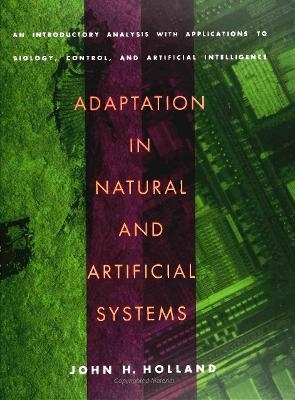
Adaptation in Natural and Artificial Systems
MIT Press (Verlag)
978-0-262-58111-0 (ISBN)
- Titel ist leider vergriffen;
keine Neuauflage - Artikel merken
In its most familiar form, adaptation is a biological process, whereby organisms evolve by rearranging genetic material to survive in environments confronting them. In this now classic work, Holland presents a mathematical model that allows for the nonlinearity of such complex interactions. He demonstrates the model's universality by applying it to economics, physiological psychology, game theory, and artificial intelligence and then outlines the way in which this approach modifies the traditional views of mathematical genetics.
Initially applying his concepts to simply defined artificial systems with limited numbers of parameters, Holland goes on to explore their use in the study of a wide range of complex, naturally occuring processes, concentrating on systems having multiple factors that interact in nonlinear ways. Along the way he accounts for major effects of coadaptation and coevolution: the emergence of building blocks, or schemata, that are recombined and passed on to succeeding generations to provide, innovations and improvements.
John H. Holland is Professor of Psychology and Professor of Computer Science and Engineering at the University of Michigan; he is also Trustee and External Professor at the Santa Fe Institute. He is the author of Hidden Order: How Adaptation Builds Complexity and other books.
Part 1 The general setting: preliminary survey; a simple artificial adaptive system; a complex natural adaptive system; some general observations. Part 2 A formal framework: discussion; presentation; comparison with the Dubins-Savage formalization of the gambler's problem. Part 3 Illustrations: genetics; economics; game-playing; searches, pattern recognition, and statistical inference; control and function optimization; central nervous systems. Part 4 Schemata. Part 5 The optimal allocation of trials: the 2-armed bandit; realization of minimal looses; many options; application to schemata. Part 6 Reproductive plans and genetic operators: generalized reproductive plans; generalized genetic operators - crossing-over; generalized genetic operators - inversion; generalized genetic operators - mutation; further increases in power; interpretations. Part 7 The robustness of genetic plans: adaptive plans; the robustness of plans; robustness vis-a-vis a simple artificial adaptive system; robustness vis-a-vis a complex and natural adaptive system; general consequence. Part 8 Adaptation of codings and representations: fixed representation; the "Broadcast Language"; usage; concerning applications and the use of genetic plans to modify representations. Part 9 An overview: insights; computer studies; advanced questions. Part 10 Interim and prospectus: in the interim; the optimal allocation of trials revisited; recent work; possibilities.
| Reihe/Serie | Complex Adaptive Systems |
|---|---|
| Verlagsort | Cambridge, Mass. |
| Sprache | englisch |
| Maße | 178 x 229 mm |
| Gewicht | 386 g |
| Themenwelt | Geisteswissenschaften ► Psychologie ► Allgemeine Psychologie |
| Geisteswissenschaften ► Psychologie ► Verhaltenstherapie | |
| Informatik ► Theorie / Studium ► Künstliche Intelligenz / Robotik | |
| Naturwissenschaften ► Biologie ► Evolution | |
| Naturwissenschaften ► Biologie ► Genetik / Molekularbiologie | |
| Technik ► Umwelttechnik / Biotechnologie | |
| ISBN-10 | 0-262-58111-6 / 0262581116 |
| ISBN-13 | 978-0-262-58111-0 / 9780262581110 |
| Zustand | Neuware |
| Informationen gemäß Produktsicherheitsverordnung (GPSR) | |
| Haben Sie eine Frage zum Produkt? |
aus dem Bereich