Steven C. Amstrup researches bears and their ecosystems. His interests include distribution and movement patterns as well as wildlife population dynamics. Trent L. McDonald is a statistician and project manager with Western EcoSystems Technology, Inc. and Adjunct Professor of Statistics at the University of Wyoming. Bryan F. J. Manly is the author of several books on the statistics of natural selection, multivariate analysis, resource selection by animals, research study designs, computer-intensive statistics, and environmental statistics.
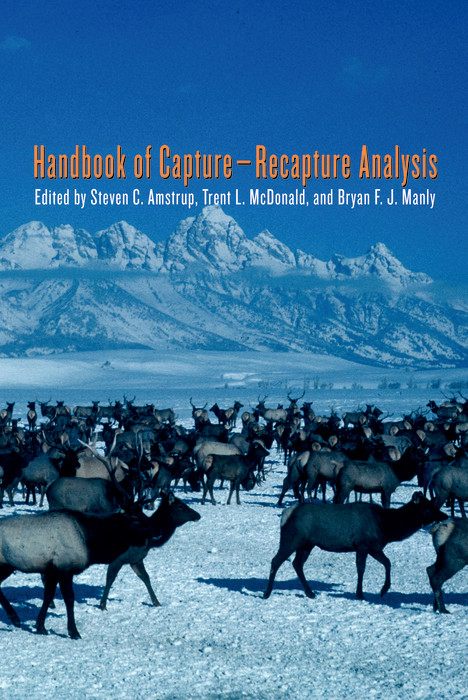
Every day, biologists in parkas, raincoats, and rubber boots go into the field to capture and mark a variety of animal species. Back in the office, statisticians create analytical models for the field biologists' data. But many times, representatives of the two professions do not fully understand one another's roles. This book bridges this gap by helping biologists understand state-of-the-art statistical methods for analyzing capture-recapture data. In so doing, statisticians will also become more familiar with the design of field studies and with the real-life issues facing biologists. Reliable outcomes of capture-recapture studies are vital to answering key ecological questions. Is the population increasing or decreasing? Do more or fewer animals have a particular characteristic? In answering these questions, biologists cannot hope to capture and mark entire populations. And frequently, the populations change unpredictably during a study. Thus, increasingly sophisticated models have been employed to convert data into answers to ecological questions. This book, by experts in capture-recapture analysis, introduces the most up-to-date methods for data analysis while explaining the theory behind those methods. Thorough, concise, and portable, it will be immensely useful to biologists, biometricians, and statisticians, students in both fields, and anyone else engaged in the capture-recapture process.
Steven C. Amstrup researches bears and their ecosystems. His interests include distribution and movement patterns as well as wildlife population dynamics. Trent L. McDonald is a statistician and project manager with Western EcoSystems Technology, Inc. and Adjunct Professor of Statistics at the University of Wyoming. Bryan F. J. Manly is the author of several books on the statistics of natural selection, multivariate analysis, resource selection by animals, research study designs, computer-intensive statistics, and environmental statistics.
| Erscheint lt. Verlag | 16.12.2010 |
|---|---|
| Zusatzinfo | 20 halftones. 6 line illus. 74 tables. |
| Verlagsort | Princeton |
| Sprache | englisch |
| Themenwelt | Mathematik / Informatik ► Mathematik ► Statistik |
| Naturwissenschaften ► Biologie ► Ökologie / Naturschutz | |
| Naturwissenschaften ► Biologie ► Zoologie | |
| Technik | |
| Schlagworte | Addition • Adviser • Akaike information criterion • Approximation • Asterisk (PBX) • Asymptotic Theory • Bayes Estimator • Bayesian inference • Bayesian Statistics • Beaufort Sea • Behavior • Behavior Modification • Bias of an estimator • Big O notation • Binomial Distribution • biologist • Bootstrapping (statistics) • Boundary value problem • B-Spline • Calculation • canada goose • Categorical variable • Causality • chemical reaction • chi-squared distribution • Chi-squared test • Clothing • Coded wire tag • coefficient of variation • cohort model • combination • Computation • Confidence interval • Contingency table • Correlation and dependence • Covariate • coverage probability • curve fitting • Data Analysis • Database • data collection • data set • data structure • Degrees of freedom (statistics) • Design Matrix • Discrete time and continuous time • Doctor of Philosophy • Dummy variable (statistics) • Equation • escapement • Estimates • estimation • Estimation theory • Estimator • Exchange Rate • expected value • Extrapolation • Fisher Information • fishery • foreign policy • FORTRAN • Geographic coordinate system • Gibbs Sampling • goodness of fit • grouped data • Handbook • Horvitz–Thompson estimator • hypothesis • identifiability • Illustration • Inequality (mathematics) • inference • Information Theory • In Sight • Interaction (statistics) • Interval estimation • Iteration • Iterative Method • Jackknife resampling • John Graunt • Joint probability distribution • legitimation crisis • Likelihood Function • Likelihood-ratio test • Linear Function • logarithm • logistic function • Logistic Regression • Logit • mallard • Mark and recapture • Maxima and minima • maximum likelihood estimation • Mixture • Mixture model • Model Selection • Moisture • Monograph • mortality rate • Multinomial distribution • natural logarithm • Notation • Nuisance parameter • Numerical analysis • operational definition • Overdispersion • Parameter • Parameter (computer programming) • parametrization • Pearson's chi-squared test • Poisson distribution • Polar bear • Policy • Population Size • Prediction • Privatization • Probability • Probability Distribution • Probability Theory • Projectile • Projection matrix • Proportionality (mathematics) • p-value • Quantity • Quasi-Likelihood • Random Variable • raw data • Real analysis • Recipe • remainder • result • Ronald Fisher • Rule Of Thumb • Sample Size • Sample (statistics) • sampling design • Sampling (signal processing) • Sampling (Statistics) • scientific notation • sea ice • Siege engine • Simulation • Spawn (biology) • Special case • standard error • Statistic • Statistical hypothesis testing • statistician • Stratified sampling • SUBGROUP • Subset • subtraction • Suggestion • summary statistics • Summation • Survival Analysis • Survival rate • Table (database) • Tagging (stamp) • Technology • test statistic • The Heritage Foundation • Trade-off • V. • Variance • welfare • year |
| ISBN-10 | 1-4008-3771-5 / 1400837715 |
| ISBN-13 | 978-1-4008-3771-7 / 9781400837717 |
| Informationen gemäß Produktsicherheitsverordnung (GPSR) | |
| Haben Sie eine Frage zum Produkt? |
 PDF (Wasserzeichen)
Größe: 1,9 MB
DRM: Digitales Wasserzeichen
Dieses eBook enthält ein digitales Wasserzeichen und ist damit für Sie personalisiert. Bei einer missbräuchlichen Weitergabe des eBooks an Dritte ist eine Rückverfolgung an die Quelle möglich.
Dateiformat: PDF (Portable Document Format)
Mit einem festen Seitenlayout eignet sich die PDF besonders für Fachbücher mit Spalten, Tabellen und Abbildungen. Eine PDF kann auf fast allen Geräten angezeigt werden, ist aber für kleine Displays (Smartphone, eReader) nur eingeschränkt geeignet.
Systemvoraussetzungen:
PC/Mac: Mit einem PC oder Mac können Sie dieses eBook lesen. Sie benötigen dafür einen PDF-Viewer - z.B. den Adobe Reader oder Adobe Digital Editions.
eReader: Dieses eBook kann mit (fast) allen eBook-Readern gelesen werden. Mit dem amazon-Kindle ist es aber nicht kompatibel.
Smartphone/Tablet: Egal ob Apple oder Android, dieses eBook können Sie lesen. Sie benötigen dafür einen PDF-Viewer - z.B. die kostenlose Adobe Digital Editions-App.
Buying eBooks from abroad
For tax law reasons we can sell eBooks just within Germany and Switzerland. Regrettably we cannot fulfill eBook-orders from other countries.
 EPUB (Adobe DRM)
Kopierschutz: Adobe-DRM
Adobe-DRM ist ein Kopierschutz, der das eBook vor Mißbrauch schützen soll. Dabei wird das eBook bereits beim Download auf Ihre persönliche Adobe-ID autorisiert. Lesen können Sie das eBook dann nur auf den Geräten, welche ebenfalls auf Ihre Adobe-ID registriert sind.
Details zum Adobe-DRM
Dateiformat: EPUB (Electronic Publication)
EPUB ist ein offener Standard für eBooks und eignet sich besonders zur Darstellung von Belletristik und Sachbüchern. Der Fließtext wird dynamisch an die Display- und Schriftgröße angepasst. Auch für mobile Lesegeräte ist EPUB daher gut geeignet.
Systemvoraussetzungen:
PC/Mac: Mit einem PC oder Mac können Sie dieses eBook lesen. Sie benötigen eine
eReader: Dieses eBook kann mit (fast) allen eBook-Readern gelesen werden. Mit dem amazon-Kindle ist es aber nicht kompatibel.
Smartphone/Tablet: Egal ob Apple oder Android, dieses eBook können Sie lesen. Sie benötigen eine
Geräteliste und zusätzliche Hinweise
Buying eBooks from abroad
For tax law reasons we can sell eBooks just within Germany and Switzerland. Regrettably we cannot fulfill eBook-orders from other countries.
aus dem Bereich