Introduction to Coding Theory (eBook)
Cambridge University Press (Verlag)
978-1-139-41532-3 (ISBN)
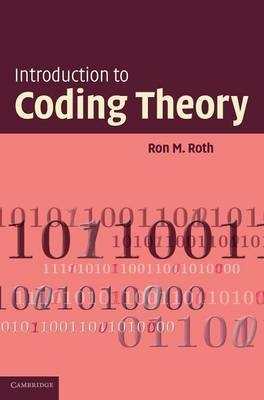
Error-correcting codes constitute one of the key ingredients in achieving the high degree of reliability required in modern data transmission and storage systems. This 2006 book introduces the reader to the theoretical foundations of error-correcting codes, with an emphasis on Reed-Solomon codes and their derivative codes. After reviewing linear codes and finite fields, the author describes Reed-Solomon codes and various decoding algorithms. Cyclic codes are presented, as are MDS codes, graph codes, and codes in the Lee metric. Concatenated, trellis, and convolutional codes are also discussed in detail. Homework exercises introduce additional concepts such as Reed-Muller codes, and burst error correction. The end-of-chapter notes often deal with algorithmic issues, such as the time complexity of computational problems. While mathematical rigor is maintained, the text is designed to be accessible to a broad readership, including students of computer science, electrical engineering, and mathematics, from senior-undergraduate to graduate level.
Error-correcting codes constitute one of the key ingredients in achieving the high degree of reliability required in modern data transmission and storage systems. This 2006 book introduces the reader to the theoretical foundations of error-correcting codes, with an emphasis on Reed-Solomon codes and their derivative codes. After reviewing linear codes and finite fields, the author describes Reed-Solomon codes and various decoding algorithms. Cyclic codes are presented, as are MDS codes, graph codes, and codes in the Lee metric. Concatenated, trellis, and convolutional codes are also discussed in detail. Homework exercises introduce additional concepts such as Reed-Muller codes, and burst error correction. The end-of-chapter notes often deal with algorithmic issues, such as the time complexity of computational problems. While mathematical rigor is maintained, the text is designed to be accessible to a broad readership, including students of computer science, electrical engineering, and mathematics, from senior-undergraduate to graduate level.
| Erscheint lt. Verlag | 31.5.2012 |
|---|---|
| Sprache | englisch |
| Themenwelt | Mathematik / Informatik ► Informatik ► Netzwerke |
| Mathematik / Informatik ► Mathematik ► Angewandte Mathematik | |
| Technik ► Bauwesen | |
| Technik ► Elektrotechnik / Energietechnik | |
| ISBN-10 | 1-139-41532-8 / 1139415328 |
| ISBN-13 | 978-1-139-41532-3 / 9781139415323 |
| Informationen gemäß Produktsicherheitsverordnung (GPSR) | |
| Haben Sie eine Frage zum Produkt? |
 PDF (Adobe DRM)
Kopierschutz: Adobe-DRM
Adobe-DRM ist ein Kopierschutz, der das eBook vor Mißbrauch schützen soll. Dabei wird das eBook bereits beim Download auf Ihre persönliche Adobe-ID autorisiert. Lesen können Sie das eBook dann nur auf den Geräten, welche ebenfalls auf Ihre Adobe-ID registriert sind.
Details zum Adobe-DRM
Dateiformat: PDF (Portable Document Format)
Mit einem festen Seitenlayout eignet sich die PDF besonders für Fachbücher mit Spalten, Tabellen und Abbildungen. Eine PDF kann auf fast allen Geräten angezeigt werden, ist aber für kleine Displays (Smartphone, eReader) nur eingeschränkt geeignet.
Systemvoraussetzungen:
PC/Mac: Mit einem PC oder Mac können Sie dieses eBook lesen. Sie benötigen eine
eReader: Dieses eBook kann mit (fast) allen eBook-Readern gelesen werden. Mit dem amazon-Kindle ist es aber nicht kompatibel.
Smartphone/Tablet: Egal ob Apple oder Android, dieses eBook können Sie lesen. Sie benötigen eine
Geräteliste und zusätzliche Hinweise
Buying eBooks from abroad
For tax law reasons we can sell eBooks just within Germany and Switzerland. Regrettably we cannot fulfill eBook-orders from other countries.
aus dem Bereich