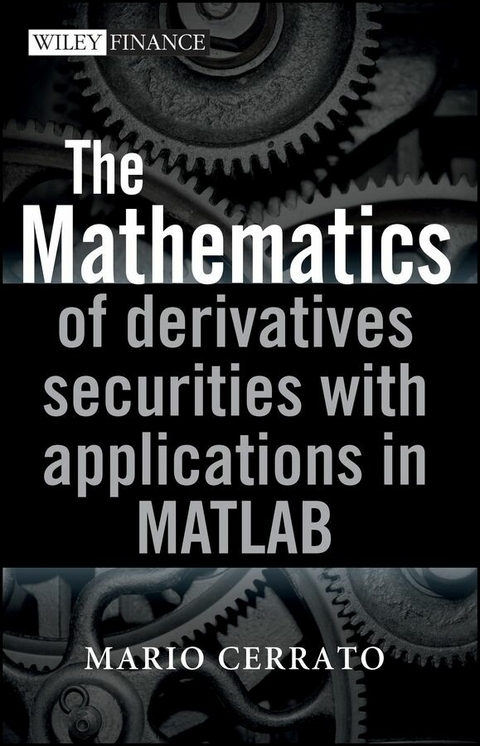
Quantitative Finance is expanding rapidly. One of the aspects of the recent financial crisis is that, given the complexity of financial products, the demand for people with high numeracy skills is likely to grow and this means more recognition will be given to Quantitative Finance in existing and new course structures worldwide. Evidence has suggested that many holders of complex financial securities before the financial crisis did not have in-house experts or rely on a third-party in order to assess the risk exposure of their investments. Therefore, this experience shows the need for better understanding of risk associate with complex financial securities in the future.
The Mathematics of Derivative Securities with Applications in MATLAB provides readers with an introduction to probability theory, stochastic calculus and stochastic processes, followed by discussion on the application of that knowledge to solve complex financial problems such as pricing and hedging exotic options, pricing American derivatives, pricing and hedging under stochastic volatility and an introduction to interest rates modelling.
The book begins with an overview of MATLAB and the various components that will be used alongside it throughout the textbook. Following this, the first part of the book is an in depth introduction to Probability theory, Stochastic Processes and Ito Calculus and Ito Integral. This is essential to fully understand some of the mathematical concepts used in the following part of the book. The second part focuses on financial engineering and guides the reader through the fundamental theorem of asset pricing using the Black and Scholes Economy and Formula, Options Pricing through European and American style options, summaries of Exotic Options, Stochastic Volatility Models and Interest rate Modelling. Topics covered in this part are explained using MATLAB codes showing how the theoretical models are used practically.
Authored from an academic’s perspective, the book discusses complex analytical issues and intricate financial instruments in a way that it is accessible to postgraduate students with or without a previous background in probability theory and finance. It is written to be the ideal primary reference book or a perfect companion to other related works. The book uses clear and detailed mathematical explanation accompanied by examples involving real case scenarios throughout and provides MATLAB codes for a variety of topics.
Quantitative Finance is expanding rapidly. One of the aspects of the recent financial crisis is that, given the complexity of financial products, the demand for people with high numeracy skills is likely to grow and this means more recognition will be given to Quantitative Finance in existing and new course structures worldwide. Evidence has suggested that many holders of complex financial securities before the financial crisis did not have in-house experts or rely on a third-party in order to assess the risk exposure of their investments. Therefore, this experience shows the need for better understanding of risk associate with complex financial securities in the future. The Mathematics of Derivative Securities with Applications in MATLAB provides readers with an introduction to probability theory, stochastic calculus and stochastic processes, followed by discussion on the application of that knowledge to solve complex financial problems such as pricing and hedging exotic options, pricing American derivatives, pricing and hedging under stochastic volatility and an introduction to interest rates modelling. The book begins with an overview of MATLAB and the various components that will be used alongside it throughout the textbook. Following this, the first part of the book is an in depth introduction to Probability theory, Stochastic Processes and Ito Calculus and Ito Integral. This is essential to fully understand some of the mathematical concepts used in the following part of the book. The second part focuses on financial engineering and guides the reader through the fundamental theorem of asset pricing using the Black and Scholes Economy and Formula, Options Pricing through European and American style options, summaries of Exotic Options, Stochastic Volatility Models and Interest rate Modelling. Topics covered in this part are explained using MATLAB codes showing how the theoretical models are used practically. Authored from an academic s perspective, the book discusses complex analytical issues and intricate financial instruments in a way that it is accessible to postgraduate students with or without a previous background in probability theory and finance. It is written to be the ideal primary reference book or a perfect companion to other related works. The book uses clear and detailed mathematical explanation accompanied by examples involving real case scenarios throughout and provides MATLAB codes for a variety of topics.
Mario Cerrato is a Senior Lecturer (Associate Professor) in Financial Economics at the University of Glasgow Business School. He holds a PhD in Financial Econometrics and an MSc in Economics from London Metropolitan University, and a first degree in Economics from the University of Salerno. Mario's research interests are in the area of financial derivatives, security design and financial market microstructures. He has published in leading finance journals such as Journey of Money Credit and Banking, Journal of Banking and Finance, International Journal of Theoretical and Applied Finance, and many others. He is generally involved in research collaboration with leading financial firms in the City of London and Wall Street.
Chapter 1 Introduction.
Overview of MatLab.
Using various MatLab's toolboxes.
Mathematics with MatLab.
Statistics with MatLab.
Programming in MatLab.
Part 1.
Chapter 2 Probability Theory.
Set and sample space.
Sigma algebra, probability measure and probability space.
Discrete and continuous random variables.
Measurable mapping.
Joint, conditional and marginal distributions.
Expected values and moment of a distribution.
Appendix 1: Bernoulli law of large numbers.
Appendix 2: Conditional expectations.
Appendix 3: Hilbert spaces.
Chapter 3 Stochastic Processes.
Martingales processes.
Stopping times.
The optional stopping theorem.
Local martingales and semi-martingales.
Brownian motions.
Brownian motions and reflection principle.
Martingales separation theorem of Brownian motions.
Appendix 1: Working with Brownian motions.
Chapter 4 Ito Calculus and Ito Integral.
Quadratic variation of Brownian motions.
The construction of Ito integral with elementary process.
The general Ito integral.
Construction of the Ito integral with respect to semi-martingales integrators.
Quadratic variation and general bounded martingales.
Ito lemma and Ito formula.
Appendix 1: Ito Integral and Riemann-Stieljes integral.
Part 2.
Chapter 5 The Black and Scholes Economy and Black and Scholes Formula.
The fundamental theorem of asset pricing.
Martingales measures.
The Girsanov Theorem.
The Randon-Nikodym.
The Black and Scholes Model.
The Black and Scholes formula.
The Black and Scholes in practice.
The Feyman-Kac formula.
Appendix 1: The Kolmogorov Backword equation.
Appendix 2: Change of numeraire.
Chapter 6 Monte Carlo Methods for Options Pricing.
Basic concepts and pricing European style options.
Variance reduction techniques.
Pricing path dependent options.
Projections methods in finance.
Estimations of Greeks by Monte Carlo methods.
Chapter 7 American Option Pricing.
A review of the literature on pricing American put options.
Optimal stopping times and American put options.
A dynamic programming approach to price American options.
The Losgstaff and Schwartz (2001) approach.
The Glasserman and Yu (2004) approach.
Estimation of the upper bound.
Cerrato (2008) approach to compute upper bounds.
Chapter 8 Exotic Options.
Digital and binary.
Asian options.
Forward start options.
Barrier options.
Hedging barrier options.
Chapter 9 Stochastic Volatility Models.
Square root diffusion models.
The Heston Model.
Processes with jumps.
Monte Carlo methods to price derivatives under stochastic volatility.
Euler methods and stochastic differential equations.
Exact simulation of Greeks under stochastic volatility.
Computing Greeks for exotics using simulations.
Chapter 10 Interest Rate Modeling.
A general framework.
Affine models.
The Vasicek model.
The Cox, Ingersoll & Ross Model.
The Hull and White (HW) Model.
Bond options.
"The book can be warmly recommended to readers who wish to
learn the main methods of quantitative finance without delving into
its mathematical foundations." (Zentralblatt
MATH, 1 December 2012)
| Erscheint lt. Verlag | 2.2.2012 |
|---|---|
| Reihe/Serie | The Wiley Finance Series | Wiley Finance Series |
| Sprache | englisch |
| Themenwelt | Mathematik / Informatik ► Mathematik ► Angewandte Mathematik |
| Recht / Steuern ► Wirtschaftsrecht | |
| Wirtschaft ► Betriebswirtschaft / Management ► Finanzierung | |
| Schlagworte | Aspects • Associate • Better • Complex • Complexity • Crisis • demand • Evidence • Expanding • Experience • Experts • Finance • Finance & Investments • Financial • Financial Engineering • Financial products • Finanztechnik • Finanz- u. Anlagewesen • Given • High • holders • Inhouse • many • numeracy • People • rapidly • Recognition • Skills |
| ISBN-13 | 9781119973409 / 9781119973409 |
| Informationen gemäß Produktsicherheitsverordnung (GPSR) | |
| Haben Sie eine Frage zum Produkt? |
 PDF (Adobe DRM)
Kopierschutz: Adobe-DRM
Adobe-DRM ist ein Kopierschutz, der das eBook vor Mißbrauch schützen soll. Dabei wird das eBook bereits beim Download auf Ihre persönliche Adobe-ID autorisiert. Lesen können Sie das eBook dann nur auf den Geräten, welche ebenfalls auf Ihre Adobe-ID registriert sind.
Details zum Adobe-DRM
Dateiformat: PDF (Portable Document Format)
Mit einem festen Seitenlayout eignet sich die PDF besonders für Fachbücher mit Spalten, Tabellen und Abbildungen. Eine PDF kann auf fast allen Geräten angezeigt werden, ist aber für kleine Displays (Smartphone, eReader) nur eingeschränkt geeignet.
Systemvoraussetzungen:
PC/Mac: Mit einem PC oder Mac können Sie dieses eBook lesen. Sie benötigen eine
eReader: Dieses eBook kann mit (fast) allen eBook-Readern gelesen werden. Mit dem amazon-Kindle ist es aber nicht kompatibel.
Smartphone/Tablet: Egal ob Apple oder Android, dieses eBook können Sie lesen. Sie benötigen eine
Geräteliste und zusätzliche Hinweise
Buying eBooks from abroad
For tax law reasons we can sell eBooks just within Germany and Switzerland. Regrettably we cannot fulfill eBook-orders from other countries.
aus dem Bereich